The Eurovision Song Contest has run 70 contests across 69 years (1956–2026, with 2020 cancelled due to COVID-19). The summary table above captures every all-time record set across that span — first-of, biggest-of, longest-of, youngest-of and most-of. Each line links to its dedicated page for the full context, table data and historical breakdown.
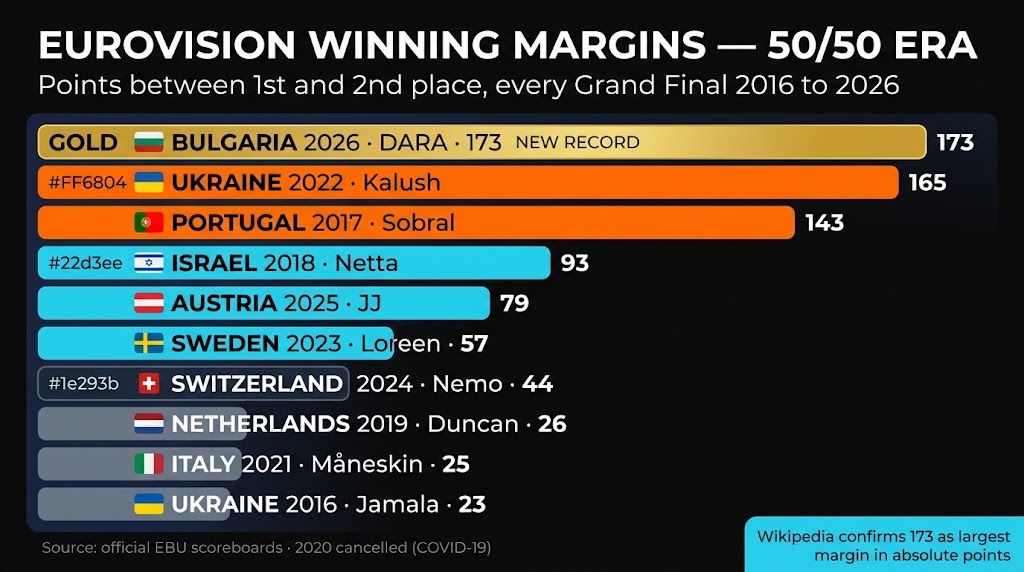
What broke in 2026. Vienna 2026 produced three new all-time records on a single night: Bulgaria's 173-point winning margin (broken from Ukraine 2022's 165), the largest absolute first-to-second gap in any scoring system in contest history (per Wikipedia editorial layer); the most sets of 12 received in a single televote pool in a semi-final (Bulgaria's 8+RoW in SF2, broken from various 5+RoW holders); and the first dual jury+televote winner since Loreen 2023.
What stood firm. Sobral's 758-point winner total (Kyiv 2017) was not threatened — Bulgaria's 516 came on a 35-bloc field after the 5-broadcaster boycott shrank the voting pool. Kalush's 439 televote total (Turin 2022) likewise unbroken. The 3-minute song length cap, introduced in 1958 after Italy's 5:09 epic the year prior, remains in effect for the 68th consecutive year. The 16-year minimum-age rule, introduced after the 1986–89 child-performer cluster, is in its 36th year unchanged.
What's likely to fall next. The realistic candidates for breaking in 2027–2030: (a) Sobral's 758-point ceiling, if the contest field expands above 40 voting blocs (currently 35 in 2026); (b) Kalush's 439 televote, if a wartime-sympathy or culturally-unanimous song lands; (c) Bulgaria's 173-point margin, almost certainly NOT next year — but possible if a structural underdog wins a 40-bloc field by 200+ points.
Records that cannot be broken. Lys Assia's "first Eurovision winner" — chronologically uncontestable. Jetty Paerl's "first Eurovision song" — same. Estonia 2024's longest-title record, on the parenthetical mechanic, would require a similar grammatical edge case in another language; the EBU on-screen graphics now cap at 80 characters but in practice no entry has even approached 60 since.