
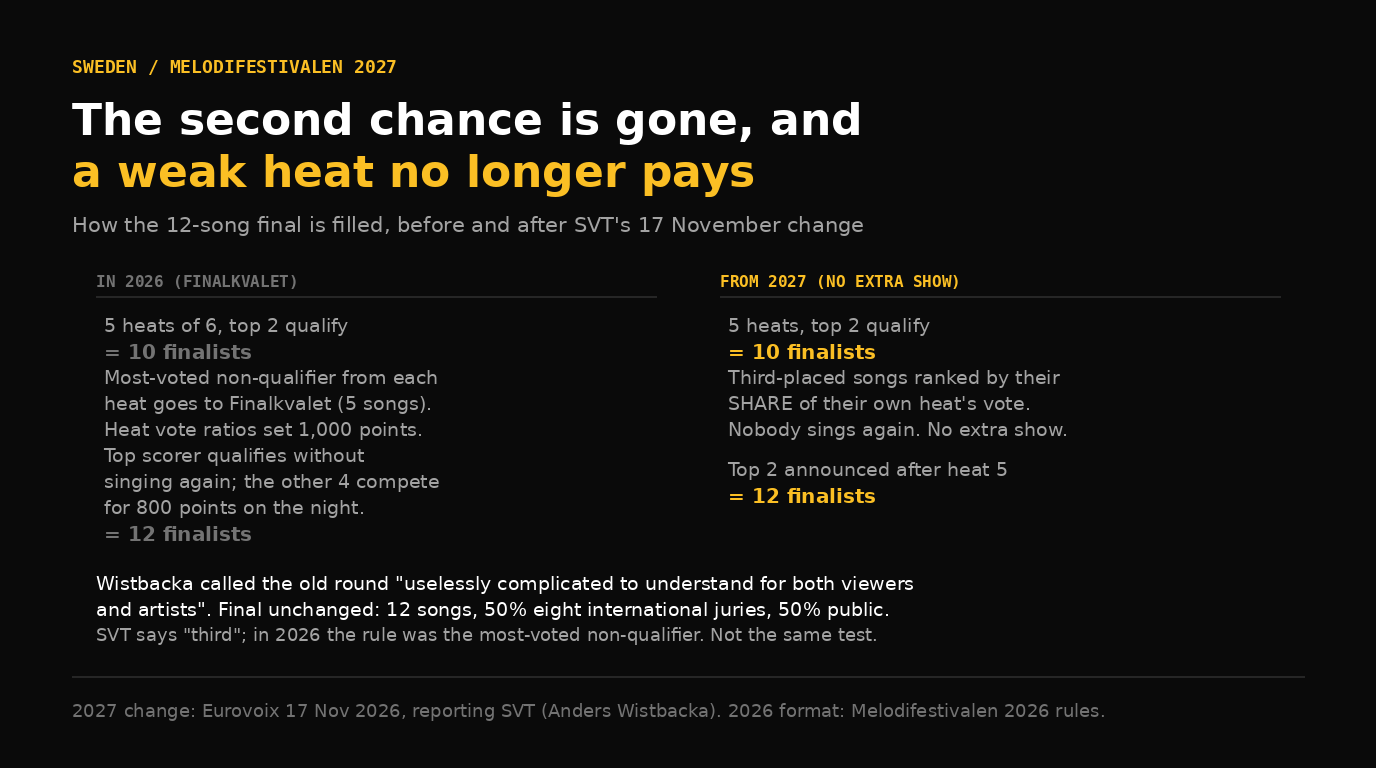
SVT has removed the second-chance round from Melodifestivalen 2027. The round that ran as Andra Chansen from 2002 to 2023 and as Finalkvalet from 2024 is gone, and it is not being replaced by another broadcast. The two remaining places in the 12-song final will instead be filled by ranking the third-placed songs from the five heats against each other, and the qualifiers will be revealed immediately after the last heat.

18+ | New customers only | T&Cs apply | Please gamble responsibly
Project manager Anders Wistbacka gave the reason bluntly, describing the old round as “uselessly complicated to understand for both viewers and artists.” Melodifestivalen 2027 begins on Saturday 6 February, hosted by Oscar Zia and Björn Kjellman, and the winner goes to the Eurovision Song Contest 2027 in Burgas.
What is actually changing, measured against what it replaces
Most coverage of this will describe it as scrapping the second chance. That is true but it understates how much of the mechanism was already there, and the detail matters if you intend to price anything.
Here is what Melodifestivalen 2026 did. Five heats of six songs, thirty entries in total. The top two in each heat qualified directly for the final, giving ten finalists: the first on the most public votes in round one, the second through the age-group points system used since 2019. The most-voted non-qualifying song from each heat — five songs in all — then went to Finalkvalet. There, the heat vote totals were converted into ratios and 1,000 points were distributed between those five songs. The highest scorer qualified immediately, without performing again. The remaining four sang, and a further 800 points were distributed on that night’s vote to decide the last finalist.
So one of the two second-chance places was already being decided by heat voting alone. What 2027 removes is the other one, and with it the broadcast. Both places now come from how the songs performed on the night they already sang.
| Melodifestivalen 2026 | Melodifestivalen 2027 | |
|---|---|---|
| Direct qualifiers | 2 per heat × 5 = 10 | 2 per heat × 5 = 10 |
| Second-chance pool | Most-voted non-qualifier per heat (5 songs) | Third-placed song per heat |
| Extra show | Yes — Finalkvalet, after heat 5 | No |
| How the 2 places are filled | 1 on heat vote ratios, 1 on a fresh public vote | Both on share of their own heat’s vote |
| Final | 12 songs, 50% juries / 50% public | 12 songs, 50% juries / 50% public |
One wording difference worth not glossing over
The report of the 2027 change describes the pool as the songs finishing third in their heats. The 2026 rule was the most-voted non-qualifying song in each heat — and those are not guaranteed to be the same song, because placings below the top two were set by a points system incorporating age-group weightings while “most-voted” is a raw count. The Melodifestivalen 2026 format explicitly noted this as a change from the edition before it, where the third-placed entry had advanced.
So 2027 may be a reversion to the older test, or it may be loose phrasing for the same rule. We are not going to resolve it by choosing the reading we prefer. SVT’s full published rules will settle it, and until they do, the sensible position is that the pool is “the best-performing non-qualifier from each heat on some measure of the heat vote” and that the exact measure is not yet nailed down.
The part that changes how you should handicap it
This is the genuinely consequential bit, and it has nothing to do with television scheduling. Under the old format, a third place was a ticket to a separate contest. You went to Andra Chansen or Finalkvalet, you performed again, in front of a new audience, on a night with its own dynamics, and you could win through on that performance regardless of how modest your heat had been. Being third in a weak heat was worth roughly as much as being third in a strong one, because what happened next was a fresh vote.
Under the new format, a third place is a number computed from a night that has already happened — your share of your own heat’s total vote. There is no second performance and no opportunity to improve it. And because the measure is share of the heat total rather than raw votes, the comparison is normalised across heats of different sizes, which is the fairest version of the test but also an unforgiving one.
The practical consequences for anyone pricing a Melodifestivalen market:
- Heat draw matters more than it used to, and differently. A third place behind two dominant favourites now scores badly, because those two soak up the share. The same song third in a heat with a flatter spread scores better. Previously that distinction washed out in the second-chance show.
- There is no longer a live event between the heats and the final in which a reputation can be rebuilt, a staging fixed, or a narrative turned around. The qualifiers are announced straight after heat 5.
- Two fewer performances means two fewer pieces of information before the final. Anyone forming a view on the eventual winner is working from heat footage alone for those two acts.
- The arithmetic of the final is unchanged. Twelve songs, decided 50% by eight international juries and 50% by the public. The route in changed; the destination did not.
A worked example of the new test
Because the measure is share of a heat’s total vote rather than raw votes or a placing, it is worth seeing what it does with plausible numbers. Take two heats, each of six songs, and look only at the song that finished third.
| Heat A | Heat B | |
|---|---|---|
| Winner’s share | 34% | 22% |
| Runner-up’s share | 28% | 19% |
| Third place’s share | 11% | 18% |
| Remaining three | 27% combined | 41% combined |
Both songs finished third. Under the old format both would have gone forward to a second-chance show and sung again, where the 11% song could comfortably have beaten the 18% song in front of a fresh audience. Under the new rule the 18% song qualifies and the 11% song does not, and no further performance can change it.
Note what drives the difference. Heat A’s third-placed song was not weak in absolute terms — it was crowded out by two dominant entries at the top. Heat B’s was third in a flatter field. The new rule rewards being third in a heat without a runaway winner, which is a function of the draw as much as of the song. Anyone handicapping the heats should therefore be looking at the projected spread of each heat, not just at which acts are in it.
These figures are illustrative, not forecasts. SVT has not published a worked example and the exact vote measure is still to be confirmed in the full rules.
The field the new rule will be applied to
The raw material is already in: submissions closed on 11 September 2026 with a record 4,077 songs, from which SVT picks the 30 that compete, with about 30% to be performed mainly in Swedish. That submission total is the largest in the competition’s history and is part of why the selection has become a year-round production rather than a winter one.
One unresolved question sits underneath that pile, and it is Wistbacka’s own. In October he told Aftonbladet he was “convinced that we will receive quite a few AI songs” among the 4,077, that SVT has no technology to screen submissions for AI use and has not banned it, and that SVT does not want to be the first broadcaster to write AI rules because “this is an issue that the music industry will solve.”
That is a notable position to hold going into a selection that feeds a contest whose own rules on the subject are tightening — several 2027 national selections, including Cyprus’s open submission process, explicitly prohibit AI-generated entries. Sweden has chosen not to. Whether that becomes a story depends entirely on whether anything in the 30 turns out to have been generated, which nobody can currently test.
The dates, and the one to put in the diary
The heats and the final were announced on 17 September 2026, earlier than SVT’s usual late-autumn press conference: five heats on 6 February (Karlstad, Löfbergs Arena), 13 February (Göteborg, Scandinavium), 20 February (Malmö Arena), 27 February (Halmstad Arena) and 6 March (Norrköping, Himmelstalundshallen), with the final on 13 March 2027 at the Strawberry Arena in Stockholm.
The date that is new today is 1 December 2026. Per Aftonbladet, as cited in the reporting of the format change, SVT is expected to hold a press conference that day to reveal the full line-up of 30 artists. That is the first real information event of the Swedish season: submissions closed on 11 September with a record 4,077 songs, from which the 30 are drawn, with about 30% to be performed mainly in Swedish.
Sweden is not the only selection moving this week
The 2027 national-final season has started in earnest, and three other broadcasters put dates on the record within 48 hours:
- Moldova — TRM launched its selection on 16 November. Submissions close 11 December, with a live final on 30 January 2027 decided 50% jury and 50% public. A live audition round sits in between, from which a jury picks up to 16 acts. Two escape clauses are written in: TRM may add semi-finals, and it may skip the final entirely and appoint whichever act scores highest at the auditions.
- Latvia — the Supernova 2027 field will be revealed on 20 November at 07:30 CET on RePlay.lv, chosen from 125 submissions. The final is on 6 February at the Xiaomi Arena in Riga, with a superfinal decided by public vote alone.
- Poland — evaluation of entries for Krajowe Preselekcje began on 17 November and runs to 20 November, selecting up to 20 acts for a live audition in Warsaw on 17 December, from which 7 to 10 go to a national final in early 2027. The winner is chosen by SMS vote, with a five-person reserve jury empowered to decide if the vote fails or a tie cannot be resolved.
All four are tracked, with their sourcing and caveats, on our Eurovision 2027 page, alongside the 36 confirmed broadcasters and the two rows still open.
What there is to bet on: almost nothing
No Eurovision 2027 winner market exists on any venue, and no fixed-odds bookmaker has opened one. Checked on 17 November 2026, Kalshi lists no open Eurovision market on either contest, and Polymarket has exactly one — the Eurovision 2027 Participants book, which is about which countries enter rather than who wins. Twelve of its fourteen contracts resolved on 28 October when the EBU published its 36-country field; only Spain and Slovenia remain open, both undecided with a December deadline.
Melodifestivalen itself has no market either, which is normal at this stage: the 30 artists are not known until 1 December. Historically Swedish bookmakers price the heats once the line-up is out, and the 1 December press conference is the trigger to watch. Until then there is no price to quote, and we are not going to imply one exists. Our winner odds page remains the 2026 archive, and our bookmakers page sets out which venues cover Eurovision at all.
Sources
- Eurovoix, 17 November 2026 — Second Chance round removed from Melodifestivalen (reporting SVT; Anders Wistbacka quoted; Aftonbladet cited for the 1 December press conference)
- Eurovoix, 16 November 2026 — Moldova’s Eurovision 2027 selection launched (regulations published by TRM at eurovision.md)
- Melodifestivalen 2026 format — used here for the Finalkvalet rules being replaced, which the 2027 report does not restate