
Something remarkable has happened to Eurovision betting in 2026. While traditional bookmakers like Betfred, Paddy Power, and William Hill continue to offer the odds that fans have relied on for decades, a parallel universe of Eurovision wagering has exploded on Polymarket — the world's largest prediction market platform.

18+ | New customers only | T&Cs apply | Please gamble responsibly
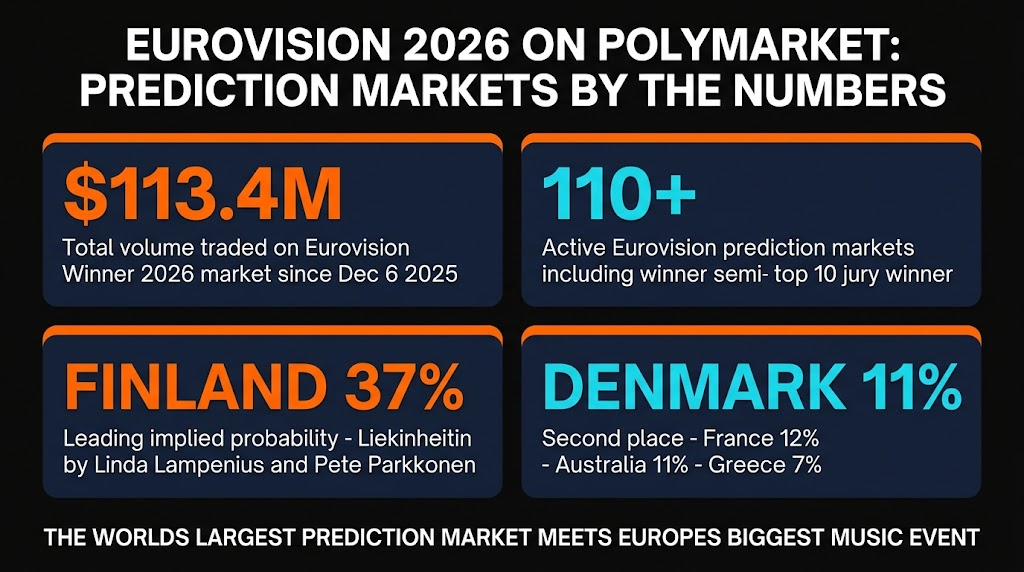
The numbers are staggering: $113.4 million in total volume traded on the "Eurovision Winner 2026" market alone since it launched on December 6, 2025. Across all Eurovision-related markets on the platform, the figure is even higher. More than 110 active markets cover everything from the outright winner to top 3 finishes, jury vote winners, semi-final qualifiers, and individual country matchups.
This is no longer a niche curiosity. Prediction markets have become a genuine force in how Europe analyses, discusses, and bets on the world's biggest song competition.
What Is Polymarket and How Does It Work?
Polymarket is a prediction market platform where users buy and sell shares in the outcomes of real-world events. Unlike traditional bookmakers — where you place a bet at fixed or variable odds and the house takes a margin — prediction markets operate more like a stock exchange for events.
Here is the core mechanism:
- Each possible outcome (e.g. "Finland wins Eurovision 2026") is represented as a share priced between $0.01 and $1.00
- If the outcome happens, each share pays out exactly $1.00
- If it does not happen, the share pays out $0.00
- The current share price equals the market's implied probability — a share trading at $0.37 implies a 37% chance of that outcome occurring
- You can buy shares if you think an outcome is more likely than the market suggests, or sell shares if you think it is less likely
- You can also exit your position at any time before the event resolves, locking in profit or cutting losses
This last point is critical and represents the biggest difference from traditional betting. With a standard bookmaker bet, you place your wager and wait for the result. With Polymarket, you can trade in and out of positions as the market moves — buying Finland at $0.30 in January, selling at $0.40 in March, and pocketing the difference without waiting for the Grand Final.
The Eurovision 2026 Winner Market: $113.4M and Counting
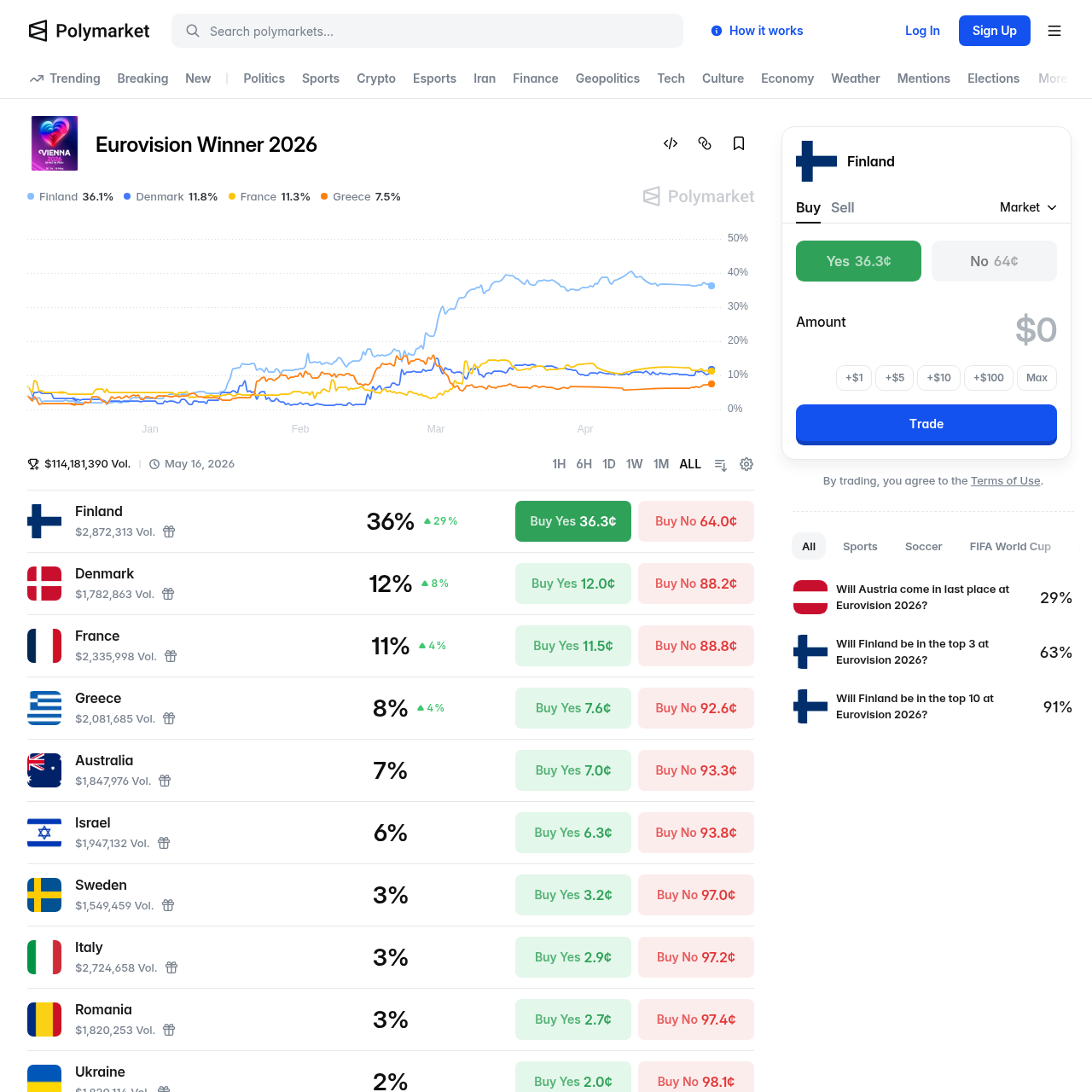
The flagship "Eurovision Winner 2026" market has attracted extraordinary volume since its December 2025 launch. Here are the current implied probabilities for the top contenders:
| Country | Polymarket Price | Implied Probability |
|---|---|---|
| Finland | $0.37 | 37% |
| France | $0.12 | ~12% |
| Denmark | $0.11 | ~11% |
| Australia | $0.11 | ~11% |
| Greece | $0.07 | ~7% |
Finland's dominance mirrors the traditional bookmaker market, where Liekinheitin has been the favourite since early 2026. But the precision of Polymarket's pricing is notable — at 37%, the market is saying Finland has roughly a 1-in-2.7 chance of winning, which is a strong favourite but far from a certainty. That leaves a 63% probability that someone else takes the trophy, and the race for second favourite is remarkably tight between France, Denmark, and Australia.
The $113.4 million in total volume traded does not mean $113.4 million is currently at stake — it represents the cumulative value of all buy and sell transactions since the market opened. But it demonstrates the extraordinary level of interest and the depth of liquidity. When a market has this much volume, the prices tend to be efficient — meaning the collective wisdom of thousands of traders has priced each outcome with considerable accuracy.
Beyond the Winner: 110+ Eurovision Markets
The outright winner is just the beginning. Polymarket hosts a sprawling ecosystem of Eurovision 2026 markets that let traders take positions on virtually every aspect of the contest:
Top 3 Finish Market
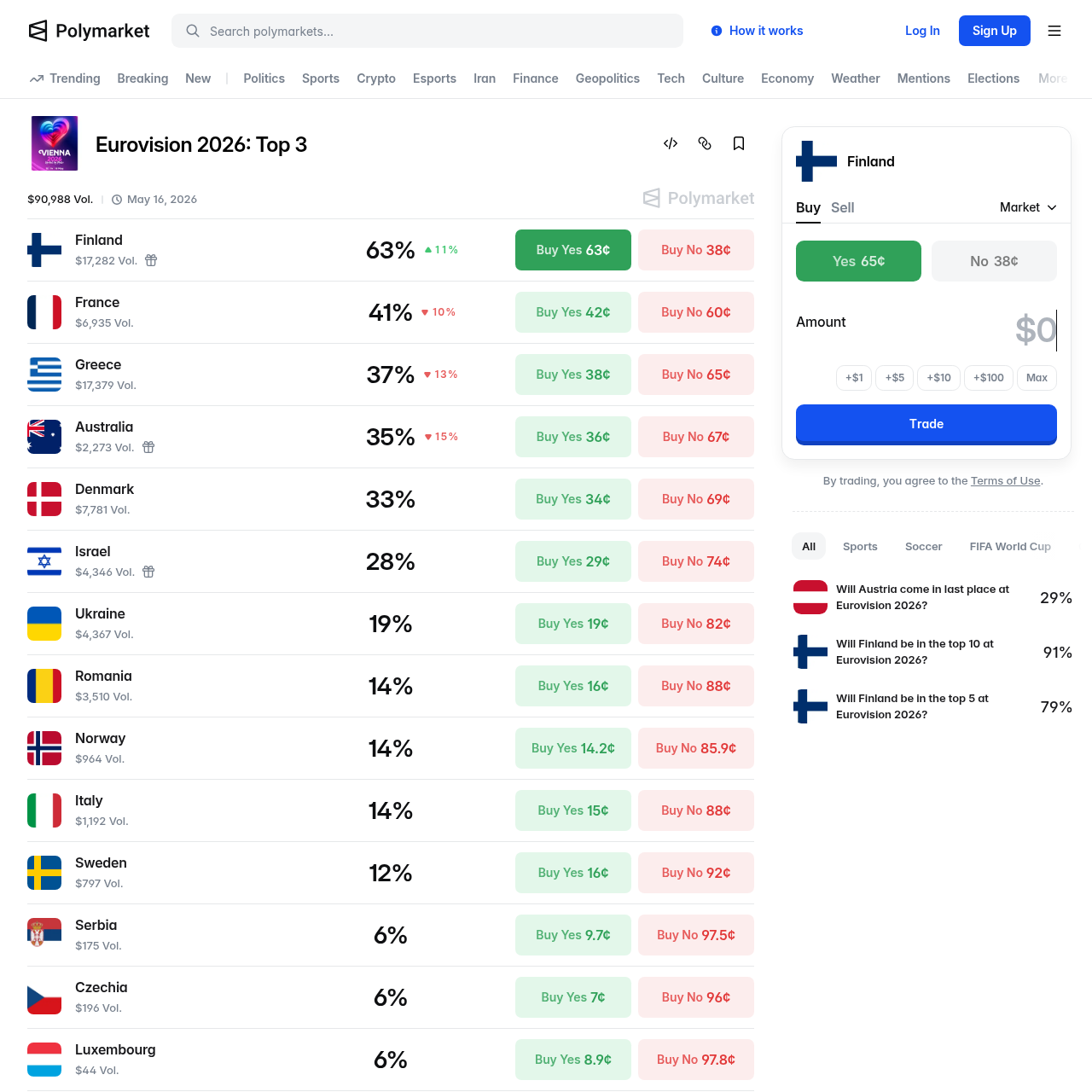
This market asks which countries will finish in the top 3 of the Grand Final. The current implied probabilities paint a compelling picture:
- Finland — 70% to finish top 3
- France — 41% to finish top 3
- Denmark — implied ~35%
- Australia — implied ~33%
- Greece — implied ~20%
Finland at 70% for a top 3 finish is remarkably high — the market is saying there is only a 30% chance Finland finishes outside the medals. For comparison, this is a level of confidence typically reserved for overwhelming favourites in individual sports. France at 41% suggests the market sees Monroe's operatic entry as a near-coin-flip for a podium spot.
Semi-Final Qualification Markets
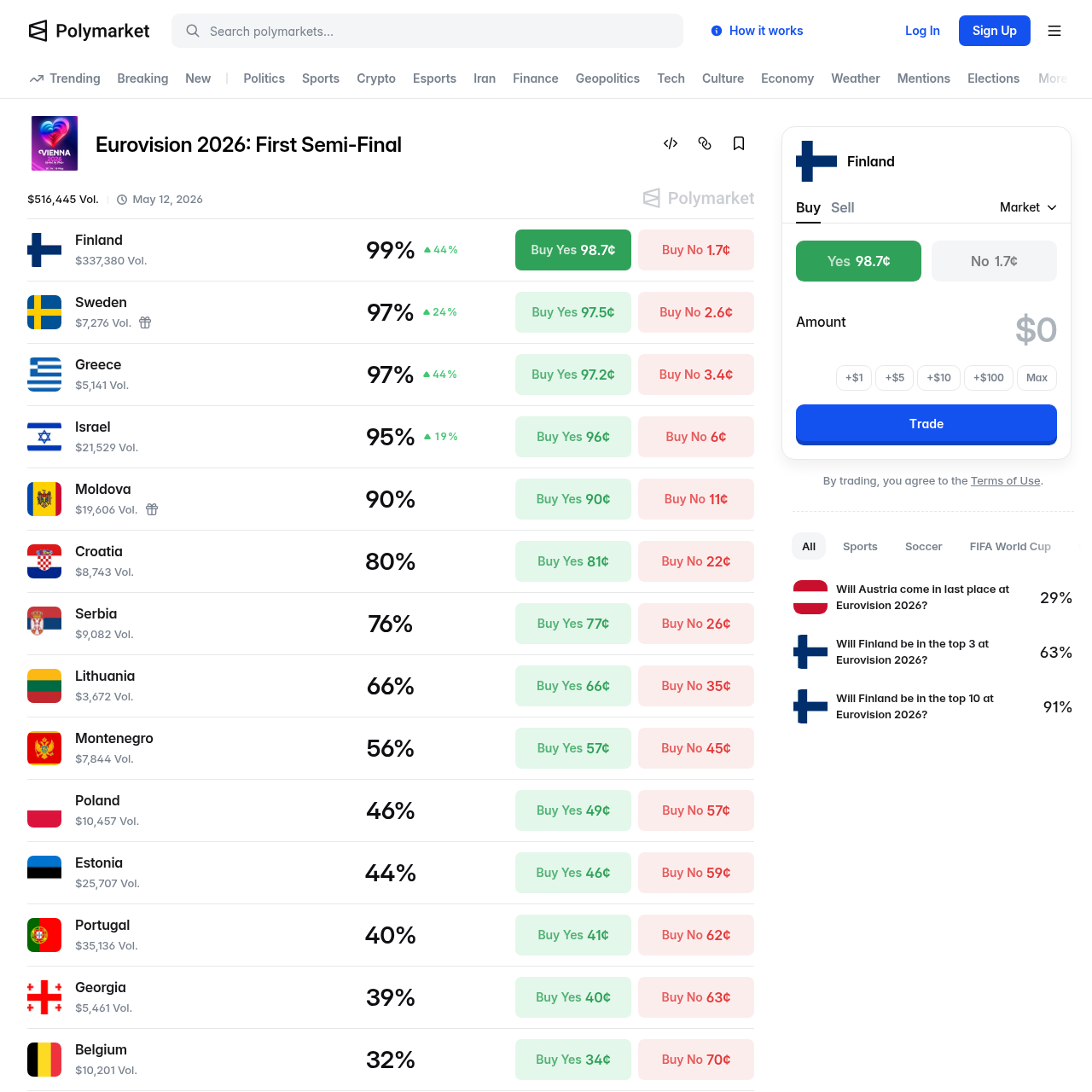
Individual markets cover whether each country will qualify from their semi-final. The extremes are instructive:
- Finland — 98% to qualify from Semi-Final 1
- Sweden — 97% to qualify from Semi-Final 1
- Greece — 96% to qualify from Semi-Final 1
- Australia — 95% to qualify from Semi-Final 2
- Denmark — 94% to qualify from Semi-Final 2
At the other end, countries like Montenegro, Latvia, and Luxembourg are priced below 30% to qualify. These qualification markets offer interesting opportunities for contrarian traders who believe a specific entry is undervalued or overvalued based on staging potential, rehearsal footage, or insider knowledge.
Other Markets
The full range of Eurovision Polymarket offerings includes:
- Top 10 finish for individual countries
- Jury vote winner
- Televote winner
- Head-to-head matchups (e.g. "Will Finland score more than France?")
- Will [country] participate? (relevant during the boycott period)
- Nul points markets
Polymarket vs Traditional Bookmakers: Key Differences
For Eurovision fans accustomed to checking Oddschecker for the latest odds, Polymarket represents a fundamentally different experience. Here is how the two approaches compare:
| Feature | Traditional Bookmakers | Polymarket |
|---|---|---|
| How you bet | Place a wager at given odds | Buy/sell shares at market price |
| Can you exit early? | Cash-out available (limited) | Sell position any time at market price |
| Who sets the odds? | Bookmaker's trading team + market forces | Purely supply and demand from traders |
| House margin | 5–15% built into odds (overround) | No overround; small trading fees |
| Regulation | Licensed by UK Gambling Commission etc. | Decentralised; regulatory status varies |
| Payment | GBP/EUR via bank/card | USDC (cryptocurrency) |
| Market depth | Winner + 5–10 specials | 110+ individual markets |
| Availability | UK/EU regulated territories | Global (with some restrictions) |
The absence of a house margin is perhaps the most significant practical difference. When you bet at a traditional bookmaker, the odds are structured so that the total implied probabilities exceed 100% — the excess is the bookmaker's profit margin (typically 5–15% on Eurovision markets). On Polymarket, prices are set purely by trader activity, and the platform charges small transaction fees instead of building margin into the odds.
This means that Polymarket prices are often considered a purer reflection of true probabilities than bookmaker odds. Academic research consistently shows that prediction markets outperform expert forecasts and polls in predicting outcomes across politics, economics, and entertainment.
Why $113 Million? What Is Driving the Volume
Several factors explain why Eurovision 2026 has generated unprecedented prediction market interest:
- Polymarket's explosive growth. The platform surged in popularity during the 2024 US Presidential election, when it accurately called the result while polls showed a toss-up. That success brought millions of new users to the platform, many of whom now trade on entertainment markets including Eurovision.
- Eurovision's unique betting appeal. With 35 competing countries, multiple scoring mechanisms (jury + televote), and a highly engaged global fanbase, Eurovision offers a rich landscape for prediction market trading. The information asymmetry between casual fans and dedicated followers creates profitable opportunities for knowledgeable traders.
- The boycott storyline. The 2026 boycotts (Spain, Ireland, Iceland, Netherlands, Slovenia) created enormous early-market activity as traders reassessed probabilities based on the reduced and reshuffled competition field.
- Rehearsal-driven volatility. Eurovision's rehearsal period produces rapid information revelations — first rehearsal photos, 30-second clips, press reactions — that cause sharp price movements. Active traders thrive on this volatility.
Where Polymarket and Bookmakers Agree — and Disagree
Cross-referencing Polymarket prices with traditional bookmaker odds reveals some interesting convergences and divergences:
Strong agreement:
- Finland as clear favourite (~37% on both platforms)
- France, Denmark, and Australia clustered in the 10–12% range on both
- Greece as the 5th favourite at ~7%
Notable divergences:
- Israel: Polymarket tends to price Israel slightly higher than traditional bookmakers, likely reflecting a more internationally diverse trader base that weights the televote potential differently
- Sweden: Traditional bookmakers have been marginally more bullish on Sweden than Polymarket, possibly reflecting European bettors' historical confidence in Melodifestivalen's selection process
- Czechia: The Daniel Zizka surge registered earlier on Polymarket than at traditional bookmakers, suggesting prediction market traders may have identified the value sooner
When the two platforms agree, the signal is particularly strong. Finland's consistent ~37% across both represents genuine market consensus — not an artefact of one platform's methodology or user base.
How to Use Prediction Markets for Eurovision Betting
Even if you prefer to bet through regulated UK bookmakers like Betfred, Polymarket data is a valuable analytical tool:
- Use Polymarket as a probability calculator. Bookmaker odds include a margin that distorts true probabilities. Polymarket prices, with no overround, give you a cleaner read on what the market genuinely believes. If a bookmaker offers Finland at 2/1 (implied 33%) but Polymarket prices Finland at 37%, the bookmaker's price may represent slight value — or they may be slow to adjust.
- Track price movements for timing signals. Polymarket operates 24/7 and reacts faster than traditional bookmakers to news, rehearsal footage, and social media sentiment. A sharp move on Polymarket often precedes a similar move at bookmakers by hours or even days. Watching Polymarket prices during rehearsal week can help you place traditional bets before the bookmakers adjust.
- Compare qualification pricing. Polymarket's semi-final qualification markets offer granular probabilities that most bookmakers do not match. If Polymarket prices Portugal at 45% to qualify but your bookmaker offers generous odds on a Portugal qualification bet, the prediction market is telling you there may be value.
The Wisdom of the Crowd in Action
Prediction markets are fundamentally built on the "wisdom of crowds" principle — the idea that the aggregated judgement of many informed participants tends to be more accurate than any individual expert. At $113.4 million in volume, the Eurovision winner market represents one of the deepest entertainment prediction markets ever created.
Does this mean Polymarket will correctly predict the Eurovision 2026 winner? Not necessarily. The favourite wins Eurovision approximately 40% of the time over the past two decades. But it does mean that if you are looking for the most information-dense, real-time assessment of each country's chances, Polymarket's prices are arguably the single best data source available — better than any individual pundit, fan poll, or statistical model.
The 70th Eurovision Song Contest takes place on May 16 in Vienna. Whether you trade on Polymarket, bet through traditional bookmakers, or simply use the data to inform your viewing, the prediction market revolution has given Eurovision fans a powerful new lens through which to analyse the contest.
18+. Please gamble responsibly. BeGambleAware.org
Related Articles
- Eurovision 2026 Odds Update (April 9): Finland Narrows, Denmark Surges
- Eurovision 2026: Jury vs Televote — The Complete Betting Strategy Guide
- How to Bet on Eurovision 2026: A Beginner's Guide
- Eurovision 2026 Complete Guide: Betting Odds & Predictions
- Eurovision 2026 Dark Horses: Value Bets & Best Odds
Frequently Asked Questions
How much money has been traded on Eurovision 2026 on Polymarket?
Over $113.4 million in total volume has been traded on the "Eurovision Winner 2026" market since it launched on December 6, 2025. Across all Eurovision-related markets (winner, top 3, semi-final qualifiers, jury winner, etc.), the total is significantly higher. There are currently more than 110 active Eurovision markets on the platform.
Is Polymarket legal in the UK?
Polymarket operates as a decentralised prediction market and is not licensed by the UK Gambling Commission. UK residents should check the platform's current terms of service and their local regulations before participating. For regulated Eurovision betting in the UK, licensed bookmakers offer comprehensive markets with full consumer protections.
Who does Polymarket favour to win Eurovision 2026?
Finland leads the Polymarket Eurovision Winner market at 37% implied probability, followed by France (~12%), Denmark (~11%), Australia (~11%), and Greece (~7%). These probabilities are broadly consistent with traditional bookmaker odds, though the absence of a house margin means Polymarket prices are considered a purer reflection of true market consensus.
Can I use Polymarket data to make better bets at traditional bookmakers?
Yes. Polymarket's margin-free pricing provides a cleaner probability estimate than bookmaker odds (which include a built-in profit margin). Comparing Polymarket implied probabilities with bookmaker odds can help identify value bets — situations where a bookmaker's price implies a lower probability than the prediction market consensus, suggesting the bookmaker may be offering generous odds.