
Every year, Eurovision delivers one of the most predictable dramas in entertainment: the jury and the televote disagree. Sometimes they disagree a little. Sometimes they disagree so violently that the entire final ranking feels like a compromise nobody wanted. For bettors, this split is not a problem. It is an opportunity.

18+ | New customers only | T&Cs apply | Please gamble responsibly
Eurovision 2026 offers separate betting markets for jury winner, televote winner, and outright winner. Most casual bettors pile into the outright market and ignore the other two. That is a mistake. The jury and televote markets frequently offer superior value, and understanding how the two voting blocs behave differently is the single biggest edge you can develop as a Eurovision bettor.
This guide breaks down exactly how the scoring system works, what each voting bloc rewards, who the favorites are for each market in 2026, and how to build a betting strategy around the split.
How Eurovision Scoring Actually Works
Before placing a single bet, you need to understand the mechanics. Eurovision uses a combined scoring system where the final ranking is determined by adding two separate point totals together.
The Jury Vote (50% of final score)
Each participating country assembles a national jury of five music industry professionals. These jurors watch the dress rehearsal (not the live show) and rank all competing entries from first to last. Their individual rankings are combined into a national jury result, which is then converted into Eurovision points: 12 points to first place, 10 to second, then 8, 7, 6, 5, 4, 3, 2, and 1 to third through tenth place. Countries outside the top 10 receive zero jury points from that nation.
The Televote (50% of final score)
Viewers in each participating country vote during the live grand final broadcast. They can vote up to 20 times by phone, SMS, or the official Eurovision app. They cannot vote for their own country. The televote results from each nation are converted into the same 12-10-8-7-6-5-4-3-2-1 point structure.
The Combined Result
Jury points and televote points are added together. The country with the highest combined total wins Eurovision. This means a song could finish first in the jury vote and fifth in the televote but still win overall — or a televote landslide could overcome a poor jury showing.
The critical insight for bettors: these are effectively two different competitions happening simultaneously, judged by audiences with very different tastes.
What Wins the Jury Vote
Juries are music professionals — composers, producers, singers, radio DJs, music journalists. They evaluate entries on vocal performance, songwriting craft, musical arrangement, and artistic merit. They watch the dress rehearsal, not the live show, which means staging spectacle and crowd energy matter less to them.
Jury favorites tend to share these characteristics:
Vocal excellence. Juries reward singers who demonstrate technical ability — range, control, tone, and the ability to deliver consistently. A polished vocal performance in the dress rehearsal carries enormous weight.
Sophisticated songwriting. Juries appreciate harmonic complexity, clever lyrics, unexpected melodic choices, and structural ambition. A well-crafted ballad or an art-pop piece with interesting production will score higher with juries than a simple, catchy hook.
Western European and Anglophone sensibilities. Historically, juries favor entries that sound like they could be mainstream radio hits in Western Europe, Scandinavia, or the English-speaking world. French chanson, Scandinavian pop craftsmanship, and polished singer-songwriter material all perform well.
Restraint over spectacle. While juries appreciate strong staging, they are less swayed by pyrotechnics, costume changes, and gimmicks than the general public. A singer standing still and delivering a stunning vocal can win the jury vote.
What Wins the Televote
The televote is the voice of the people — millions of viewers across Europe and beyond, voting in real time during the live broadcast. The televote audience is not evaluating entries like a panel of judges. They are reacting emotionally to what they see and hear in that moment.
Televote winners tend to share these characteristics:
Spectacle and staging. The live show experience matters enormously. Dramatic staging, memorable visual moments, dance routines, and "water cooler" moments drive televotes. If a performance makes someone grab their phone and vote immediately, it wins.
Diaspora and bloc voting. Countries with large diaspora populations across Europe have a structural televote advantage. Greek communities across Germany, the UK, and Australia vote for Greece. Turkish communities vote for entries that align culturally. Eastern European and Balkan countries tend to exchange televote points. This is not corruption — it is genuine cultural affinity — but it shapes outcomes.
Emotional resonance. Entries that tap into collective emotion — whether through sympathy, solidarity, joy, or national pride — overperform in the televote. Ukraine's victories in 2016 and 2022 were driven partly by political sympathy combined with genuinely strong entries.
Uptempo bangers. While juries can appreciate a slow burn, televote audiences tend to reward energy. High-tempo entries with singalong choruses, strong drops, and festival-ready production consistently overperform in the televote relative to their jury placing.
Authenticity and uniqueness. The televote rewards entries that feel genuinely different. Folk elements, unusual instruments, performances in native languages, and acts that clearly represent their country's culture tend to connect with voters.
2026 Jury Favorites: Where the Smart Money Goes
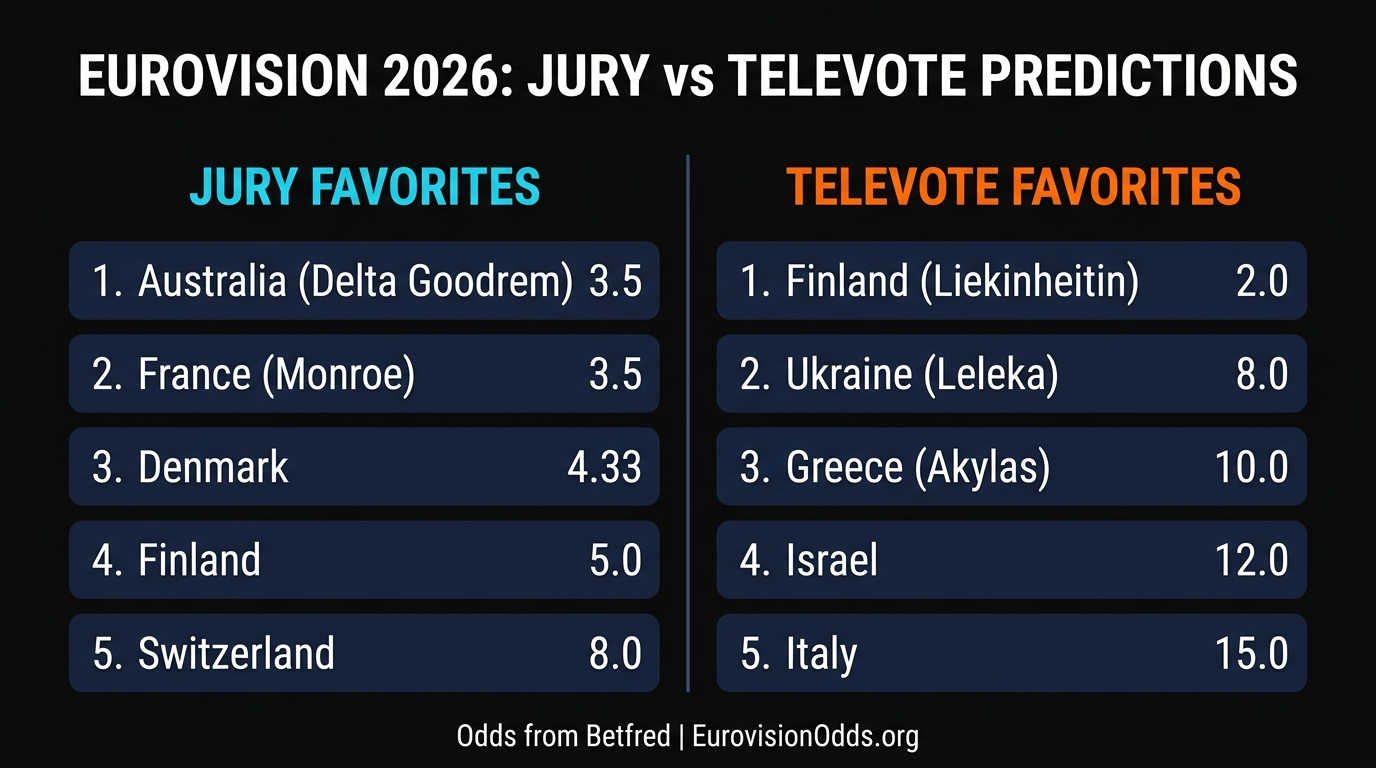
The jury winner market for Eurovision 2026 has some clear frontrunners, and the odds reflect a race between polished, vocally impressive entries.
Australia — Delta Goodrem (3.5)
Delta Goodrem is the definition of a jury magnet. A globally recognized artist with decades of professional experience, impeccable vocal control, and the kind of singer-songwriter credibility that juries adore. Her entry is expected to lean into her strengths — emotional delivery, soaring melodies, and a polished production. At Betfred, 3.5 represents genuine value if her rehearsal performance matches expectations. Australian entries have historically performed well with juries, and Goodrem's pedigree puts her in a different league from most Eurovision debutantes.
France — Monroe (3.5)
France sending a strong entry is always dangerous in the jury vote. French acts benefit from the cultural prestige of chanson, and juries from across Europe tend to appreciate Francophone artistry. Monroe at 3.5 sits level with Goodrem, and the market essentially views them as co-favorites. France's jury pedigree is exceptional — even in years where France finishes mid-table overall, their jury points are often significantly higher than their televote.
Denmark (4.33)
Denmark has quietly become a jury darling in recent years, sending well-crafted pop entries that hit the sweet spot of accessibility and sophistication. At 4.33, Denmark offers a strong each-way prospect in the jury market. Scandinavian entries benefit from the region's reputation for pop excellence, and juries tend to reward the clean, precise production style that Danish entries typically deliver.
Finland (5.0)
Finland at 5.0 for the jury vote is interesting because Finland is also the strong televote favorite. If Finland's entry bridges both audiences — think a well-produced, vocally strong piece with broad appeal — the jury price offers value. However, Finland's televote strength historically comes from entries that are more crowd-pleasing than jury-friendly (think Lordi, Kaarija), so this bet carries more uncertainty.
2026 Televote Favorites: The People's Choice
The televote market tells a completely different story, and this divergence is where the betting value lives.
Finland (Strong Favorite)
Finland enters 2026 as the dominant televote favorite. Finnish entries have generated enormous televote support in recent contests — Kaarija's "Cha Cha Cha" in 2023 won the televote by a landslide despite losing overall to Sweden. Finland consistently sends entries with massive crowd energy, strong staging, and the kind of viral appeal that drives phone votes. The Finnish fanbase is also extremely engaged and mobilized. If you are looking for the most likely televote winner, Finland is the market leader for good reason.
Ukraine (Sympathy + Diaspora)
Ukraine remains a televote powerhouse in 2026. The combination of genuine sympathy for the ongoing conflict, a massive and politically engaged diaspora across Europe, and Ukraine's track record of sending genuinely excellent entries makes them a perennial televote threat. Ukraine won the televote in 2022 by an enormous margin and has consistently placed in the televote top 5 in recent years. The diaspora effect alone — Ukrainians living in Poland, Germany, Czech Republic, UK, and beyond — guarantees a strong baseline of televote support.
Israel (Controversial but Gets Votes)
Israel is one of the most complex televote stories in Eurovision 2026. Despite — or perhaps because of — the intense controversy surrounding their participation, Israel tends to receive significant televote support. There is a motivated voting bloc that supports Israel precisely because of the political pressure to withdraw, and the diaspora vote adds a reliable floor. Israel's televote performance often exceeds what polls and social media sentiment would suggest.
Greece (Diaspora Power)
Greece is a televote machine. The Greek diaspora is one of the largest and most Eurovision-engaged in Europe, with significant populations in Germany, the UK, Australia, Cyprus, and across the continent. Greece receives reliable televote support regardless of song quality, and when they send a genuinely strong entry, the diaspora effect amplifies it. Cyprus consistently gives Greece 12 televote points, and the broader diaspora ensures a strong baseline across multiple countries.
Italy (Cultural Weight)
Italy benefits from enormous cultural affinity across Europe and a large, engaged diaspora. Italian entries that lean into the country's musical identity — whether through operatic vocals, Mediterranean pop, or rock with Italian flair — tend to galvanize televote support. Italy's win in 2021 with Maneskin was a televote triumph, and the country remains a televote contender whenever they send an entry with broad appeal.
Historical Jury vs Televote Splits: Lessons for Bettors
The divergence between jury and televote results is not a rare occurrence. It happens almost every year, and some splits have been dramatic enough to reshape how bettors think about the contest.
2023: Sweden vs Finland
The most instructive recent example. Loreen (Sweden) won the jury vote by a comfortable margin with her polished, vocally masterful "Tattoo." Kaarija (Finland) won the televote by a landslide with the explosive "Cha Cha Cha," receiving 376 televote points to Sweden's 243. The jury gave Sweden enough of a lead that Loreen won overall, but the two markets told completely different stories. A bettor who backed Finland for the televote and Sweden for the jury would have won both bets.
2019: North Macedonia vs Norway vs Netherlands
North Macedonia's Tamara Todevska won the jury vote convincingly but finished seventh overall. Norway's KEiiNO won the televote with their Sami-influenced banger but finished sixth overall. The Netherlands' Duncan Laurence won the contest by performing well in both votes without winning either one outright. Three different stories, three different potential winning bets.
2016: Australia vs Ukraine
Dami Im (Australia) won the jury vote with a technically stunning vocal performance. Ukraine's Jamala won the televote and the contest overall with the politically charged "1944." Australia finished second. The jury and televote were telling bettors completely different things about which entry deserved to win.
2015: Sweden vs Italy
Sweden won both the jury vote and the overall contest, but Italy won the televote with "Grande Amore" by Il Volo. The operatic trio connected with the public in a way that the jury's preferred Swedish entry did not, but Sweden's jury dominance was too large to overcome.
The pattern is clear: backing the jury favorite and the televote favorite as separate bets gives you two distinct chances to win, and the two markets frequently have different winners.
How the 2026 Boycott Changes Everything
Eurovision 2026 operates under unusual circumstances that bettors must account for. Several countries have withdrawn or are boycotting the contest, which affects both voting blocs in different ways.
Fewer jury panels. Each boycotting country removes one five-person jury panel from the equation. If traditionally jury-friendly countries withdraw, the remaining jury pool shifts. Fewer panels also mean each individual jury carries more weight, increasing the variance in jury results. A song that appeals strongly to the specific juries that remain could outperform its "true" quality, while an entry that would have been buoyed by now-absent juries might underperform.
Different televote dynamics. Fewer participating countries means fewer televote pools. If countries with large diasporas in boycotting nations lose those voting populations, their televote totals drop. Conversely, if boycotting countries have diasporas that would have split votes, remaining entries from that cultural sphere might consolidate support.
Smaller field, higher concentration. With fewer entries, the available points concentrate among fewer songs. This can amplify gaps — a frontrunner might win by a larger margin than usual because there are fewer mid-table entries absorbing stray points.
For bettors, the boycott increases the importance of understanding exactly which countries are in and which are out, and modeling how that changes the voting dynamics for specific entries.
Betting Strategy: Jury vs Televote vs Outright
Here is where we turn analysis into action. The three markets — jury winner, televote winner, and outright winner — require different approaches.
The Jury Winner Market: Where Value Lives
The jury winner market is consistently underbet. Most casual Eurovision bettors focus on the outright market, which means the jury market often has less efficient pricing. At bookmakers like Betfred, you can find jury winner odds that do not fully account for how predictable jury behavior actually is.
Jury results are more predictable than televote results because:
- Juries are smaller, more homogeneous groups with similar professional backgrounds
- Jury preferences follow established patterns (vocal quality, songwriting craft, Western European sensibilities)
- Rehearsal reports from the press provide strong signals about jury-friendly performances
- Historical jury data shows consistent biases that can be modeled
If you are a sophisticated bettor who reads rehearsal reports, follows professional music critics, and understands jury tendencies, the jury winner market is where you should focus your most confident bets.
The Televote Winner Market: High Confidence, Low Odds
The televote market tends to be priced more efficiently because televote favorites are highly visible — they are the entries generating social media buzz, streaming numbers, and fan community excitement. When a clear televote favorite emerges (as Finland has in 2026), the odds compress quickly.
The televote market is still worth betting when:
- You identify a televote favorite before the market does (early in the season)
- You spot a value play on a non-favorite with strong diaspora support or viral potential
- You want to hedge an outright bet with a correlated televote position
The Outright Market: Highest Volume, Most Competition
The outright market is the most liquid and most analyzed. Prices here reflect the broadest consensus and are hardest to beat. However, understanding the jury-televote split gives you an edge even in the outright market — if you can identify an entry that will perform well in both votes, you can spot outright winners that the market undervalues.
Specific 2026 Bet Recommendations
Based on the current market dynamics, here are concrete positions worth considering.
Jury Winner: Australia (Delta Goodrem) at 3.5
This is the standout value bet of the three markets. Goodrem's vocal pedigree, professional experience, and the type of entry Australia typically sends all scream jury favorite. At 3.5 on Betfred, you are getting better than implied 28% probability on an outcome that arguably has a 35-40% chance of occurring. The only risk is if her dress rehearsal vocal disappoints, which is unlikely given her experience.
Televote Winner: Finland
Finland is the clear televote favorite and the price reflects it. This is a high-confidence, lower-value bet. Consider it as part of a broader strategy rather than a standalone play. If Finland's entry generates the kind of viral staging moment that "Cha Cha Cha" did, the televote could be a runaway.
Outright: France (Monroe) each-way
France has genuine potential to perform well in both votes — strong enough for a high jury placing and enough cultural prestige and televote support to stay competitive in the public vote. An each-way bet on France outright captures value if they finish on the podium without needing an outright win.
Value play: Ukraine televote top 3
If your bookmaker offers a top-3 televote finish market, Ukraine is almost a certainty to place. The diaspora alone provides a floor, and any emotional resonance from their entry pushes them higher. This is a high-probability, modest-odds bet that adds consistency to a betting portfolio.
Hedge strategy: Back different entries for jury and televote
The most sophisticated approach is to back Australia or France for the jury win and Finland for the televote win. If the jury and televote produce different winners (which they usually do), you win one of your two bets. If the same entry wins both, you lose one bet but the other pays. This creates a natural hedge that reduces variance.
Timing Your Bets
When you place your bets matters almost as much as what you bet on.
Now (pre-season): Lock in jury winner bets while the market is least efficient. Jury favorites tend to drift shorter as rehearsal reports confirm vocal quality, so early value erodes. Most bookmakers currently offer competitive prices on the jury market.
After rehearsals: This is when televote favorites become clearer. Staging quality, visual impact, and crowd reactions during rehearsals provide strong televote signals. Adjust your televote positions after the first rehearsals.
After semi-finals: Semi-final results reveal both jury and televote tendencies. If a jury favorite dominates their semi-final jury vote, their final jury odds will shorten. Move before the market catches up.
Avoid: Placing all your bets on grand final day. By then, the market has absorbed all available information and odds are at their most efficient. The value is in the weeks and days before.
The Bottom Line
Eurovision's jury-televote split is not just a scoring quirk. It is the single most exploitable structural feature of the contest for bettors. Two different audiences evaluate the same entries with different criteria, producing different results that bookmakers offer as separate markets.
In 2026, the smart play is to treat the jury and televote as separate contests. Back Goodrem or France for the jury. Back Finland for the televote. Use the outright market for hedging or each-way value. And remember that the boycott adds an extra layer of unpredictability that favors bettors who do their homework over those who follow the crowd.
The entries that win the jury are rarely the ones that win the televote. That is not a bug. For sharp bettors, it is the feature that makes Eurovision one of the most interesting betting events on the calendar.