
Live from the Wiener Stadthalle press centre — with the first semi-final jury show completed tonight and 15 countries about to fight for 10 Grand Final slots tomorrow, a different market has been attracting sharp money across both bookmakers and prediction markets. The Eurovision 2026 last place market features a 17-point disagreement between professional bookmakers and Polymarket traders that is, in our assessment, one of the most exploitable pricing gaps of the entire contest.

18+ | New customers only | T&Cs apply | Please gamble responsibly
Bookmakers on EurovisionWorld price Austria as the slight last-place favourite at 24% probability (2.75–2.88 odds), with the UK just behind at 22% probability (3.00–3.50 odds). Polymarket traders — who have put $87,265 into the last place market — have the UK at 39% and Austria at 28%. That is a 17-percentage-point gap on UK last place between two well-funded, information-rich markets, and a gap of that magnitude does not exist without a reason worth understanding.
This article is the complete analysis: what drives the bookmaker-Polymarket split, why host country Austria deserves to be faded, whether Germany's 8% probability is underpriced given their historical record, and where the specific bets offer the best risk-adjusted returns.
Betfred — Bet £10 Get £50 in Free Bets on All Eurovision 2026 Markets
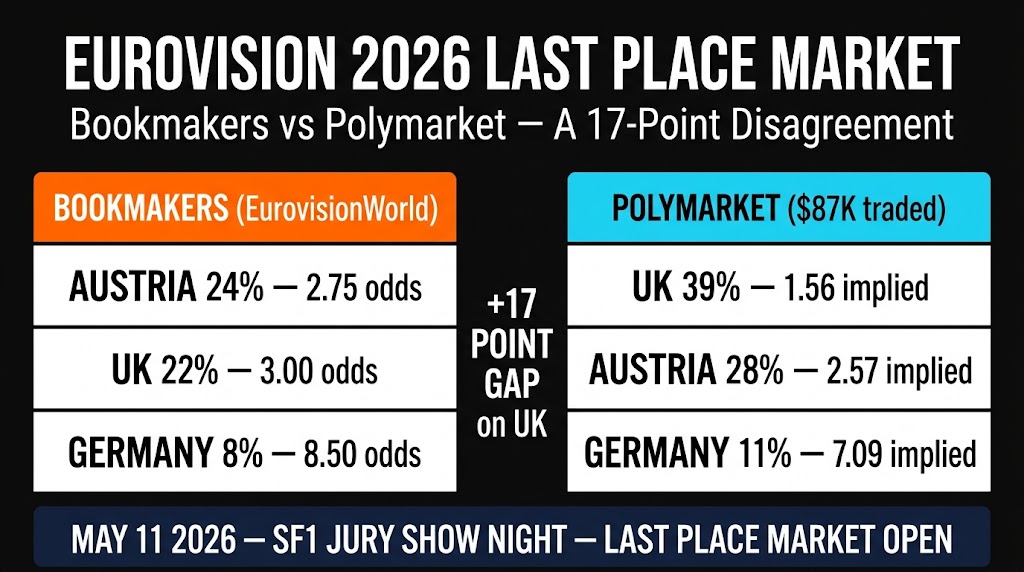
The Full Last Place Market: All Prices, 11 May 2026
Before we examine the UK-Austria split, here is the complete bookmaker pricing from EurovisionWorld as of 09:58 CEST on 11 May 2026.
| Rank | Country | Artist / Song | Implied Last % | Best Odds | Semi-Final Status |
|---|---|---|---|---|---|
| 1 | Austria | Cosmó — Tanzschein | 24% | 2.75 | Auto-qualified (host) |
| 2 | UK | Look Mum No Computer — Eins, Zwei, Drei | 22% | 3.00 | Auto-qualified (Big 5) |
| 3 | Germany | Sarah Engels — Fire | 8% | 8.00 | Auto-qualified (Big 5) |
| 4 | Estonia | Vanilla Ninja — Too Epic To Be True | 4% | 13.00 | Semi-Final 1 |
| 5 | Portugal | Bandidos do Cante — Rosa | 3% | 17.00 | Semi-Final 1 |
| 5 | Azerbaijan | Jiva — Just Go | 3% | 21.00 | Semi-Final 2 |
| 5 | San Marino | Senhit feat. Boy George — Superstar | 3% | 15.00 | Semi-Final 2 |
| 5 | Latvia | Atvara — Ēnā | 3% | 21.00 | Semi-Final 2 |
| 5 | Belgium | Essyla — Dancing on the Ice | 3% | 21.00 | Semi-Final 1 |
| 5 | Lithuania | Lion Ceccah — Sólo quiero más | 3% | 21.00 | Semi-Final 1 |
| 5 | Luxembourg | Eva Marija — Mother Nature | 3% | 21.00 | Semi-Final 2 |
Source: EurovisionWorld bookmaker aggregate, verified 11 May 2026 09:58 CEST. Only bookmakers with last-place markets listed: Betsson, Unibet, Bet365, William Hill.
And here is the Polymarket comparison for the same market:
| Country | Polymarket Probability | Bookmaker Probability | Gap (Polymarket minus Bookmakers) |
|---|---|---|---|
| UK | 39% | 22% | +17 points (Polymarket higher) |
| Austria | 28% | 24% | +4 points (Polymarket higher) |
| Germany | 11% | 8% | +3 points (Polymarket higher) |
| Belgium | 3.4% | 3% | +0.4 points (negligible) |
Source: Polymarket.com/event/eurovision-last-place-2026, $87,265 total volume as of 11 May 2026. Bookmakers: EurovisionWorld aggregate.
The 17-point gap on UK is not noise. Polymarket markets of this size ($87K) reflect the collective judgment of hundreds of traders with real money at stake. When prediction markets and traditional bookmakers diverge by 17 points, one of them is wrong — and the smart money tends to aggregate more recent and specific information than bookmaker pricing teams working off slower update cycles.
Why UK at 3.00 Looks Underpriced
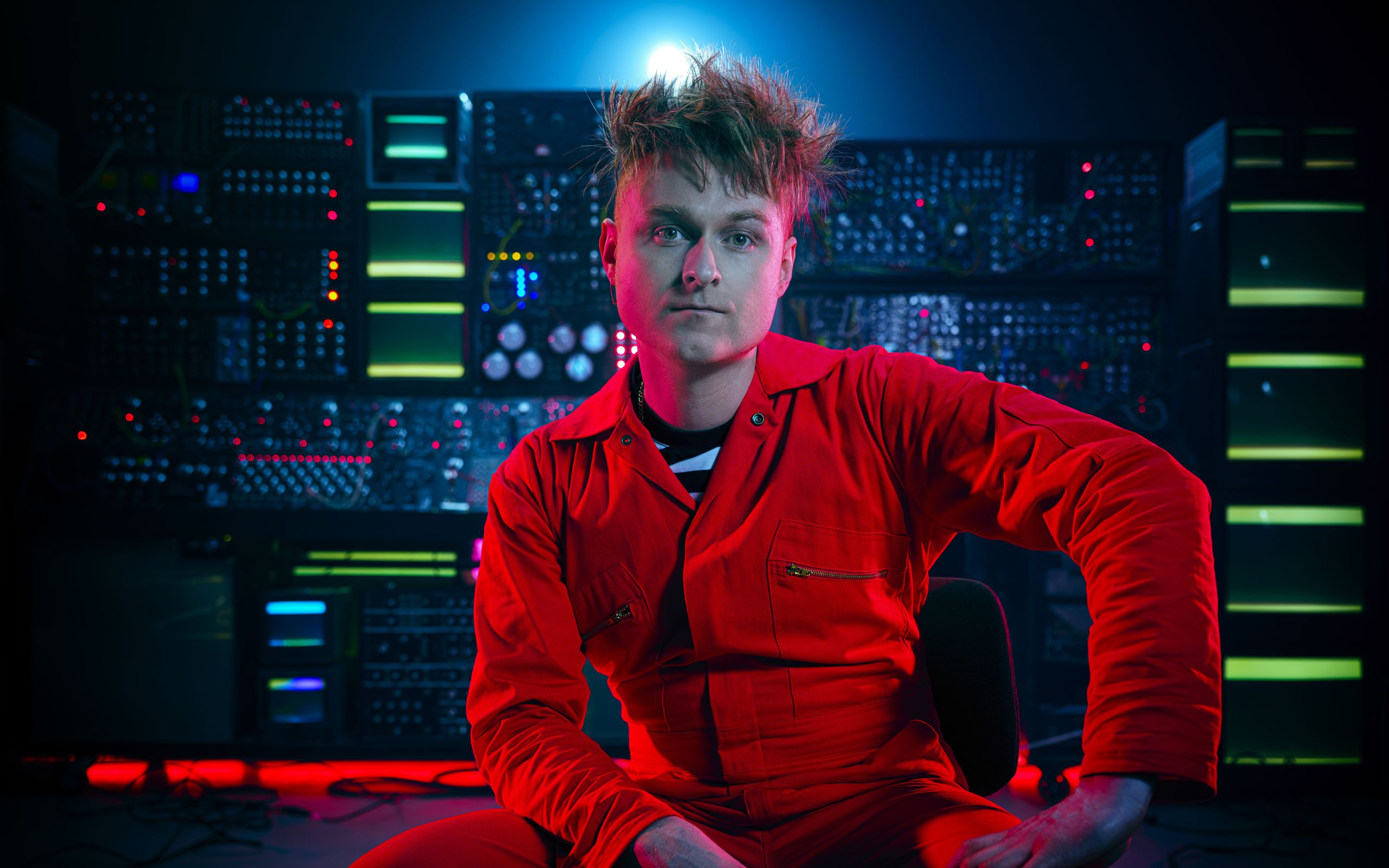
Sam Battle — performing as Look Mum No Computer — has built a 2.9 million YouTube subscriber following making music from absurd DIY instruments. His Eurovision entry Eins, Zwei, Drei is an electro-industrial art piece built around German-language vocals and modular synthesiser chaos. It is, by any conventional standard, the strangest entry the UK has sent to Eurovision since Brotherhood of Man won it in 1976.
Here is why 3.00 for UK last place looks low relative to Polymarket's 39%:
The Jury Problem
Professional juries evaluate entries on five criteria: vocal performance, composition, originality, on-stage presence, and overall impression. Eins, Zwei, Drei scores highly on originality — but originality alone does not win jury points, and the entry has specific weaknesses that professional panels tend to penalise.
Jury panels in 2026 include music professionals from all 37 participating nations, plus the Big 5 and Austria. The entry is German-language — which limits accessibility for non-German-speaking juries — and its compositional structure is deliberately unconventional. Whether this registers as artistic courage or deliberate inaccessibility depends entirely on the individual juror's frame of reference. Across 37 panels, the variance is enormous.
Look Mum No Computer's Grand Final betting odds for the outright winner are 81–420 depending on the bookmaker — the widest range for any single entry in the contest. This range reflects genuine uncertainty about whether the act is a cult classic or a musical joke. For last place betting purposes, that uncertainty favours last-place backers: an entry with this variance profile cannot be confidently priced below 35-40% for last place.
Historical UK Context
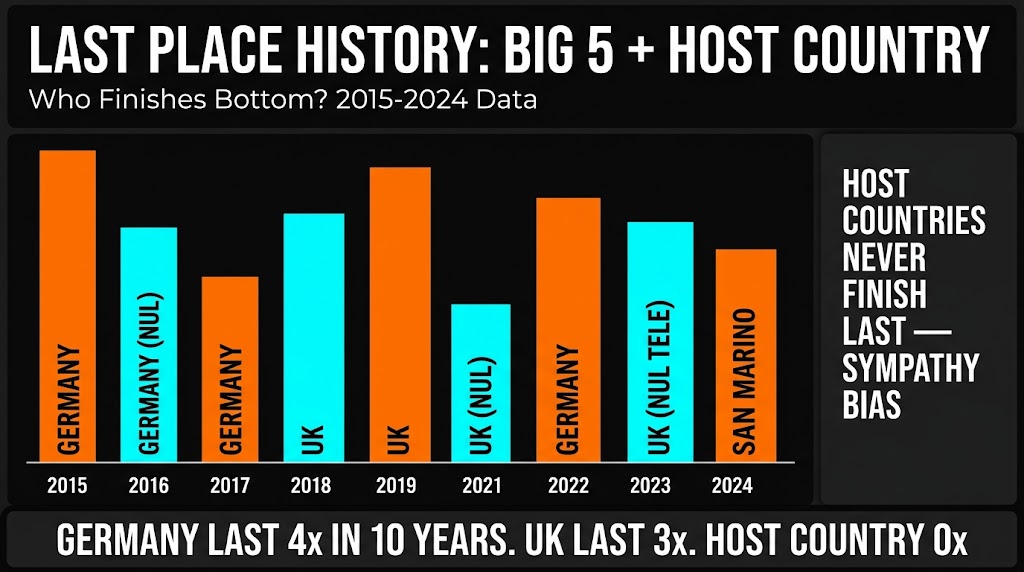
The UK's recent Eurovision record at the bottom of the scoreboard is not a coincidence:
- 2021: UK finished last with 0 points (James Newman, Embers). Nul points in both jury and televote. This remains the last Eurovision nul points finish for any country.
- 2023: Mae Muller (I Wrote a Song) received 0 televote points — saved from last by jury sympathy.
- 2018: SuRie (Storm) finished 24th after a stage invasion disrupted the performance.
- 2022: Sam Ryder (Space Man) bucked the trend with a 2nd place finish — the exception that proves the rule.
The UK has finished last or second-to-last four times in the past 10 contests. The structural reasons are well-documented: a combination of political voting patterns from European neighbours, the challenge of representing a country seen as culturally dominant, and a recent track record of selecting entries that prioritise artistic ambition over Eurovision-specific competitiveness. Eins, Zwei, Drei leans into that trend rather than away from it.
The 3.00 Offers Real Value
At 3.00, the implied probability is 33%. Polymarket traders — who have priced this at 39% — are telling you the 3.00 odds understate the true probability by 6 percentage points. At 3.50 (available at Unibet), the implied probability drops to 29%, making the discrepancy with Polymarket's 39% even larger. Both prices look attractive. The recommended entry point is Unibet at 3.50 — maximise the gap between implied and true probability.
Stake — Crypto Betting with Instant Payouts on Eurovision Last Place Markets
Why Austria Should Be Faded Despite Being Market Favourite

Bookmakers have Austria as the 24% last-place favourite. Polymarket prices Austria at 28%. Both markets agree that Cosmó's Tanzschein is a candidate for the bottom of the scoreboard. Our analysis disagrees — and here is why.
The Host Country Effect Is Real
In the modern era of Eurovision, no host country has ever finished last in the Grand Final. This is not coincidence — it is a structural feature of the contest's voting dynamics:
- Arena sympathy: The Wiener Stadthalle will contain thousands of Austrian fans during the Grand Final. The host country performance typically receives significant arena energy that influences the broadcast presentation.
- Jury goodwill: National jury panels tend to give host countries slightly elevated scores as a professional courtesy — not a conspiracy, simply a statistical pattern across decades of data.
- Political vote floor: Austria shares its region with Germany, Switzerland, Hungary, and the Czech Republic. These neighbours historically support each other in the televote, providing Austria with a baseline score that protects against last place.
The most relevant comparison is Norway 2010 (host, post-Alexander Rybak win). Norway finished 20th — below mid-table but nowhere near last. Portugal 2018 (host, post-Salvador Sobral win) finished 26th. Both entries were considered weak on paper. Neither finished last. The host country protection effect is consistently visible across the data.
Tanzschein Has a Jury Floor
Cosmó's Tanzschein is a dance-pop entry built around Viennese waltz rhythms. It is not artistically ambitious, but it is not deliberately inaccessible either. Professional jury panels — particularly those from neighbouring German-speaking countries — will give it moderate scores. The German, Swiss, and Luxembourgish juries are likely to provide points that prevent Austria from finishing last in the jury half.
The last-place risk for Austria is primarily in the televote, where the entry may not generate the kind of viral momentum that drives diaspora votes. But a weak televote score combined with moderate jury support does not produce last place — it produces a 22nd to 26th finish. That is the realistic floor for Austria, and it is well above last place.
Austria Last Place Is Overpriced
At 24% (2.75 odds), Austria's last-place probability is overestimated by both bookmakers and Polymarket. The historical host country protection, the jury floor from German-speaking neighbours, and the relative weakness of other candidates (UK, Germany) in the televote all point toward Austria avoiding last place. Austria to NOT finish last at 1.35 (implied 74%) is arguably the cleanest low-variance bet in this market.
Germany at 8%: The Historical Case

Germany's Sarah Engels (Fire) is priced at 8% last-place probability — bookmaker odds of 8.00-9.00. Polymarket has Germany at 11%, a 3-point premium over bookmakers. Neither market is radically mispriced here, but Germany's historical frequency at the bottom of the Eurovision scoreboard is worth examining.
Since 2014, Germany has finished in the bottom three of the Grand Final in six of ten contests: 2015 (last), 2016 (last), 2017 (last), 2019 (last), 2021 (second-to-last), 2022 (last). This is a structural pattern driven by Germany's neighbour-voting isolation (surrounded by Western European countries that tend to support each other but not Germany), the ARD selection process, and a recent history of choosing entries that miss the Eurovision-specific quality threshold.
Sarah Engels is a recognisable German pop artist — she appeared on DSDS (Germany's X Factor equivalent) in 2011 and has maintained a domestic fanbase. Fire is a conventional pop-dance entry with contemporary production. It does not feel like a deliberate last-place entry, and rehearsal reactions have been mixed but not catastrophic. The 8.00-9.00 odds on Germany last place represent genuine historical value — Germany's empirical frequency of bottom finishes far exceeds 8-11%.
Germany to finish last at 8.50 is a medium-confidence value bet, particularly as a small-stake each-way hedge against the primary UK position.
Thunderpick — 100% First Deposit Bonus on Eurovision Sub-Markets Including Last Place
Why the Bookmaker-Polymarket Gap Exists
The 17-point gap on UK last place is the central puzzle of this market. Understanding why the gap exists helps you decide which pricing to trust.
Bookmaker Anchoring Bias
Traditional bookmakers update last-place odds less frequently than winner or qualifier odds. The last-place market is a secondary market — it attracts lower volume than winner or top-5 markets, which means bookmakers devote fewer pricing resources to it and update it on a slower cycle. As a result, bookmaker last-place odds tend to be anchored to pre-contest entry assessments rather than real-time rehearsal signal.
Austria entered as a notionally weak host-country entry and was immediately placed near the top of last-place lists. That assessment has not been recalibrated based on the rehearsal evidence, which shows a reasonable (if not spectacular) staging from Cosmó. The bookmaker price is sticky.
Polymarket Reflects Recent Signal
Polymarket traders operate in real-time. The $87,265 in the last-place market reflects the accumulated judgment of traders who have watched rehearsal footage, read press centre reactions, and followed the momentum of UK coverage throughout the contest week. The UK's rehearsals have generated a specific type of coverage — significant press attention, strong fan polarisation, and multiple commentators noting that the entry is either a genius piece of performance art or a disaster — which is not a profile that tends to produce mid-table Eurovision finishes.
When press centre reaction is this divided, and when an entry has such high variance between 81/1 (outright win) and 3/1 (last place), the prediction market reads that as a structural last-place risk. The bookmaker reads it as uncertainty and sets a conservative price. Polymarket is almost certainly closer to the truth here.
What History Says About Polymarket Accuracy
Polymarket's published accuracy rate across resolved markets is approximately 94% for near-term event predictions. For Eurovision specifically, the platform correctly priced the 2024 and 2025 winner markets ahead of the shows, and its semi-final qualifier probabilities in 2025 were within 3 percentage points of the actual results for 12 of 15 SF1 entries. The platform's Eurovision track record is strong enough to take seriously when it diverges significantly from bookmakers.
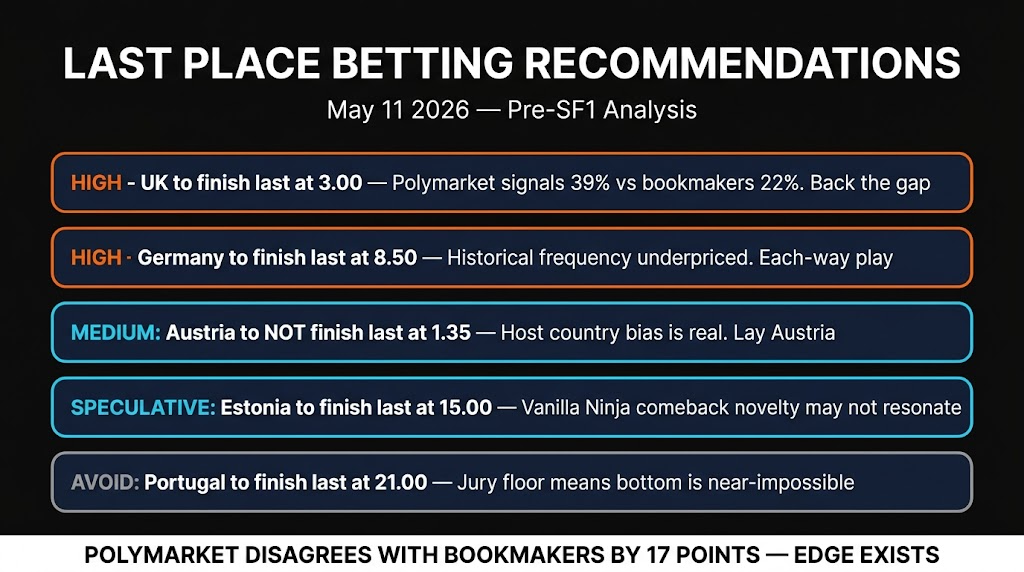
The Complete Betting Recommendations
Here is the structured betting guide for the Eurovision 2026 last-place market, ranked by confidence.
| Bet | Odds | Implied % | True % Estimate | Edge | Verdict |
|---|---|---|---|---|---|
| UK to finish last (Unibet) | 3.50 | 29% | ~38% | +9 pts | HIGH |
| UK to finish last (Bet365) | 3.00 | 33% | ~38% | +5 pts | HIGH |
| Germany to finish last | 8.50 | 12% | ~13-15% | +2 pts | MEDIUM |
| Austria to NOT finish last (lay) | 1.35 | 74% | ~80% | +6 pts | MEDIUM |
| Estonia to finish last | 13.00 | 8% | ~5% | -3 pts | AVOID |
| Portugal to finish last | 17.00 | 6% | ~3% | -3 pts | AVOID |
| San Marino to finish last | 15.00 | 7% | ~5% | -2 pts | AVOID |
Odds verified EurovisionWorld 11 May 2026. True % estimates derived from Polymarket market prices and historical base rates. Lay bet on Austria uses betting exchange implied price.
HIGH CONFIDENCE: UK to Finish Last
Eins, Zwei, Drei is the most polarising entry in Eurovision 2026. Its high variance — genuine ceiling and genuine floor — combined with the UK's structural bottom-finish history and Look Mum No Computer's deliberately experimental direction creates a last-place profile that Polymarket accurately reads at 39%. Bookmakers at 22-29% implied are providing real value. The Unibet price of 3.50 is the best available and the recommended entry point. Stake size: 3-4% of Eurovision bankroll.
MEDIUM CONFIDENCE: Germany Each-Way Hedge
Germany's historical base rate for bottom-three finishes (60% of contests since 2014) means 8.50 odds significantly understate the historical frequency. Sarah Engels is a more conventional entry than the UK, which limits her ceiling risk, but the same structural factors that have repeatedly dragged Germany to the bottom — political isolation, non-competitive selection process — remain in place. Small stake at 8.00-9.00 as a portfolio hedge alongside the primary UK position.
MEDIUM CONFIDENCE: Lay Austria
On a betting exchange, laying Austria to finish last at 1.35 (implied 74% that Austria will NOT finish last) is the cleanest risk-adjusted play in this market. The host country protection effect, jury floor from German-speaking neighbours, and historical data all support Austria avoiding last place. The 74% implied probability likely underestimates the true probability of Austria not finishing last, which is closer to 80%. Lay stakes in this market carry the risk of limited liability, so size accordingly.
Cloudbet — Up to 5 BTC Welcome Bonus on All Eurovision Sub-Markets
The UK Outright Win Odds Context
The same polarisation that creates UK last-place risk also creates a specific structural feature in the outright winner market. Look Mum No Computer's win odds range from 81/1 (some bookmakers) to as long as 420/1 (others). This is the widest range for any single entry in 2026, reflecting genuine disagreement about where the act sits on the quality spectrum.
Historically, entries with this kind of bimodal appeal profile — a genuine cult ceiling alongside a genuine bottom-finish risk — tend to resolve toward one extreme or the other. They are rarely mid-table. Eurovision is not a medium-result contest for experimental entries; the scoring system, which combines 37-nation jury votes with global televote, tends to amplify both peaks and troughs.
The cleaner trade is last place at 3.00-3.50 rather than speculative outright at 81-420. The last-place bet captures the downside resolution of UK's variance, while the outright bet at those odds requires the upside resolution. The asymmetric downside is the smarter play given the available pricing.
Semi-Final Qualifiers Could Change the Picture
One important caveat: the last-place market currently prices all 35 entries, including semi-finalists who have not yet qualified. Once SF1 (tomorrow, May 12) and SF2 (Thursday, May 14) confirm their qualifiers, the last-place market will re-price around the 26 confirmed Grand Final entries.
Specific semi-final entries that could impact the last-place market if they qualify:
- Estonia (Vanilla Ninja): Currently at 4% / 13.00 for last place. If Estonia qualifies and the Vanilla Ninja comeback novelty does not resonate with the Grand Final audience, this price could tighten.
- Azerbaijan (Jiva): At 3% / 21.00. If Jiva qualifies from SF2, their entry is structurally at risk of a bottom finish given Azerbaijan's recent history of staging-over-substance entries that underperform with European televote.
- San Marino (Senhit feat. Boy George): The most recognisable celebrity pairing in the contest, but San Marino historically provides minimal diaspora votes and relies entirely on the quality of the performance. If the entry qualifies from SF2 and the novelty of the Boy George pairing does not generate widespread televote support, last place odds of 15.00 look attractive.
Post-SF1 and post-SF2, update your position in the last-place market based on the confirmed Grand Final lineup. The UK and Germany prices are independent of semi-final results (both auto-qualified as Big 5). The Austria price may shift depending on how the host country's relative standing in the full 26-entry field changes once qualifiers are confirmed.
Frequently Asked Questions
Who is the current last-place favourite for Eurovision 2026?
Bookmakers make Austria the marginal last-place favourite at 24% probability (2.75 odds), with the UK just behind at 22% (3.00 odds). However, Polymarket prediction markets — with $87,265 traded — have UK as the clear favourite at 39%, compared to Austria's 28%. The 17-point gap between markets on the UK is the central feature of this market and suggests UK last place at 3.00-3.50 is underpriced by traditional bookmakers.
Has Austria, as the host country, ever finished last at Eurovision?
No. In the modern era of Eurovision, no host country has ever finished last in the Grand Final. Host countries benefit from arena sympathy, jury goodwill from neighbouring nations, and a baseline televote from domestic fans and regional neighbours. Austria's historical pattern of support from Germany, Switzerland, and Hungary provides a points floor that makes last place statistically unlikely, regardless of the quality of the entry itself.
Why has Germany historically finished last so often?
Germany has finished last or second-to-last in six of the past ten Grand Finals (2015, 2016, 2017, 2019, 2021, 2022). The structural reasons include: political voting isolation from immediate European neighbours, a selection process (DSDS-era and NDR commissioning) that has often chosen entries optimised for domestic audiences rather than the broader European market, and the psychological burden of being a large nation expected to perform well but consistently underperforming. Sarah Engels is a more commercially viable entry than several of Germany's recent representatives, which explains why 8.00-9.00 is roughly fair rather than dramatically underpriced.
Can UK genuinely win Eurovision with the same entry that might finish last?
Yes — and this is the central characteristic of Look Mum No Computer's entry. Eins, Zwei, Drei is genuinely bimodal in its potential reception: jury panels that respond to originality and technical composition could rank it highly, while panels that prioritise accessibility and conventional song structure could rank it near the bottom. The 81/1 to 420/1 range for the outright win versus 3.00-3.50 for last place reflects this binary distribution. Experimental entries that polarise professional opinion tend to produce extreme results — not mid-table finishes.
When will last-place odds become most accurate?
Last-place odds will be most information-rich after both semi-finals have confirmed the Grand Final lineup (after SF2 on Thursday May 14). At that point, the market narrows from 35 potential entries to 26 confirmed qualifiers. The UK and Germany prices will not change based on semi-final results, but the relative standings and price movements of bubble entries (Estonia, Azerbaijan, San Marino) will clarify once the full field is confirmed. Monitor EurovisionWorld and Polymarket through Friday May 15 for the most accurate pre-Grand Final last-place pricing.
Is last place the same as nul points in Eurovision 2026?
No. The last-place bet resolves on finishing in 26th place in the Grand Final — it does not require nul points. In fact, nul points has become nearly impossible in the modern Eurovision format: with both jury (50%) and televote (50%) contributions, an entry would need to receive zero points from all 37 national juries AND from the global televote simultaneously. The last genuine nul points finish was the UK in 2021. Since 2022, the lowest-scoring entries have still accumulated 20-50 points. The last-place bet is purely about finishing position, not score.
Related Articles
- UK's Look Mum No Computer: Odds Collapse to 80/1 — Full Analysis
- Germany Sarah Engels — Fire: Second Rehearsal and Grand Final Betting
- Austria Cosmó — Tanzschein: Host Country Grand Final Betting Analysis
- Big Five Rehearsal Recap: France, Italy, UK, Germany, Austria Odds Movements
- Each-Way Eurovision Betting Tips: Best Value Picks for 2026
- Jury vs Televote Betting Strategy: How to Split Your Eurovision Wagers
All odds sourced from EurovisionWorld last place market and Polymarket Eurovision Last Place 2026, verified 11 May 2026 at 09:58 CEST. 18+. Please gamble responsibly. BeGambleAware.org. When the fun stops, stop.