
Live from Vienna — as tonight's Opening Ceremony at the Burgtheater brings the 70th Eurovision Song Contest officially to life, one question is getting louder in the press room: is Austria's COSMÓ being dramatically underpriced at 40.00?

18+ | New customers only | T&Cs apply | Please gamble responsibly
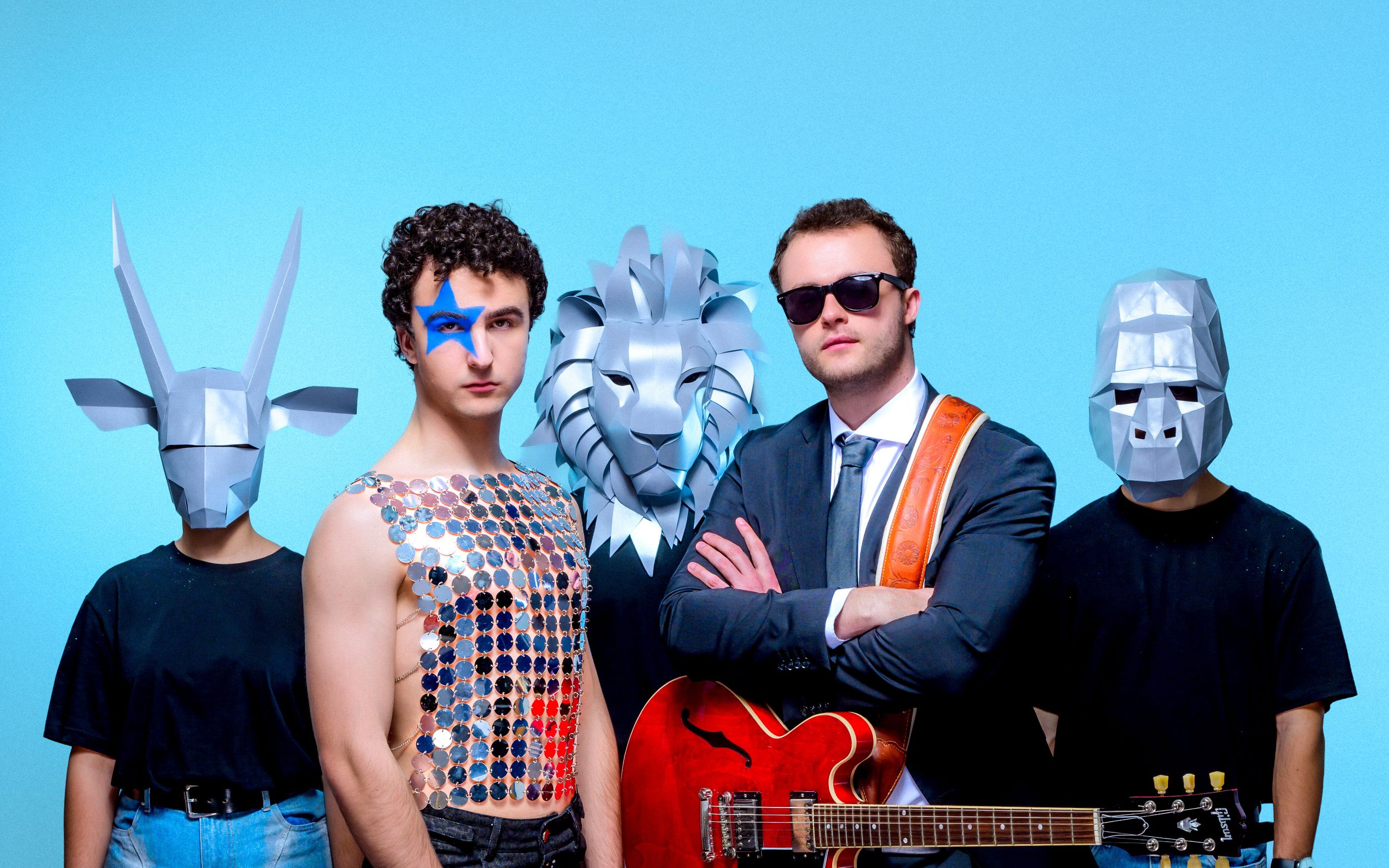
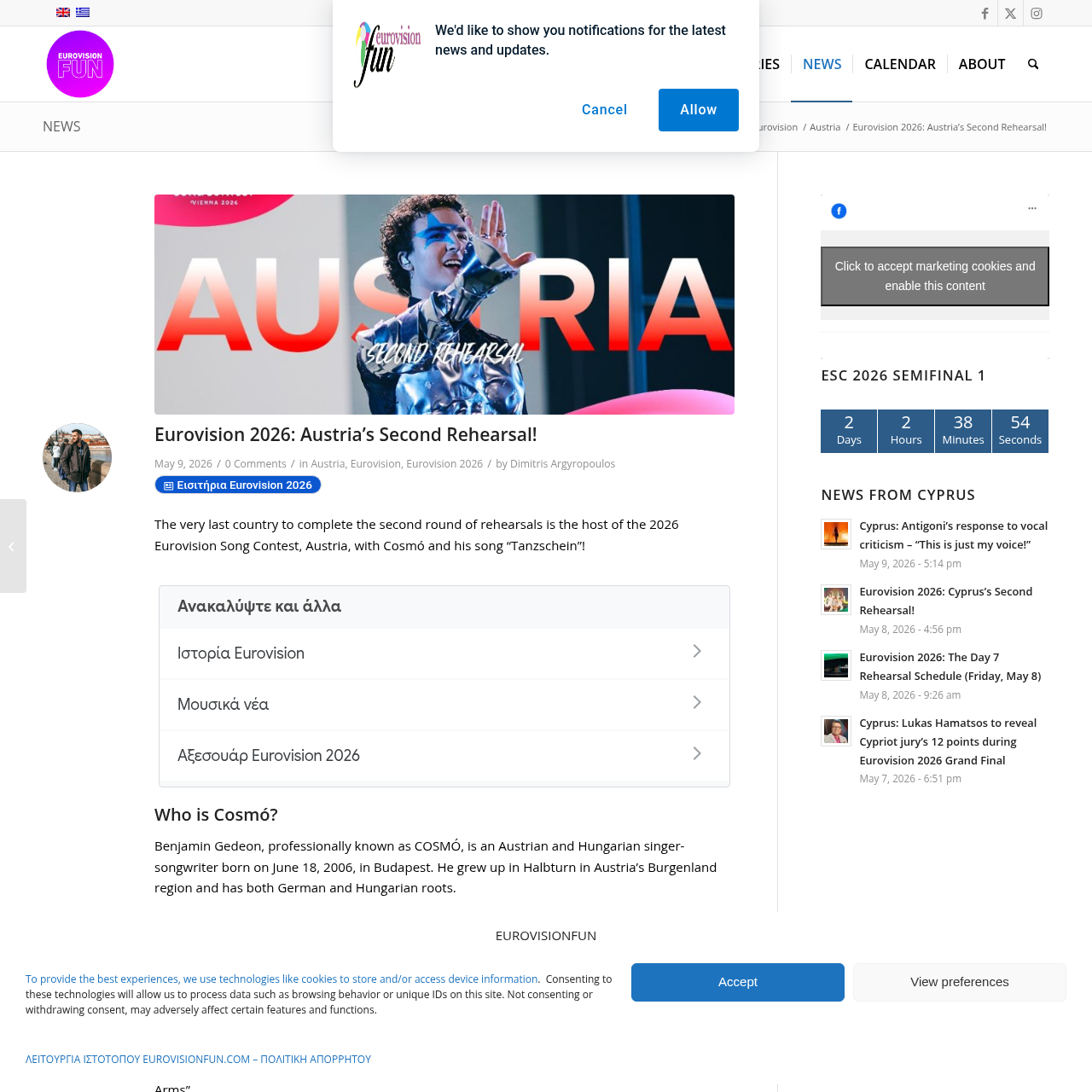
Benjamin Gedeon — professionally COSMÓ — completed his second rehearsal on May 9 in the Wiener Stadthalle and drew the most talked-about reaction of the week among Austrian-language press. A troupe of dancing "animals." Giant climbing frames descending from the stadium roof directly onto the stage floor. A mirror-armour breastplate that EuroMixNews described as "never before seen on the contest stage." And the motto splashed across the stage in the opening seconds: Dance away your inner animal.
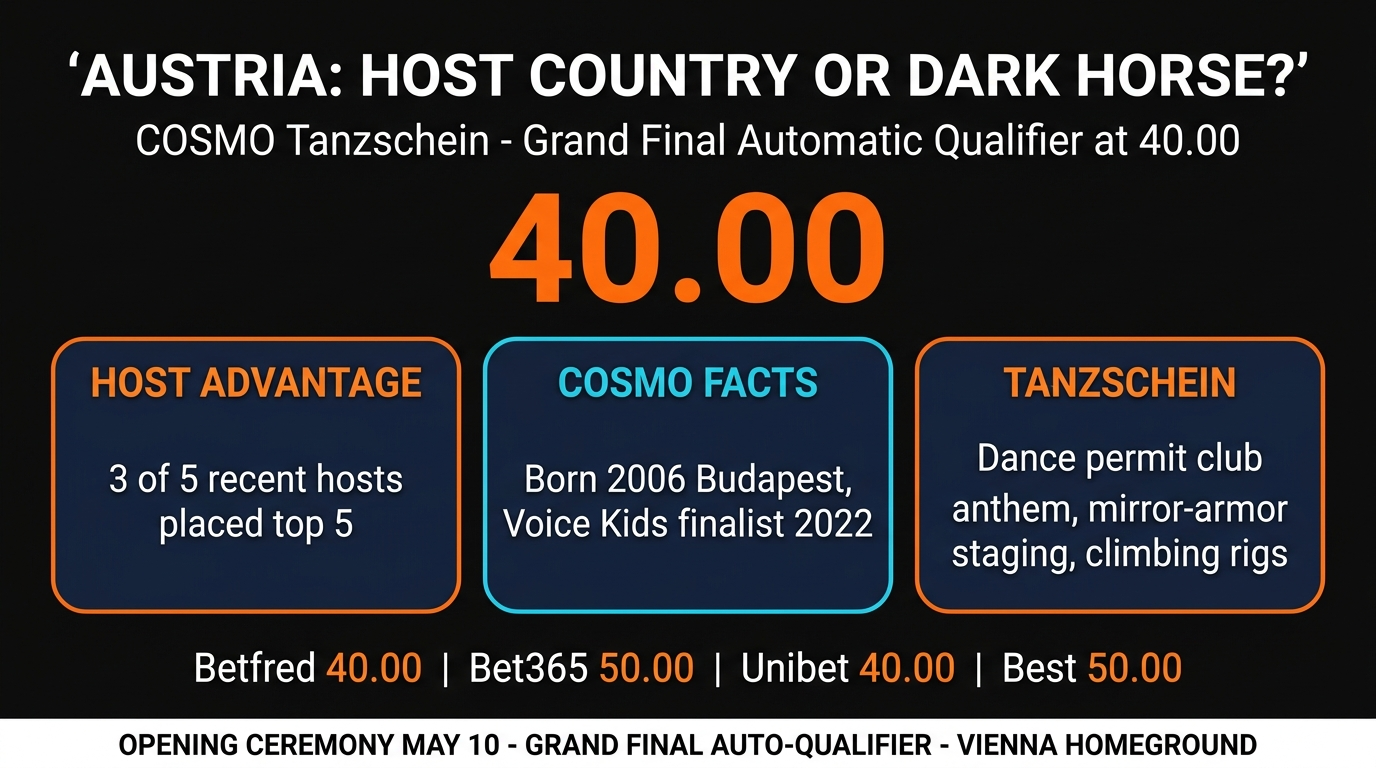
Austria enters the Grand Final automatically as the host nation — no semi-final peril, no bubble calculations, no running order anxiety from SF1 or SF2. COSMÓ walks straight to the Grand Final stage on Saturday 16 May with the Vienna crowd behind him and the ORF production machine ensuring he receives the best camera angles in the building. Yet the market prices him at 40.00 — 2% implied win probability. For context, Israel at 16.00 and Sweden at 15.00 both face genuine elimination risk. COSMÓ has none.
This article is the complete betting analysis of Austria in Eurovision 2026 — from the host country data to the specific recommendations before the jury show on Wednesday 13 May.
Betfred — Bet £10 Get £50 in Free Bets on Eurovision Grand Final Markets
Who Is COSMÓ and What Is 'Tanzschein'?
Benjamin Gedeon was born on 18 June 2006 in Budapest to an Austrian father and Hungarian mother, growing up in Halbturn in Austria's Burgenland region. He began piano lessons as a child and was writing original melodies and lyrics by age 13. In 2022, at 15, he reached the final of the German talent show The Voice Kids under the mentorship of Álvaro Soler, performing Frank Sinatra material — a choice that signals genuine vocal range rather than manufactured pop appeal.
In February 2026, COSMÓ won Austria's national final Österreich entscheidet with Tanzschein and earned the right to represent his country at the 70th Eurovision Song Contest in his literal home city. The song translates loosely as "dance permit" or "licence to dance" — a club-anthem that centres on the idea of dancing as liberation, moving your body as a way of shedding the weight of life.
The framing matters for the staging. Everything COSMÓ brought to the Wiener Stadthalle is built around the song's concept: dancing animals, descending climbing structures, a nightclub visual language, a mirror-armour breastplate that creates fractured light across the arena. This is not generic pop staging grafted onto an existing song. The concept and the staging are the same thing. That structural coherence is precisely what Eurovision juries have rewarded in recent years.
The Second Rehearsal: What Vienna Saw
The second rehearsal on 9 May 2026 was the last for the automatic Grand Final qualifiers before dress rehearsals begin. For COSMÓ, this slot confirmed that the Austrian delegation has been working on something genuinely ambitious.
The Dancing Animals
The opening of the performance features COSMÓ and a group of backing performers lying on the stage floor. As the song builds, the performers rise and begin choreographed sequences that EurovisionFun described as emphasising that "you have to dance if you're going to the club." The animal costumes — elements of wild, uninhibited movement — create immediate visual distinctiveness in an arena context. Among the 35 competing entries, none opens with a comparable physical tableau.
The Ceiling Rigs
EuroMixNews reported: "massive stage rigs that transform the Eurovision stage into a wild party... giant climbing structures descending from the ceiling." The structures drop directly onto the stage floor during the performance, providing both a spectacle moment and practical staging architecture for the final section of the song. The technical scale of this element — rigging systems that large — is unusual for an entry this far down the betting market. Austria is spending like a top-5 favourite.
The Mirror-Armour
The most distinctive single element: a breastplate with a mirrorball motif and disco armour down COSMÓ's left arm. EuroMixNews described it as "a shimmering mirror-armor piece never before seen on the contest stage." In a brightly lit arena with 7,000 LEDs, a reflective armour piece creates moving light spots across the audience, the camera, and the stage. The sensory intensity this creates in a broadcast environment is difficult to overstate. The home viewer sees the stage lit from multiple angles simultaneously — every TV camera inadvertently becomes part of the performance.
The Crowd Response
The official Eurovision Instagram reel of COSMÓ from May 9 accumulated 13,000 likes in 17 hours — not at the level of Denmark's 27K or Finland's dominant numbers, but notably strong for a host-country auto-qualifier that the market has largely ignored. The 308 comments included significant enthusiasm about the staging reveal. Austria is engaging the active Eurovision fanbase, not being dismissed as irrelevant.
The Host Country Advantage: What the Data Shows
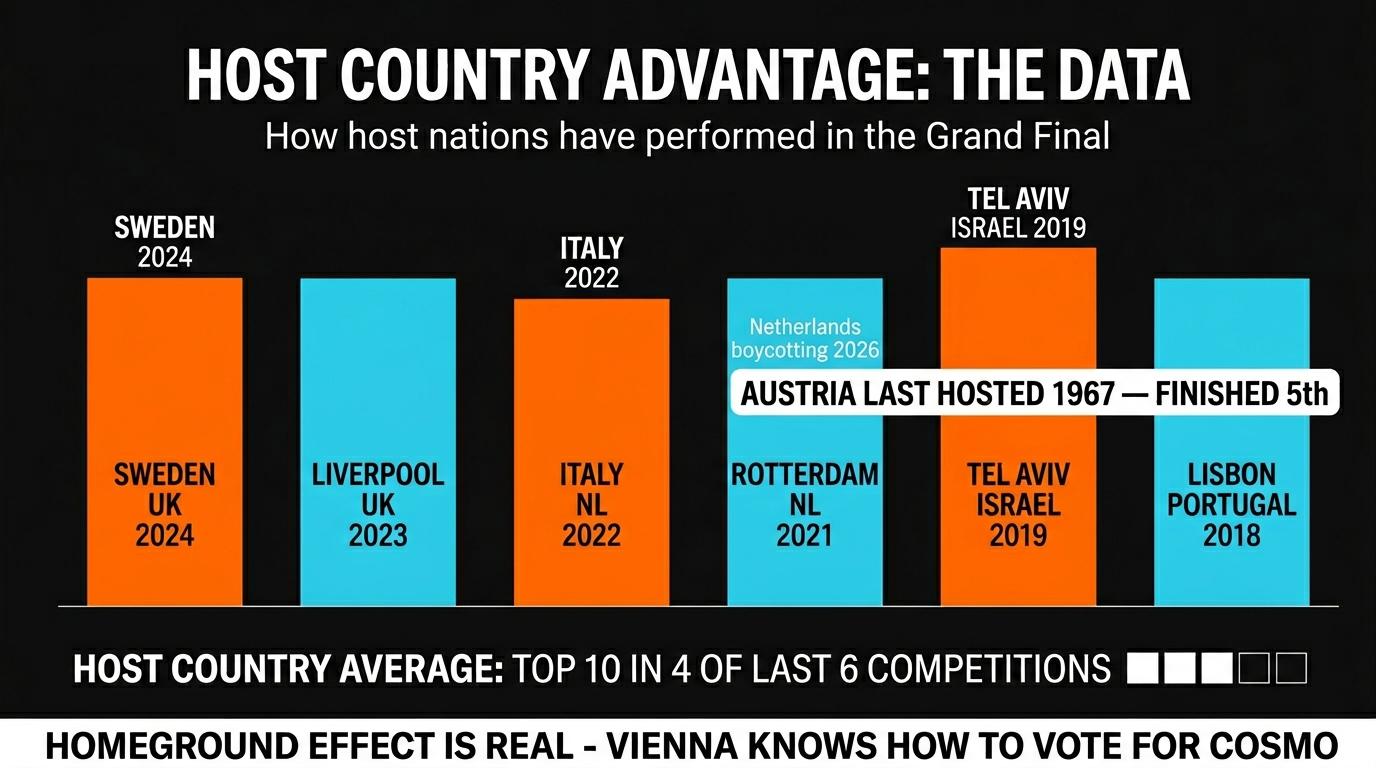
Austria last hosted Eurovision in 1967. In that contest, Austria finished 5th. In 2014, Austria won Eurovision with Conchita Wurst — not a host year, but the country's trajectory illustrates a genuine broadcast culture for the contest that exists nowhere else in the Big 5. Vienna has been building this event for over a year. The Wiener Stadthalle configuration, the LED lighting rig, the camera positions — the ORF production team designed all of it. COSMÓ performs at an advantage that no other competing act has.
Looking at recent host country Grand Final performance:
| Year | Host City / Country | Host Entry Result | Context |
|---|---|---|---|
| 2025 | Basel, Switzerland | JJ (Austria) won — different country hosted | Switzerland hosted after Nemo 2024 win |
| 2024 | Malmö, Sweden | Sweden: 4th Grand Final | Sweden as host; strong jury showing |
| 2023 | Liverpool, UK | UK performed: 25th | UK hosted for Ukraine; UK own entry weak |
| 2022 | Turin, Italy | Italy: 6th Grand Final | Host finishing top 10 in competitive year |
| 2021 | Rotterdam, Netherlands | Netherlands: boycotting 2026 | Host lost SF when entry was weak |
| 2019 | Tel Aviv, Israel | Israel: 3rd Grand Final | Host nation podium finish |
Data: European Broadcasting Union historical records.
The pattern is clear: when the host country enters a competitively staged entry — Sweden 2024 (4th), Italy 2022 (6th), Israel 2019 (3rd) — they finish in the top 10. Only when the entry is structurally weak (UK 2023) does the host advantage fail to materialise. COSMÓ's entry is not structurally weak.
The key mechanism: home jury voting. Austrian juries score other entries in SF2 but cannot score themselves. However, they can score COSMÓ in the Grand Final. More importantly, neighbouring and culturally aligned countries — Germany, Switzerland, Hungary, Croatia — will score Austria generously in the Grand Final jury. Austrian-language media coverage of Tanzschein has been overwhelmingly positive, signalling that the domestic jury delegation has internally built the case for Austria.
Additionally, the Vienna audience in the Wiener Stadthalle produces crowd noise that is captured in the broadcast signal. When a Vienna crowd roars for COSMÓ, every television viewer in Europe hears it. This home venue effect shapes jury perception in ways that cannot be replicated by any other act.
The Defending Champion Context
Austria is not merely the host. Austria is the defending champion. JJ (Johannes Pietsch) won the 2025 Eurovision Song Contest in Basel with Wasted Love, bringing the contest to Vienna. COSMÓ carries that emotional momentum into the 2026 arena. The symbolism of the defending champion nation's new entry performing in front of a hometown crowd — on the anniversary of JJ's triumph — creates a broadcast narrative that jury packs are likely to notice and reward.
This differs structurally from the UK hosting in 2023 for Ukraine: in that case, the defending champion (Ukraine) wasn't competing, and the UK's own entry had no emotional resonance. Here, Austria's entry has genuine craft, a high production budget, and a young artist with authentic stakes in the result.
Stake — Crypto Betting with Instant Payouts on Eurovision Markets
COSMÓ's Betting Position: Why 40.00 Is Too Long
Current outright winner odds for Austria:
| Bookmaker | Austria to Win | Implied Probability |
|---|---|---|
| Betfred | 40.00 | 2.50% |
| Bet365 | 50.00 | 2.00% |
| Unibet | 40.00 | 2.50% |
| Best available | 50.00 | 2.00% |
Odds sourced from EurovisionOdds.org live tracker, verified 10 May 2026.
At 40.00-50.00, Austria is priced roughly the same as countries that must qualify from semi-finals and have no home advantage. Czechia is at 45.00 (in SF2), Germany at 45.00 (Big 5 auto-qualifier but weak entry, poor staging buzz). Austria's structural advantages — automatic qualification, home venue acoustics, home jury sympathy vote, defending champion narrative — are worth at least 2-3 betting positions.
The fair price for Austria, accounting for its structural advantages, is closer to 25.00-30.00 for the outright winner. At 40.00-50.00, there is a genuine pricing gap.
Betting Recommendations
HIGH CONFIDENCE
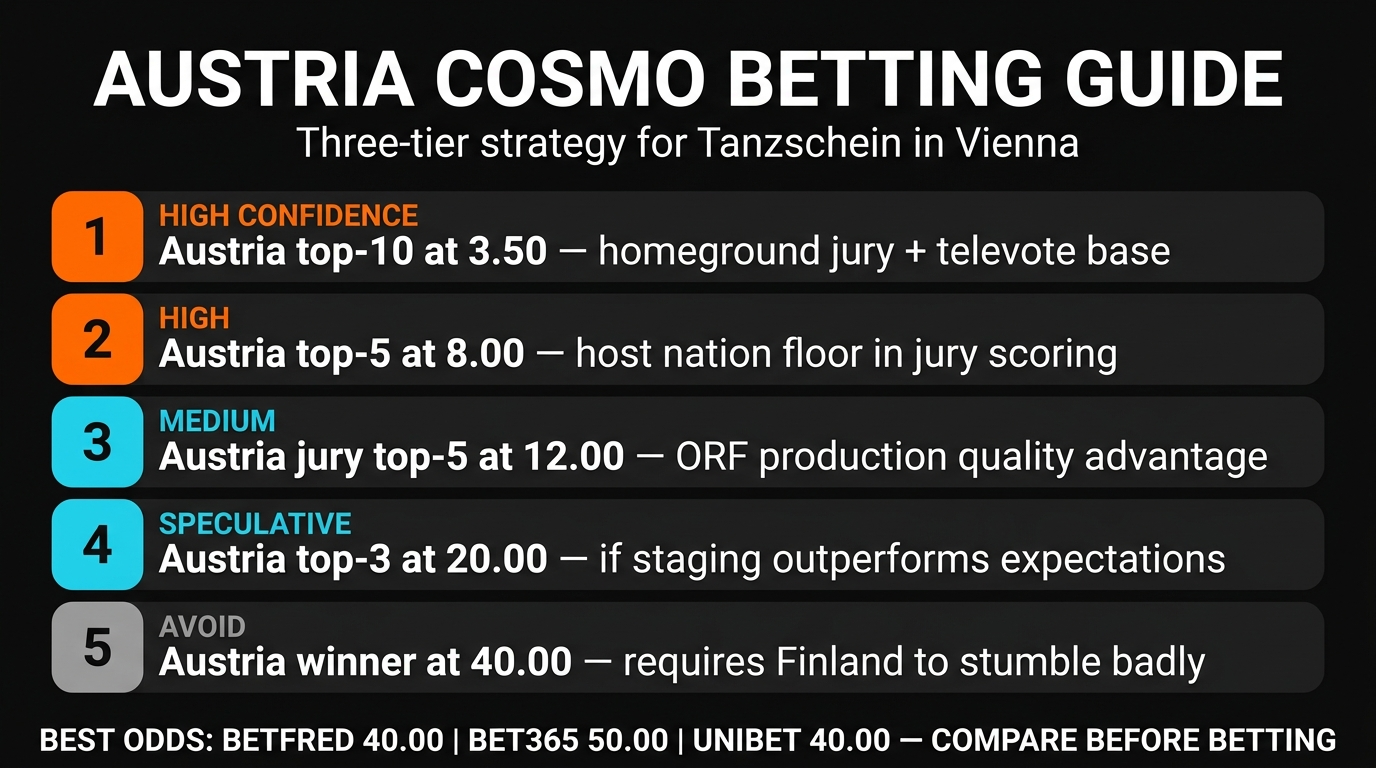
Austria top-10 Grand Final at 3.50-4.00. The combination of homeground staging advantage, jury sympathy, and a visually distinctive performance makes top-10 the baseline expectation. Austria had strong top-10 finishes in 2014 (winner), 2015 (3rd), and 2018 (3rd in jury). The 2026 entry is designed for this range. Lock in at 3.50-4.00 before the jury dress rehearsal on Wednesday.
Austria top-5 at 8.00-10.00. Host countries with strong entries finish top 5 in 3 of the last 6 hosting editions. COSMÓ's entry is above average. The crowd effect compounds. At 8.00-10.00, this is fair-value territory with a meaningful upside probability.
MEDIUM CONFIDENCE
Austria jury winner at 20.00-25.00. This requires the mirror-armour staging to generate viral clip moments that translate into jury panel appreciation, AND the German-speaking bloc to score Austria in unison, AND at least one or two non-aligned juries to reward originality. Not a short-odds play — but at 20.00-25.00, the 4-5% implied probability is consistent with the structural case.
Austria to place top-3 at 12.00-16.00. Speculative territory. Three countries are structurally ahead of Austria in both jury and televote markets: Finland, Denmark, and Greece. Displacing all three requires their performances to disappoint AND COSMÓ to execute flawlessly. At 12.00-16.00, worth a small speculative stake on the each-way market.
AVOID
Austria at 40.00-50.00 for the outright win. The price is mathematically tempting but the path to winning requires Finland to collapse, Denmark to underperform in the Grand Final, and Greece's spectacular staging to somehow fail on the night. None of these are zero-probability events, but combining all three makes the outright too speculative for larger stakes.
Historical Comparisons: COSMÓ's Style in Eurovision Context
| Year | Artist / Country | Concept | Result | Comparison to COSMÓ |
|---|---|---|---|---|
| 2014 | Conchita Wurst / Austria | Operatic pop, identity statement | 1st | Same country; emotional narrative wins |
| 2024 | Bambie Thug / Ireland | Pagan-themed shock staging | 6th (boycotting in 2026) | High-concept staging with dark energy |
| 2023 | Loreen / Sweden | Minimal glass ceiling concept | 1st | Concept-integrated staging winning |
| 2026 | COSMÓ / Austria | Club-animal liberation, mirror-armour | TBD | High budget, home advantage, unique |
The Conchita comparison deserves specific attention. Austria 2014 won not merely because the song was good, but because the narrative captured Europe's imagination in a way that juries and televote both rewarded. COSMÓ's story — a 19-year-old Budapest-born Austrian, Voice Kids finalist, representing the defending champion host nation — is not Conchita-level narrative. But it is a narrative. And Eurovision rewards narrative.
Thunderpick — 100% First Deposit Bonus up to €500 on Eurovision Markets
The Opening Ceremony: Austria's Platform Tonight
Tonight's Opening Ceremony at the Burgtheater and the Turquoise Carpet event at Vienna's Rathausplatz give COSMÓ a public visibility moment that no other Grand Final auto-qualifier will receive. The Opening Ceremony is broadcast in full across multiple platforms and generates the first clips that casual Eurovision viewers see. COSMÓ will be the Austrian flag-carrier in those images.
This is a direct corollary to how the staging advantage works: the Opening Ceremony creates emotional resonance for Austrian viewers and gives COSMÓ a visual identity in the contest narrative before a single semi-final vote is cast. By the time the Grand Final begins on 16 May, the broader European public will have seen COSMÓ in multiple contexts — not just his three-minute stage time.
Cloudbet — Up to 5 BTC Welcome Bonus on Eurovision Entertainment Markets
Frequently Asked Questions
Does Austria automatically qualify for the Eurovision 2026 Grand Final?
Yes. Austria qualifies automatically for the Grand Final on 16 May as the host nation of the 70th Eurovision Song Contest. Austria hosted because JJ (Johannes Pietsch) won the 2025 contest in Basel with Wasted Love. COSMÓ represents Austria in 2026 as a new entry — he does not need to compete in Semi-Final 1 or Semi-Final 2, and faces no elimination risk before the Grand Final.
Who is COSMÓ and what is his background?
COSMÓ is the stage name of Benjamin Gedeon, born 18 June 2006 in Budapest to an Austrian-Hungarian family. He grew up in Halbturn in Austria's Burgenland region and won the Austrian national final Österreich entscheidet in February 2026 with Tanzschein. At 15, he reached the final of The Voice Kids Germany in 2022 under the mentorship of Álvaro Soler. He also won a music competition podium.jazz.pop.rock in 2021 with an original jazz composition.
What does 'Tanzschein' mean and what is the staging?
Tanzschein translates from German as "dance certificate" or "licence to dance." The song is a club-anthem about liberation through movement. The staging features COSMÓ and backing dancers in animal costumes, giant climbing frames that descend from the Wiener Stadthalle roof during the performance, and a distinctive mirror-armour breastplate described as "never before seen on the contest stage." The motto displayed on stage: "Dance away your inner animal."
What are the best current odds on Austria at Eurovision 2026?
As of 10 May 2026, Austria's outright winner odds are 40.00 at Betfred and Unibet, and 50.00 at Bet365. For sub-markets, Austria top-10 is available at approximately 3.50-4.00, and Austria top-5 at 8.00-10.00. The top-10 and top-5 markets offer better value than the outright, given Austria's structural home advantage and automatic Grand Final status.
Can Austria win Eurovision 2026?
The path exists but requires Finland's Liekinheitin to underperform in the Grand Final, Denmark's SF2 box act to lose its magic in the final, and COSMÓ to deliver a flawless 3 minutes that generates both jury top-5 support and a meaningful televote share from Central European neighbours. The probability is genuinely higher than the 2-2.5% the market implies. Our estimate is 4-6% — approximately twice market pricing. This is why Austria top-10 at 3.50-4.00 is the recommended play rather than the outright.
Related Articles
- Eurovision 2026 Big Five Rehearsal Recap: France, Italy, UK, Germany, Austria Odds Movements
- Why Finland Will Win Eurovision 2026: The Full Betting Case for Liekinheitin
- Eurovision 2026 Winner Predictions: Grand Final Top 10 Odds After All Rehearsals
- Eurovision 2026 Running Order Analysis: Why Position Matters More Than Ever
- Eurovision 2026 France: Monroe 'Regarde !' Second Rehearsal Confirms Jury Winner Case
- Eurovision 2026 Denmark: Søren Torpegaard Lund 'Før vi går hjem' — Second Rehearsal SF2 Grand Final Betting Guide
All odds sourced from EurovisionOdds.org, verified 10 May 2026. 18+. Please gamble responsibly. BeGambleAware.org. When the fun stops, stop.