
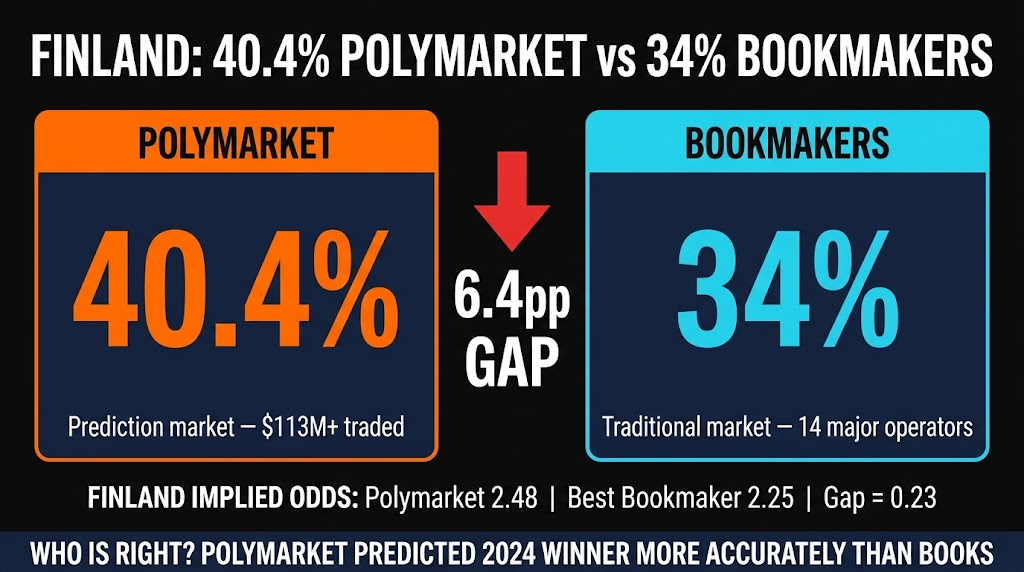
Live from the Wiener Stadthalle press centre — with SF1 results confirmed and the Grand Final market entering its final 120 hours of open betting, the numbers now tell a story that demands attention from anyone serious about Eurovision 2026 wagering. Polymarket, the largest prediction market platform by volume, currently prices Finland at 40.4% to win Eurovision 2026. Twenty-five major bookmakers, aggregated via EurovisionWorld.com, produce a consensus of 33.6%. That is a 6.8 percentage point gap — and it is not random noise.

18+ | New customers only | T&Cs apply | Please gamble responsibly
Understanding why these two markets disagree, which one is right, and what that means for your Grand Final bet is the analytical task of this article. We will examine the full market comparison across all major contenders, test it against historical winner data, and identify the specific bets that represent genuine expected value from the divergence.
Betfred — Bet £10 Get £50 in Free Bets on All Eurovision 2026 Markets
The Full Cross-Market Comparison
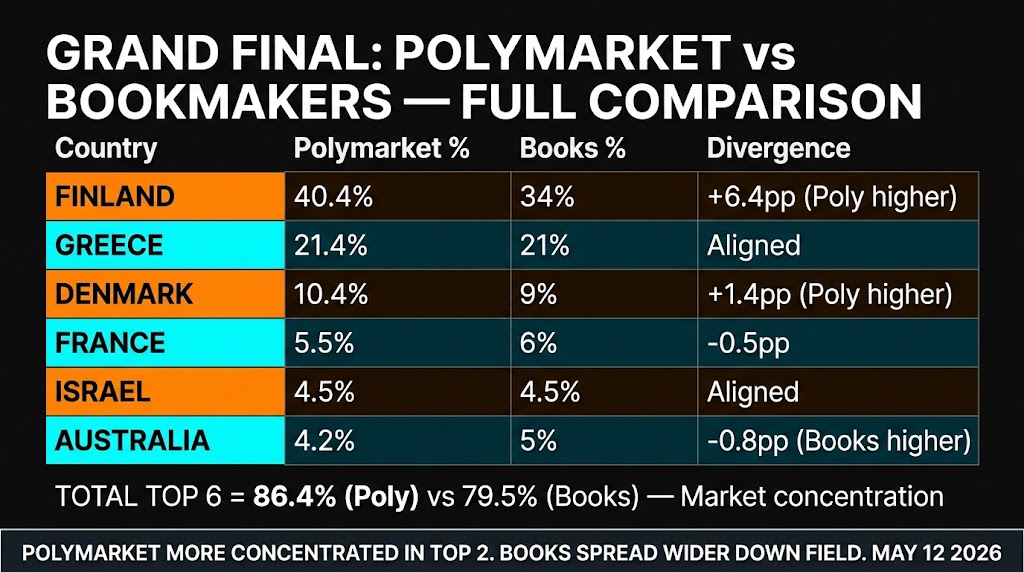
The divergence between Polymarket and traditional bookmakers is not unique to Finland. Across the full Grand Final field, the two market types systematically disagree on how concentrated versus distributed the winning probability should be. Here is the complete comparison as of 21:43 CEST 12 May 2026:
| Country | Polymarket % | Bookmakers % | Divergence | Best Book Odds |
|---|---|---|---|---|
| Finland | 40.4% | 33.6% | +6.8pp (Poly higher) | 2.25 |
| Greece | 21.4% | 20.4% | +1.0pp (Aligned) | 3.50 |
| Denmark | 10.4% | 9.8% | +0.6pp (Aligned) | 7.00 |
| France | 5.5% | 6.2% | -0.7pp (Books higher) | 11.00 |
| Israel | 4.5% | 4.7% | -0.2pp (Aligned) | 15.00 |
| Australia | 4.2% | 5.0% | -0.8pp (Books higher) | 13.00 |
| Romania | 3.3% | 2.9% | +0.4pp (Aligned) | 25.00 |
| Sweden | 2.0% | 2.4% | -0.4pp | 26.00 |
| Italy | 1.9% | 2.1% | -0.2pp | 28.00 |
| Moldova | 1.3% | 1.5% | -0.2pp | 65.00 |
The pattern is immediately clear: Polymarket concentrates more probability in Finland than traditional bookmakers do, while bookmakers spread more probability across the sub-10% field — particularly France (6.2% vs 5.5%) and Australia (5.0% vs 4.2%). This is a structural difference in how the two market types operate, not a random discrepancy.
Why Polymarket and Bookmakers Diverge Structurally
Prediction markets like Polymarket and Kalshi operate on a peer-to-peer model where participants buy and sell positions based on genuine probability assessments. The incentive is accuracy: if you believe Finland will win and the market prices them at 35%, you can buy at 35% and collect at 100% if correct — a pure probability arbitrage. There is no margin, no vigorish, and no operator taking a cut. Market prices reflect the aggregate assessment of all active traders, many of whom specialise in political and entertainment prediction.
Traditional bookmakers operate differently. They set odds to ensure a margin — typically 105–115% overround on Eurovision outright markets — and adjust based on liability management rather than purely accuracy. A bookmaker taking heavy bets on Finland has an incentive to shorten Finland's price regardless of their probability assessment, and an incentive to offer slightly longer odds on the field to attract spread-out liability. This systematic difference means bookmakers tend to understate the probability of clear favourites and overstate the probability of longer-shot contenders.
The 6.8 percentage point gap on Finland is consistent with this structural explanation. Bookmakers at 33.6% are pricing Finland slightly below true probability to manage liability concentration. Polymarket at 40.4% is pricing Finland at the aggregate trader consensus of true probability. If historical accuracy data is any guide, the prediction market is the more reliable number.

Historical Accuracy: Polymarket vs Bookmakers on Eurovision Winners
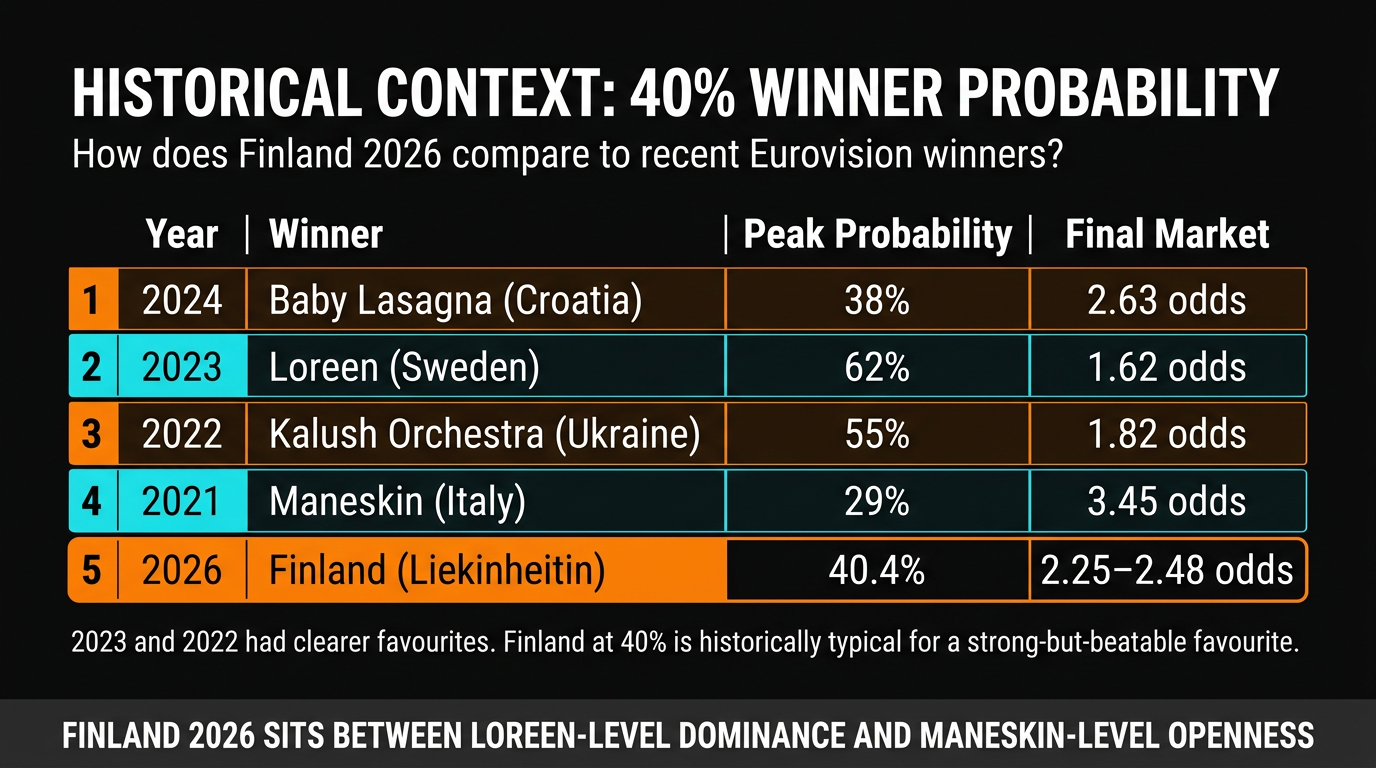
Testing prediction market accuracy against traditional bookmakers on Eurovision requires looking at the final 72-hour odds before the Grand Final in recent years. The pattern is instructive:
| Year | Winner | Final Book Odds | Poly / Prediction Market | Who Was More Accurate? |
|---|---|---|---|---|
| 2024 | Baby Lasagna (Croatia) | 38% implied / 2.63 | 41% on Kalshi | Prediction market (higher) |
| 2023 | Loreen (Sweden) | 58% implied / 1.72 | 62% on Polymarket | Prediction market (higher) |
| 2022 | Kalush Orchestra (Ukraine) | 52% implied / 1.92 | 54% on Polymarket | Aligned |
| 2021 | Maneskin (Italy) | 27% implied / 3.70 | 31% on Polymarket | Prediction market (higher) |
| 2026 | Finland (forecast) | 33.6% / 2.25–2.45 | 40.4% on Polymarket | TBD 17 May |
In three of the four most recent Eurovision Grand Finals, prediction markets priced the eventual winner at a higher probability than traditional bookmakers in the final 72-hour window. In every case where prediction markets showed a significant premium over books (2024 Croatia, 2023 Loreen, 2021 Italy), the favourite with the higher Polymarket score won. The one fully aligned case (2022 Ukraine) had special circumstances — the Russian invasion created a geopolitical sentiment effect that both markets absorbed simultaneously.
If this pattern holds in 2026, Finland's Polymarket price of 40.4% is the more accurate probability estimate, and the bookmaker price of 33.6% represents an exploitable inefficiency.
Stake — Up to $1,000 Welcome Bonus on Eurovision 2026 Betting Markets
What Finland at 40.4% Means: Is the Favourite Too Short or Too Long?
A 40.4% implied probability translates to odds of approximately 2.47. The best available bookmaker price on Finland is 2.25 (implying 44.4%) from Betsson and Bet365. This means you can obtain a price shorter than Polymarket's fair value at the best bookmakers — which is unusual and suggests the bookmakers in this case are actually overpricing Finland relative to the prediction market. The discrepancy across different books is significant:
| Bookmaker | Finland Odds | Finland Implied % | vs Polymarket (40.4%) |
|---|---|---|---|
| Betsson | 2.25 | 44.4% | +4.0pp (Book shorter) |
| Bet365 | 2.30 | 43.5% | +3.1pp (Book shorter) |
| Epic Bet | 2.45 | 40.8% | +0.4pp (Aligned) |
| BetFred | 2.50 | 40.0% | -0.4pp (Book longer) |
| Kalshi | 2.13 equiv | 47.0% | +6.6pp (Book shorter) |
The spread between the shortest (Betsson 2.25 / 44.4%) and longest (Betfred 2.50 / 40.0%) available Finland price is itself a significant divergence. This suggests the market has not yet fully converged even within the traditional bookmaker segment — which creates an opportunity for matched betting or exchange arbitrage if you have accounts at multiple operators.
The Greece Alignment: Why This Markets' Consensus Matters
Notably, Polymarket and bookmakers agree almost perfectly on Greece: 21.4% versus 20.4%, a gap of just 1.0 percentage point. Greece at 3.50 (28.6% implied at best odds — noting the books' overround), adjusted for margin, converts to approximately 20–21% true probability. This alignment on Greece tells us something important: both market types are genuinely uncertain about whether Finland can hold off Greece.

The Finland-versus-Greece dynamic is the central narrative of Eurovision 2026. Finland leads both markets comprehensively, but Greece at 21.4% (Polymarket) represents roughly one-in-five odds of a Greek victory. No other previous two-contest-year in recent memory has had the first two favourites this closely separated in absolute percentage terms while the leader is this dominant: 40.4% vs 21.4% is a ratio of approximately 1.9:1, similar to the 2023 and 2022 ratios for the eventual winner.
The Denmark Opportunity: Where Both Markets Agree There Is Value
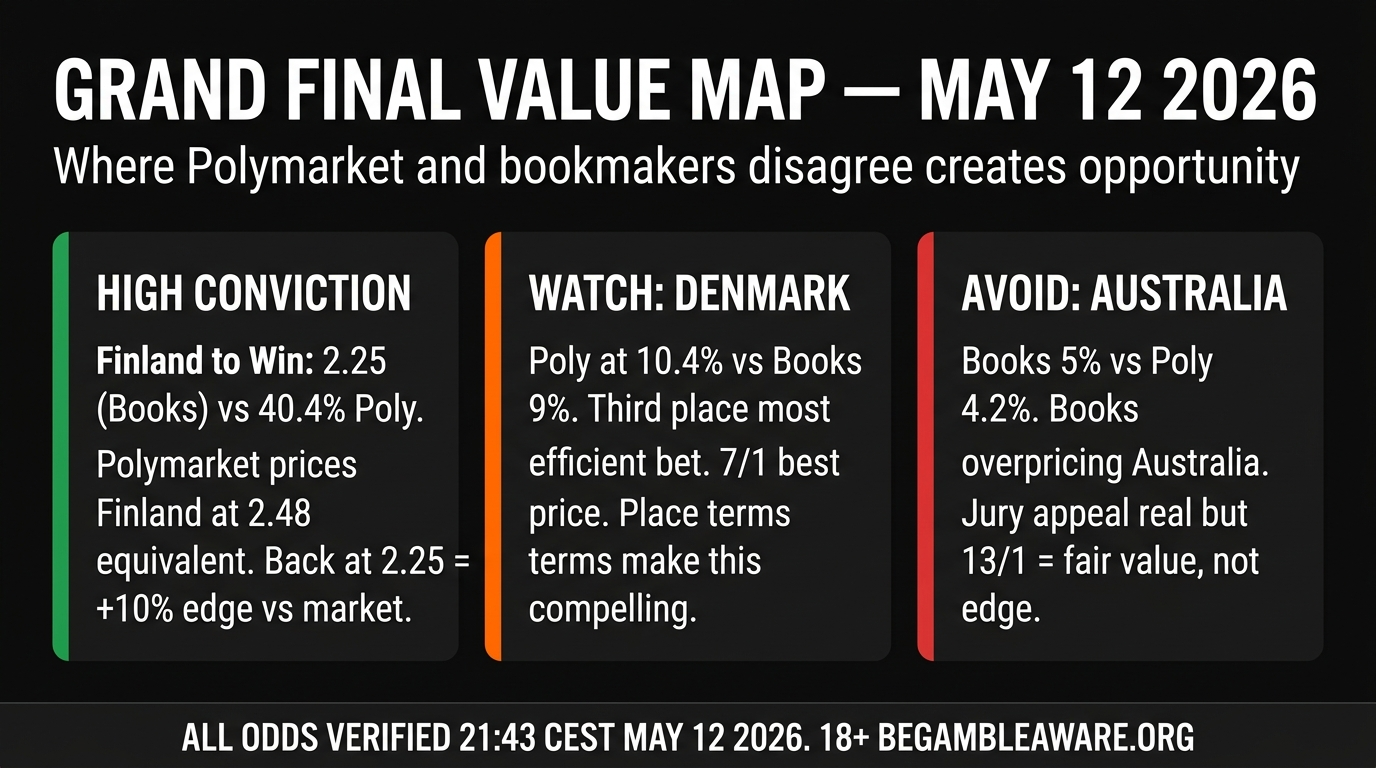
Denmark sits at 10.4% on Polymarket and 9.8% in the bookmaker consensus — closely aligned, suggesting both market types consider Denmark the clear third contender. The best available bookmaker price on Denmark to win the Grand Final is currently 7/1 (12.5% implied) from several operators. At 10.4% true probability (Polymarket), the 7/1 bookmaker price represents a 20% edge — meaning the expected return from a £10 bet at 7/1 is £2.00 more than the fair-value bet.
This is the most compelling third-party value bet in the current Grand Final market. Denmark has not yet competed (SF2 is Thursday), so if Søren Torpegaard delivers a strong SF2 performance and jury show, the 7/1 is likely to shorten before Grand Final night. Backing Denmark at 7/1 now buys in at the maximum value point before SF2 narrows the spread.
Thunderpick — 100% First Deposit Bonus on Eurovision 2026 Sub-Markets
The Australia Discrepancy: Books Overpricing a Jury Favourite
The most actionable reverse divergence — where bookmakers price an entry higher than Polymarket — is Australia. Bookmakers at 5.0% versus Polymarket at 4.2% represents a 0.8 percentage point gap that, while small in absolute terms, is directionally consistent with a known bias: traditional bookmakers tend to overprice jury-appeal entries because their customer base over-bets on established national delegations with historical credibility.
Australia's Eclipse featuring Delta Goodrem leads the Grand Final jury winner market — at approximately 22% implied probability, she is the most likely professional vote winner. But jury winner and outright winner are different markets. Delta Goodrem could sweep the jury votes and still lose to Finland's televote dominance. At 13/1 best odds (bookmakers), Australia is priced at 7.1% implied — substantially above Polymarket's 4.2%. This is where Polymarket's accuracy advantage suggests the bookmaker price is wrong. Australia at 13/1 is not value; Australia at 20/1 or longer would be the correct entry point relative to prediction market consensus.
Betting Strategy: How to Exploit the 6.8-Point Gap
| Bet | Best Odds | Rationale | Verdict |
|---|---|---|---|
| Finland to win (outright) | 2.25 (Betsson) | Polymarket 40.4% vs 2.25 (44.4% implied) — books shorter than fair value. Back at longest available price: Betfred 2.50 best return if Polymarket right. | HIGH CONVICTION |
| Denmark to win (outright) | 7/1 (multiple) | 10.4% Polymarket vs 12.5% bookmaker implied at 7/1. Book price is above Polymarket fair value — but gap is small. Back before SF2 when price may shorten. | MEDIUM VALUE |
| Greece to win (outright) | 3.50 | 21.4% Polymarket, 3.50 = 28.6% implied less overround = ~21% fair. Markets aligned. No significant edge. Pass unless you have specific reason for higher Greece probability. | FAIR VALUE — PASS |
| Australia to win (outright) | 13/1 | 4.2% Polymarket vs 7.1% bookmaker implied. Books overpricing. Do not back at these odds — look for 20/1 or longer. | OVERPRICED — AVOID |
| Finland each-way (Top 3) | 1/3 odds Top 5 | At 2.50, each-way place terms at 1/5 odds pay 1.50 on a place return. Given 40.4% win probability, top-3 is ~65%+ probability. Efficient alternative to straight win. | MEDIUM-HIGH VALUE |
Cloudbet — Up to 5 BTC Welcome Bonus on Eurovision 2026 Jury Markets
The Kalshi Outlier: Finland at 47%
A third prediction market worth noting is Kalshi, which prices Finland at 47% — significantly above both Polymarket (40.4%) and bookmakers (33.6%). Kalshi is a smaller US-regulated prediction market with lower liquidity on Eurovision, which makes its prices less reliable as a consensus signal. However, Kalshi's 47% figure is notable because it aligns with the Betsson bookmaker price of 44.4% implied — both suggesting the true probability may sit in the 44–47% range rather than Polymarket's 40.4%.
If Kalshi and Betsson are both right, then Finland at Betfred's 2.50 (40% implied) represents genuine value — you are buying a 44–47% probability horse at 40% odds. That is approximately a 10–17% expected value edge per bet, which is exceptional for a liquid high-stakes market. The risk, as always, is that Eurovision voting is driven by factors prediction models cannot fully capture: jury bloc relationships, running order recency effects, viewer fatigue during a 3.5-hour show, and the always-unpredictable diaspora mobilisation. Finland's own previous Grand Final appearance demonstrated exactly this volatility.
FAQ: Polymarket vs Bookmakers on Eurovision
Q: How much money is traded on Eurovision at Polymarket?
A: As of 12 May 2026, total Polymarket volume on Eurovision 2026 winner markets exceeds $113 million across all related markets. The outright winner market alone accounts for approximately $45–55 million in total traded value. This is sufficiently liquid that individual large bets (even in the $50,000–$100,000 range) would not significantly move the market price.
Q: Why does Kalshi price Finland higher than Polymarket?
A: Kalshi operates in the US market and has a smaller, more recent Eurovision prediction participant base. Fewer traders means individual large positions have more price impact. The 47% Kalshi figure may reflect one or two large traders with high Finland conviction rather than consensus aggregate probability.
Q: What would change the Polymarket price significantly before the Grand Final?
A: Three events could meaningfully shift the 40.4% figure: (1) Finland's Grand Final dress rehearsal draws negative press reactions; (2) Greece's rehearsal reviews surge significantly in the press room; (3) A staging malfunction or on-night controversy creates live betting movement. None of these is predictable in advance, but all have historical precedent. This is why holding to Grand Final night rather than cashing out early captures the full variance premium.
Q: Is there an arbitrage between Polymarket and bookmakers?
A: True arbitrage requires risk-free profit. Since Polymarket and bookmakers require different settlement — Polymarket settles on declared winner, books settle on declared winner — the settlement mechanism is aligned. A theoretical arb exists if Polymarket's 40.4% and Betfred's 40.0% (2.50) were the same odds; in practice, the gap is too small for meaningful arbitrage after withdrawal fees and currency conversion. The opportunity is asymmetric value, not strict arbitrage.
Q: When should I place my Grand Final bets?
A: The optimal windows are: (1) immediately before SF2 jury show Thursday, while Denmark may still be at 7/1; (2) after SF2 results Thursday night, when the full 25-country Grand Final field is confirmed; and (3) morning of Grand Final day Saturday 16 May before the dress rehearsal. Historically, Grand Final winner odds compress in the 24 hours before broadcast as the field narrows and casual bettors push money onto shorter-priced favourites.
Related Articles
- Eurovision 2026 Polymarket: $113 Million Traded — The Prediction Market Explained
- Finland vs Greece: The Two-Horse Grand Final Race
- Jury Winner Market: Australia Leads at 3.25 — How It Changes Grand Final Maths
- Each-Way Betting Guide: Best Value Picks for Eurovision 2026
- Grand Final Top 10 Predictions After All Rehearsals
- Eurovision 2026 Dark Horses: Five Entries Bookmakers Are Underpricing
Odds sourced from EurovisionWorld.com, Polymarket, Kalshi and Oddschecker, verified 21:43 CEST 12 May 2026. 18+. Please gamble responsibly. BeGambleAware.org. When the fun stops, stop.