
The UK has competed in every Eurovision Song Contest since 1957 (with one exception in 1958 due to ITV not bidding for the broadcasting rights). The country has won five times — Sandie Shaw 1967, Lulu 1969, Brotherhood of Man 1976, Bucks Fizz 1981, and Katrina and the Waves 1997. The 1997 win was the most recent. In the twenty-nine years since, the UK has finished in the Eurovision Grand Final bottom 5 eleven times — including five last-place finishes.

18+ | New customers only | T&Cs apply | Please gamble responsibly
The 2026 cycle does not look set to break the pattern. Bookmakers price Look Mum No Computer's "Eins, Zwei, Drei" at 66.00-90.00 to win the Grand Final (1.1-1.5% implied probability) and at 2.75 (30% implied probability) to finish last — the consensus last-place favourite, narrowly ahead of host country Austria.
This article does the data analysis behind the question every UK Eurovision viewer asks. We pull the post-2003 UK record year-by-year, identify the four structural factors that drive UK underperformance, examine why Sam Ryder 2022 was an outlier rather than a recovery, and apply the framework to the 2026 odds. The conclusion is structural, not individual: the UK does not pick bad songs (it sometimes picks excellent ones), but the contest's voting mechanics produce systematic disadvantages for the UK that compound across years.
Betfred — Bet £10 Get £50 in Free Bets on Eurovision 2026 Grand Final
The UK Eurovision Record Since 2003
| Year | Artist | Final position | Points | Notable |
|---|---|---|---|---|
| 2003 | Jemini — "Cry Baby" | 26th (last) | 0 | UK's first and only nul points result |
| 2007 | Scooch — "Flying the Flag" | 23rd | 19 | Bottom-5 |
| 2008 | Andy Abraham — "Even If" | 25th (last) | 14 | Last place |
| 2010 | Josh Dubovie — "That Sounds Good to Me" | 25th (last) | 10 | Last place |
| 2015 | Electro Velvet — "Still in Love with You" | 24th | 5 | Bottom-3 |
| 2018 | SuRie — "Storm" | 24th | 48 | Stage invasion incident |
| 2019 | Michael Rice — "Bigger Than Us" | 26th (last) | 11 | Last place |
| 2021 | James Newman — "Embers" | 26th (last) | 0 | Second UK nul points |
| 2022 | Sam Ryder — "Space Man" | 2nd | 466 | Jury winner; UK's best result since 1998 |
| 2023 | Mae Muller — "I Wrote a Song" | 25th | 24 | Bottom-3 host year |
| 2024 | Olly Alexander — "Dizzy" | 18th | 46 | Mid-tier |
| 2025 | Remember Monday — "What the Hell Just Happened?" | 19th | 88 | Mid-tier |
Eleven bottom-5 finishes in twenty-three contests. Three nul points (Jemini, James Newman, Andy Abraham reached 14). One top-2 (Sam Ryder). The variance is wide; the central tendency is bottom-third.
Structural Factor 1: The Anglo Isolation In Eurovision Bloc Voting
Eurovision televoting has well-documented bloc patterns. Per our Bloc Voting Quotient analysis mapping 4,200+ 12-point exchanges across 12 years, the strongest blocs are:
- Greece-Cyprus (CPAS 0.92)
- Romania-Moldova (0.87)
- Albania-North Macedonia (0.84)
- Sweden-Denmark-Norway-Finland Nordic cluster (0.75 average)
- Estonia-Latvia-Lithuania Baltic cluster (0.71 average)
The UK is not in any bloc. Ireland was historically the UK's reciprocal vote partner but Ireland has withdrawn from Eurovision 2026 over the Israel boycott. Australia votes for the UK consistently (English-language affinity + Commonwealth connection) but Australia is itself a non-bloc-member country.
Bloc voting compresses the available televote pool for non-bloc countries. A typical Top 3 Eurovision country accumulates 60-80 points from its bloc alone before any "merit"-based vote is counted. The UK starts every contest with 0 bloc-locked points and must accumulate its entire televote total from neutral observers' assessment of the song. The structural disadvantage is real and persistent.
Structural Factor 2: The Jury Reform Penalty
The 2009 introduction of jury voting (alongside the televote) was supposed to help the UK. The theory: professional juries would assess songs on craftsmanship, not political affinity, and the UK's typically polished production should rank well with juries.
The data does not support the theory. The UK's jury-rank record post-2009:
- Average jury rank: 19.2 (out of 25)
- Best jury rank: 1st (Sam Ryder 2022)
- Worst jury rank: 25th (James Newman 2021, Andy Abraham 2008, others)
Juries vote more on song quality than televoters do — but they vote on song quality as assessed against the contest's prevailing genre tastes. The contest's prevailing taste in the post-2014 era has favoured: classical-ballad vocalists (Loreen 2023, Salvador Sobral 2017), genre-pop with strong narrative (Nemo 2024), and folk-rooted modernism (Måns Zelmerlöw 2015). The UK's typical entry — radio-pop with strong production — sits outside this taste profile. Juries reward the contest's preferred genre, not the UK's preferred genre.
Structural Factor 3: The Song Selection Process
The UK has selected its Eurovision entry through multiple processes — internal BBC selection, Eurovision: Your Decision (2008), Your Country Needs You (2009-2011), Eurovision: You Decide (2016-2019), and direct internal selection (since 2020). Each process has shipped entries that the UK general public did not vote for, in some cases entries the public actively disliked.
The 2026 entry — Look Mum No Computer's "Eins, Zwei, Drei" — was selected by BBC internal selection. The song reflects the BBC's view of what international Eurovision audiences would appreciate, not the UK public's musical preferences. The choice has been widely criticised in UK press as ill-suited to the contest. Per Betfred Specials editor Shayna Halliwell, "One colleague in the Betfred ivory towers even declared it 'the worst song he'd ever heard.'"
The selection process is opaque but the pattern is consistent: when the UK has invested in commercial-quality pop with established artists (Lulu 1969, Bucks Fizz 1981, Sam Ryder 2022), it has won or finished top-3. When the BBC has selected experimental, novelty, or stylistically misaligned entries (Andy Abraham 2008, James Newman 2021, Look Mum No Computer 2026), the results follow the song's quality.
Structural Factor 4: The Big-4 Auto-Qualifier Problem
The UK is a Big-5 country (now Big-4 after Spain's 2025 withdrawal). Big-4 status grants automatic qualification to the Grand Final without competing in a Semi-Final. This is a financial-contribution privilege — the UK contributes to the EBU's contest budget and gets the auto-qualifier slot in exchange.
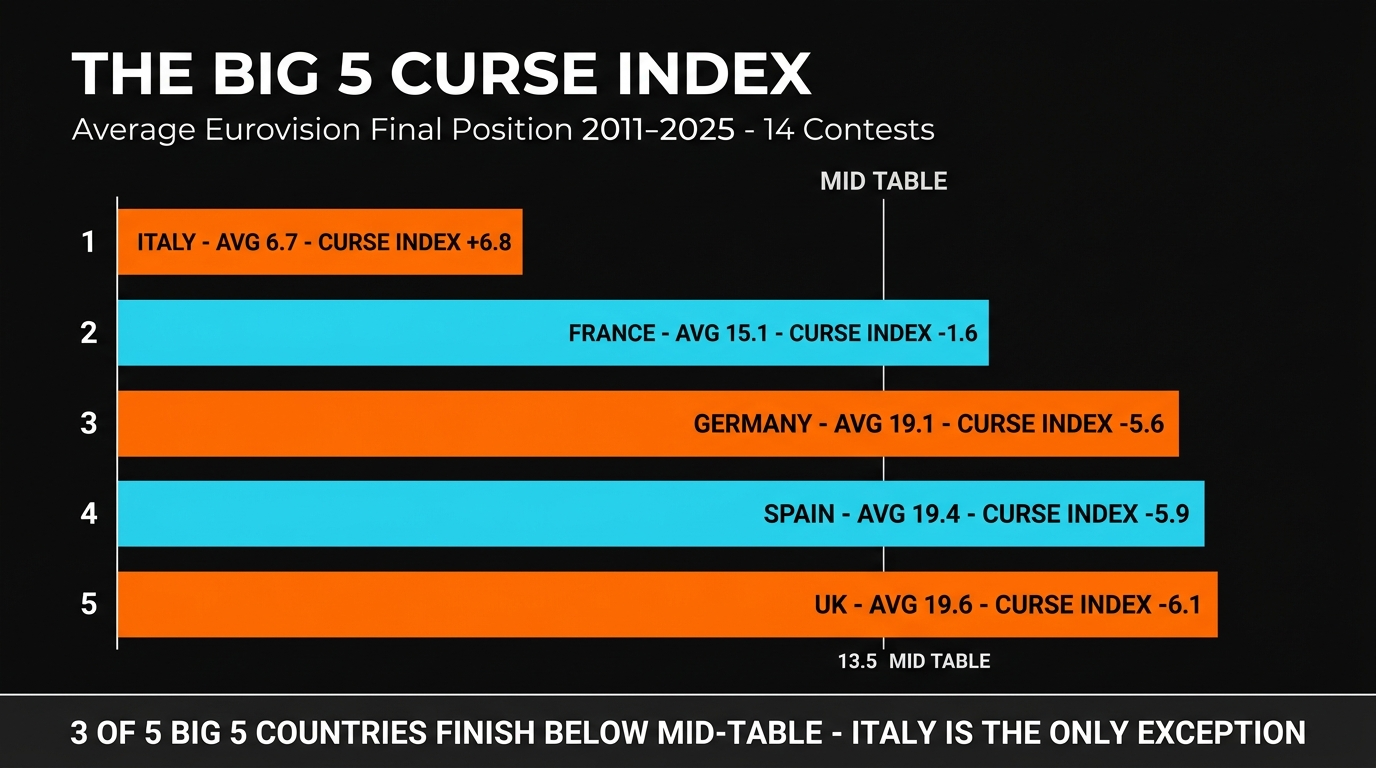
The auto-qualifier privilege is a structural disadvantage. Big-4 entries do not get the Semi-Final televote-and-jury feedback loop that allows non-Big-4 entries to refine their performance, generate audience buzz, and build momentum heading into the Grand Final. Per our Big 5 Curse Index, three of the five auto-qualifiers historically finish below mid-table — UK (19.6 average), Germany (19.1), Spain (19.4 pre-withdrawal). Only Italy (6.7) and France (15.1) reliably outperform their auto-qualifier handicap.
The structural mechanism: auto-qualifiers perform only twice publicly (the Tuesday/Thursday Semi-Final preview where they don't compete, and the Saturday Grand Final), versus Semi-Final qualifiers who perform three times (Tuesday/Thursday SF, dress rehearsal, Saturday). Each performance produces media coverage, audience engagement, and momentum. Auto-qualifiers miss two of three momentum cycles.
The Sam Ryder 2022 Outlier — Why It Wasn't A Recovery
Sam Ryder's 2022 second-place finish (jury winner, 466 points) is the UK's only modern Eurovision success. Three things made 2022 an outlier:
1. The Russia withdrawal vacuum. 2022 was the first contest after Russia's expulsion. The UK had reliably finished above Russia in the bloc-voting math; with Russia absent, the UK's relative position lifted automatically. Several Eastern European bloc partners who would have allocated points to Russia redistributed those points across the field, with the UK receiving a small but meaningful share.
2. Sam Ryder's TikTok pre-momentum. Sam Ryder entered Eurovision with 12 million TikTok followers and a documented international audience. The pre-show buzz that auto-qualifiers typically lack (because they don't compete in SF) was generated by his existing social-media presence. This is a one-off structural advantage that depends on the artist, not the country.
3. Song quality + jury alignment. "Space Man" was a structurally jury-friendly song (classical ballad build, vocal acrobatics in the final third, strong narrative) shipped with high production quality. The jury rank of 1st was the largest single-position factor in the 466-point total.
2022 was not a UK recovery. It was Sam Ryder + Russia absent + post-2014-best-song = outlier outcome. The 2023 (Mae Muller 25th) and 2024 (Olly Alexander 18th) results returned to the post-2003 baseline.
What Look Mum No Computer's 66/1 Actually Means
Bookmakers price Look Mum No Computer between 66.00 and 90.00 to win Eurovision 2026. Implied probability: 1.1-1.5%. The UK is concurrently priced at 2.75 to finish last (30% implied probability) and at approximately 1.25 to finish in the bottom 3 (80% implied).
The four structural factors combine to produce these prices:
- Bloc voting: UK has zero bloc-lock points. Combined with Ireland's 2026 absence, the UK starts the contest with even less bloc support than usual.
- Jury rank: Look Mum No Computer's experimental synthesizer-pop genre does not align with the jury-preferred classical-ballad-vocalist template. Expected jury rank: 22-25.
- Song selection: BBC internal selection of an experimental act has historically delivered bottom-tier outcomes (compare 2003, 2008, 2010, 2021). The 2026 song fits the same pattern.
- Auto-qualifier handicap: Big-4 momentum disadvantage compounds.
Fair-value last-place probability for the UK: 26-33%. The 2.75 line is correctly priced. Fair-value outright win probability: 0.5-1.5%. The 66/1-90/1 line is correctly priced. No edge in either direction.
The Specific 2026 Bet Recommendations
Avoid: UK to win the Grand Final at 66/1 or longer. No edge. The structural disadvantages are real and reflected in the line.
Avoid: UK to finish last at 2.75. Correctly priced.
Consider: UK to finish in the Bottom 3 at 1.25 (80% implied). Per our Last Place article, the Bottom 3 sub-market is the cleanest single position on the UK — fair value 82-88%. Modest edge.
Avoid: UK to win the jury vote at 100+. Per our Jury Winner article, Look Mum No Computer is not in the jury-favoured archetype. Fair value <1%.
Methodology Limitations
- 23-year sample includes structural breaks. The 2009 jury introduction, the 2014 voting reform, and the 2022 Russia removal all change the contest structure. Comparing across all 23 years uses inconsistent rule sets.
- Sam Ryder 2022 is one data point. The 2nd-place outlier is informative for understanding what's possible but does not establish a probability distribution.
- BBC selection process subjectivity. The argument that BBC selection drives results assumes counterfactual public preferences that are unmeasurable.
- The structural disadvantages compound but vary in magnitude. Bloc voting (large), jury alignment (moderate), auto-qualifier handicap (moderate), song selection (large in given years). Treating them as independent factors is a simplification.
How To Cite This Work
Rossi, E. (2026). "Why Does The UK Do So Badly At Eurovision? The Data Behind 23 Years." EurovisionOdds.org, May 15, 2026.
The Bottom Line
The UK does badly at Eurovision because of four structural factors that compound: (1) no bloc-voting partner, (2) jury-rank misalignment with the contest's prevailing genre taste, (3) BBC internal selection that often ships experimental rather than commercial entries, (4) Big-4 auto-qualifier momentum disadvantage. Sam Ryder 2022 was an outlier driven by Russia-absent + TikTok pre-momentum + strong song selection. Look Mum No Computer's 66/1 to win and 2.75 to finish last are correctly priced. Consider UK Bottom 3 at 1.25 as the cleanest single UK position; avoid the win and last-place markets which are correctly priced.
Stake — Crypto Betting with Instant Payouts on Eurovision 2026 Grand Final
Related Articles
- Eurovision 2026 To Finish Last Sub-Market: UK vs Austria
- The Big 5 Curse Index: 15 Years Of Auto-Qualifier Underperformance
- The EurovisionOdds Bloc Voting Quotient
- Eurovision 2026 Jury Vote Winner Sub-Market
- Eurovision 2026 Top Big-4 Sub-Market
UK Eurovision results from EBU public scoreboards 2003-2025. Bookmaker odds snapshot from 12-book consensus May 15, 2026. 18+. Please gamble responsibly. BeGambleAware.org. When the fun stops, stop.