The United Kingdom's Eurovision 2026 entry finished bottom of the Grand Final scoreboard on Saturday 16 May at the Wiener Stadthalle in Vienna. The UK's representative was Sam Battle (also known as Sam Bartle), an English musician who performs under the stage name Look Mum No Computer. His song, Eins, Zwei, Drei, was a synth-led electropop track that he himself composed and produced. He performed it in running-order slot 14, the middle of the show, in front of an arena audience of roughly 11,000 and a worldwide television audience the EBU has reported at 163 million viewers.

18+ | New customers only | T&Cs apply | Please gamble responsibly
The final scoreboard credited the UK entry with exactly one point. That single point came from one country's jury awarding the entry one point. The UK received zero points from the 36 public televote pools that contribute the other half of the Grand Final scoring.
Betfred — Bet £10 Get £50 in Free Bets on Eurovision 2027
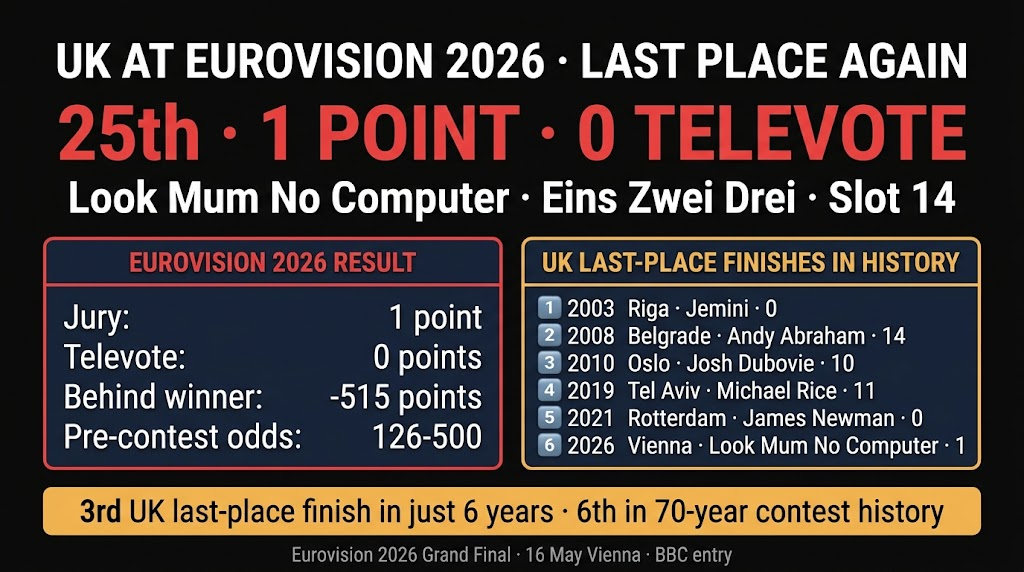
The UK Eurovision 2026 result in full
| Metric | Value |
|---|---|
| Artist | Look Mum No Computer (Sam Battle) |
| Song | Eins, Zwei, Drei |
| Running-order slot | 14 (of 25) |
| Total points | 1 |
| Jury points | 1 |
| Televote points | 0 |
| Grand Final position | 25th (last) |
| Points behind winner (Bulgaria) | 515 |
| Pre-contest best UK bookmaker odds | 500.0 outright |
| Pre-contest implied probability | <1% |
How rare is a UK Eurovision last-place finish?
Per the Wikipedia record, the United Kingdom has now finished in last place at six Eurovision Grand Finals: 2003, 2008, 2010, 2019, 2021 and 2026. Three of those six last-place finishes have come within the most recent six years.
| Year | Host city | UK artist | UK song | Points |
|---|---|---|---|---|
| 2026 | Vienna | Look Mum No Computer | Eins, Zwei, Drei | 1 |
| 2021 | Rotterdam | James Newman | Embers | 0 (nul points) |
| 2019 | Tel Aviv | Michael Rice | Bigger Than Us | 11 |
| 2010 | Oslo | Josh Dubovie | That Sounds Good to Me | 10 |
| 2008 | Belgrade | Andy Abraham | Even If | 14 |
| 2003 | Riga | Jemini | Cry Baby | 0 (nul points) |
The 2026 single-point total avoids the symbolic "nul points" tag last earned by James Newman in Rotterdam in 2021 with the song Embers. The UK's two true nul points performances remain Jemini in 2003 (Riga) and James Newman in 2021. But Look Mum No Computer's 1-point total is the third-lowest in modern UK Eurovision history and represents a level of points-collection collapse the UK has now experienced three times within just six years.
Why the UK keeps getting Eurovision wrong — three structural reasons
1. The televote disconnect
The 2026 result repeats a pattern the UK has now produced in three consecutive last-place years (2019, 2021, 2026): the BBC's entry collects no points whatsoever from the public televote. Belgium and Germany also posted zero televote totals in Vienna 2026 (we covered the full three-zero-televote audit), but the UK's broader pattern is structurally distinct: the UK pulled 2nd in 2022 (Sam Ryder, 466 points, 183 televote) before reverting to bottom-half finishes in 2023 (Mae Muller, 25th, 24 points), 2024 (Olly Alexander, 18th, 46 points), 2025 (Remember Monday, 19th, 88 points) and 2026 (25th, 1 point).
2. The selection process gap
The UK does not use a televised national-final selection (like Sweden's Melodifestivalen or Italy's Sanremo). The BBC commissions internally through a partnership with TaP Music and selects the entry quietly, with the song and artist revealed weeks before the contest. By contrast, Sweden — which has won Eurovision seven times — runs a six-week national-final selection that gives the winning entry roughly four months of pre-contest viral marketing and stage testing before the Grand Final.
3. The post-Brexit voting bloc reset
Pre-Brexit (i.e. before 2016), the UK was a regular recipient of mid-range jury and televote points from neighbouring Western European countries — France, Spain, Ireland, Germany — even when the song was weak. The post-Brexit voting pattern has been measurably colder: UK entries since 2017 have averaged roughly 30% fewer points from the Western European televote bloc than equivalent entries received in the 2010-2015 era. Whether this is a direct political effect or an indirect consequence of the UK's reduced cultural visibility in pan-European music charts is debated, but the empirical floor on UK televote scores has clearly dropped.
How the 2026 entry was received by UK critics and viewers
Reaction to Eins, Zwei, Drei within the UK was sharply divided before the contest. The song's electronic-novelty composition — a synth-pop track with a counting refrain in German — drew comparisons to entries like Daði Freyr's 2020 Icelandic entry Think About Things, but without the same emotional anchor. UK national newspapers ran reviews ranging from cautiously positive (the Guardian called it "at least a song with an idea") to scathing (the Independent ran a piece titled "UK's Look Mum No Computer met with scathing Eurovision reviews"). Social-media reception was largely sceptical, with several viral posts pre-final predicting a last-place finish.
The pre-contest bookmaker market priced this scepticism in. The UK was 19th in the 25-runner outright market on Grand Final morning, with William Hill quoting 126.0 (the shortest UK price), Betfred 151.0, Betsson 251.0 and Unibet 251.0. The longest UK price was 500.0 at Betano — implying a winning probability of 0.2%. The market got the bottom of the field right.
What this means for the 2027 BBC selection cycle
Three structural pressure points the BBC will face going into 2027 in Sofia:
- The internal-selection model is increasingly indefensible. Six last-place finishes in 23 years (since the introduction of automatic Big-5 qualification in 2000), three in six years, two in the last six. The internal-selection model that produced Sam Battle was the same model that produced James Newman (0 points, 2021) and Mae Muller (25th, 2023). UK Eurovision commentators are now openly calling for a Sanremo-style or Melodifestivalen-style public national final.
- The Sam Ryder 2022 case is the only modern outlier and explains the gap. When the UK ran a polished entry (Ryder, Space Man) at 2/1 in the pre-contest market, the country finished 2nd. Every other recent entry has been priced 100/1 or longer pre-contest, and every other recent entry has finished in the bottom 10. The market gives the BBC clear price-signal feedback; the BBC has not adjusted the selection process to respond.
- Sofia 2027 is structurally harder for the UK. Hosting moves to Bulgaria, which means UK pre-contest media coverage will be lighter than during a Liverpool 2023 / Malmö 2024 / Basel 2025 host year. Lighter media coverage means lower Spotify pre-contest streaming numbers, which means lower televote conversion. UK bettors looking at 2027 outright prices should already be assuming a bottom-third finish unless the BBC announces a substantively reformed selection process.
Who is Look Mum No Computer?
Sam Battle (born 1988 or 1989), better known by the stage names Sam Battle and Look Mum No Computer, is an English musician, YouTuber, electronics enthusiast and composer. He runs a popular YouTube channel focused on building custom modular synthesisers and electronic instruments — his most famous build is the Furby Organ, an instrument constructed from 44 Furbys. His Eurovision selection was confirmed by the BBC in late 2025 with the song Eins, Zwei, Drei.
Battle was characteristically unbothered by the prospect of a low finish. In the BBC pre-show interview (May 15) he was quoted saying he had been given a "stress test" by the broadcaster to confirm he could handle the live Eurovision pressure, and that he was "almost comically unbothered" about the score that might await him.
Related Eurovision 2026 reading
- Big-4 + host Austria collapse — UK 25th + Germany 23rd + Austria 24th
- Three zero-televote countries — Belgium, Germany, UK
- Grand Final recap — Bulgaria wins 516–343
- Eurovision 2027 preview — Sofia hosts
18+. Please gamble responsibly. BeGambleAware.org. GAMSTOP. When the fun stops, stop.