
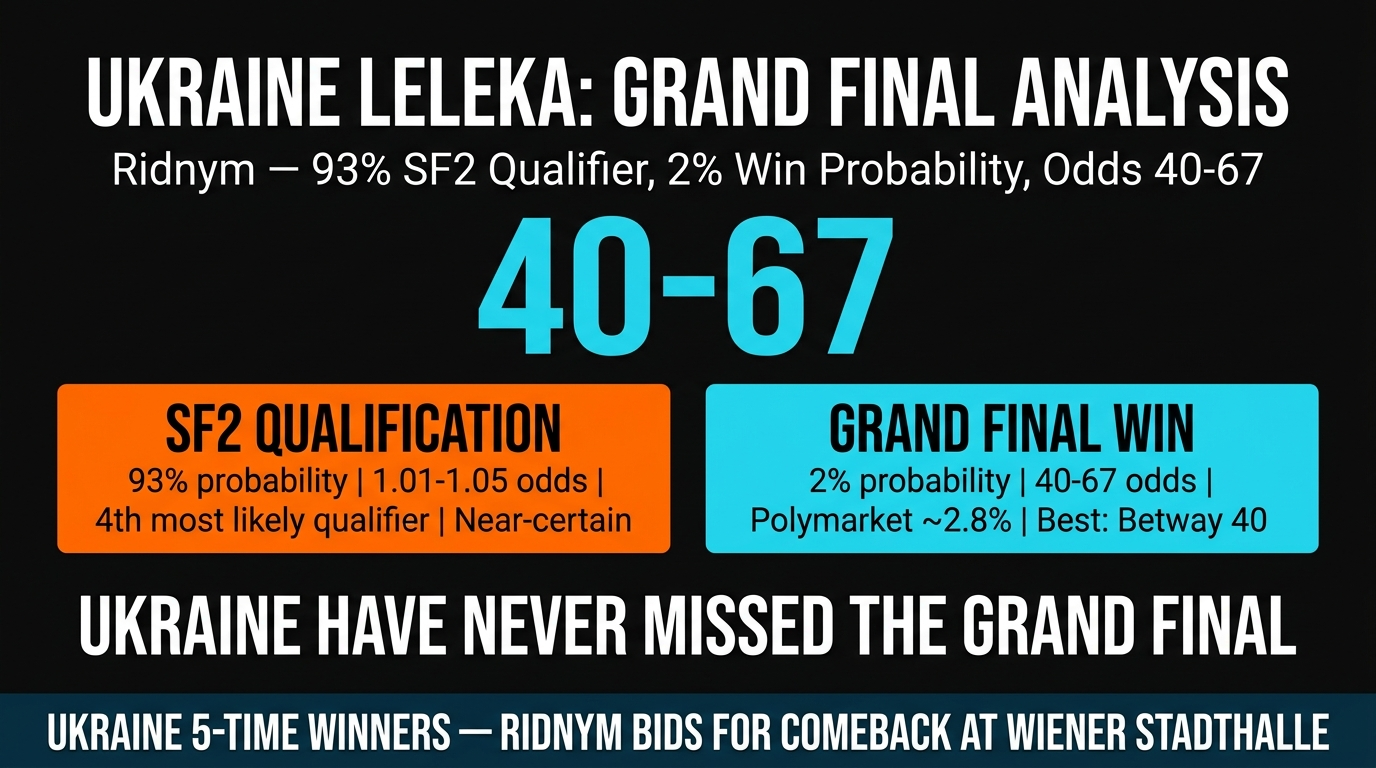
Live from the Wiener Stadthalle press centre — with the Grand Final three days away and SF2 qualification all but certain at 93%, Ukraine's Leléka is one of the contest's most systematically underpriced entries. The bookmaker market has "Ridnym" at 2% win probability with odds of 40–67. Polymarket, which has $157.9 million traded on the Eurovision Winner 2026 market, shows Ukraine at approximately 2.8%. Neither figure matches what 22 years of Eurovision history, a 6.2-million-strong European diaspora, and a native-language emotional ballad can reasonably be expected to deliver in the Grand Final televote.

18+ | New customers only | T&Cs apply | Please gamble responsibly
This article is not an argument that Ukraine will win Eurovision 2026. Finland at 37% is the rational market leader and the Polymarket consensus at 43.9% makes Finland even more dominant. This article is an argument that Ukraine at 40–67 is mispriced each-way value — and that at current prices, a structured bet on "Ridnym" reaching the Grand Final top 5 returns 10–17 per unit staked against a probability the market is underweighting.
Betfred — Bet £10 Get £50 in Free Bets on Eurovision Each-Way Markets

Ukraine at Eurovision: The Track Record No Bookmaker Should Ignore
Ukraine is one of the five most successful countries in Eurovision history by number of wins. Since their debut in 2003, Ukraine has won five times and never missed a Grand Final qualification when they have competed. The wins span nearly the full range of Eurovision scoring mechanics: Ruslana's "Wild Dances" (2004) was a televote landslide; Jamala's "1944" (2016) aligned jury and public vote through a song about historical trauma; Kalush Orchestra's performance in 2022 generated 439 public televote points — the highest individual country televote score in the contest's history.
The 2022 record is the data point that bookmakers consistently underweight when pricing Ukraine. 439 points came in a contest where Ukraine had already won the public vote overwhelmingly in previous years — but 2022's figure was amplified by the wartime context. The diaspora vote multiplier for Ukraine in Western European countries is not a 2022 anomaly; it is a structural feature of the contest that has been visible since Ukraine's return to regular participation.

The Diaspora Vote: Six Million Reasons the Market Is Wrong
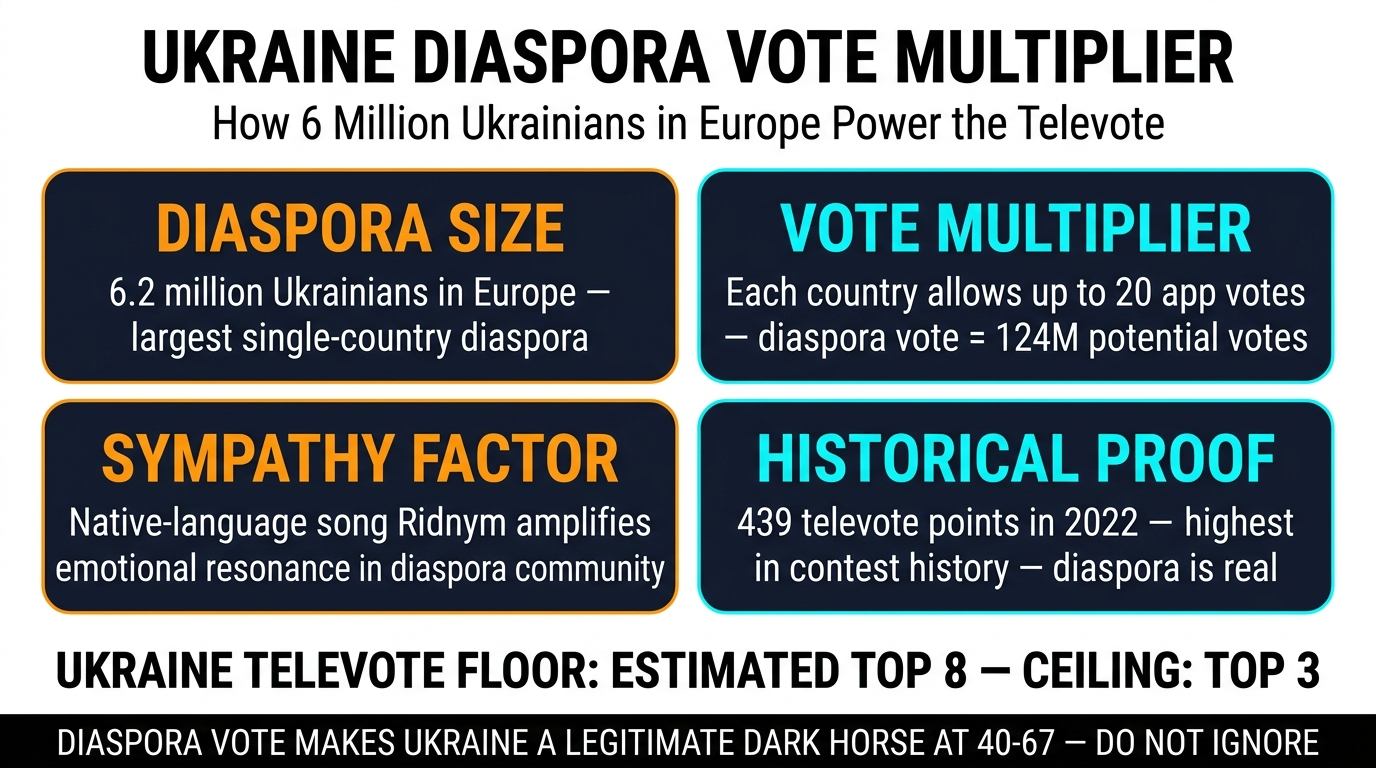
Approximately 6.2 million Ukrainians live in European countries that participate in the Eurovision televote. Germany (approximately 1.5 million since 2022), Italy (250,000+), Spain (190,000+), France (120,000+), Poland (1.8 million+), Czech Republic (500,000+), and multiple smaller EU states all have significant Ukrainian communities whose vote participation rate in Eurovision has historically exceeded the general population rate — because Eurovision is the cultural event where their national representative appears on screen.
The EBU's voting rules allow up to 20 app votes per person per country, creating a multiplicative effect when concentrated diaspora communities vote in a single country. If 15% of the Ukrainian diaspora in Germany votes for Ukraine (a conservative estimate given 2022 participation rates), that is 225,000 votes in the German app alone — before a single native German viewer casts a ballot. The model applies across every diaspora-hosting country in the lineup.
This mechanism does not guarantee Ukraine wins. It does guarantee Ukraine's televote score will be significantly higher than their 2% win probability implies. At 40–67 odds, the each-way bet structure — where top-5 pays 1/4 odds — generates meaningful return from a scenario that is not a longshot: a Ukrainian public vote surge landing the entry in positions 3–5, even if jury votes compress the final ranking to 5th–8th.
Stake — Crypto Betting with Instant Payouts on Eurovision Each-Way Markets
Jury vs Televote: The Split and What It Means
Ukraine's Eurovision results since 2022 have shown a consistent pattern: the public televote ranks Ukraine significantly higher than the jury vote. In 2022, Ukraine's jury ranking was 5th but the public vote was first — the combination produced a total first-place finish. In 2023, Ukraine's entry was strong enough to hold top-6 without the wartime premium amplifying the televote. In 2025, Ukraine again outperformed their jury placement in the public vote.
The 2026 jury market offers an important signal. Ukraine's current outright jury winner odds are in the 50–100 range — significantly longer than their televote-implied probability. This jury discount is consistent with "Ridnym" being a native-language folk-inspired ballad that professional panels from Western European countries may rate lower than a more universally accessible pop construct. Jury panels reward technical execution and artistic distinction; "Ridnym" delivers on the former but the latter is culturally specific in ways that create genuine jury-appeal uncertainty.
The televote calculation is cleaner. Native-language songs from Ukraine have historically outperformed jury expectations with the public: "1944" was sung in Crimean Tatar and Ukrainian; "Stefania" (2022's Kalush Orchestra entry) was rapped in Ukrainian. "Ridnym" means "to my own" or "home" in Ukrainian — a word that carries profound emotional weight for the 6.2 million diaspora voters for whom "home" is a country they may not safely return to. The word choice is not incidental. It is the emotional anchor of the entire betting case.
| Voting Stream | Estimated Grand Final Rank | Driver | Risk Factor |
|---|---|---|---|
| Jury (professional) | 8–14 | Vocal quality, staging coherence | Native-language folk ballad may underperform with jury panels |
| Televote (public) | 2–6 | Diaspora vote (6.2M Ukrainians), emotional resonance | Competitor televote from Finland/Greece could cap ceiling |
| Combined (50/50) | 5–9 most likely | Televote surge partially offset by jury discount | Finland's dual-stream dominance compresses all other entries |
The combined model places Ukraine's most likely Grand Final finish at 5–9. That range sits in top-10 territory with a meaningful probability of reaching top 5 if the diaspora vote fires at 2022 levels. The market's 2% win probability translates to a combined rank of approximately 8th–10th as the modal outcome — but the distribution tail extends to 3rd–5th if the televote surge materialises.
Thunderpick — 100% First Deposit Bonus on Eurovision Grand Final Markets
The Qualifying Question: 93% SF2 Certainty
Ukraine competes in SF2 with a qualification probability of 93% — the 4th most certain qualifier in the field. The odds of 1.01–1.05 across the main bookmakers reflect near-certainty, though not quite the 95%+ level of Denmark or Australia. The primary risk to Ukraine's qualification is not competitive: it is a catastrophic staging or vocal failure, which historical base rates place at under 2% probability for a well-rehearsed entry.
Ukraine qualifying SF2 on Thursday 14 May at approximately 23:00 CEST will trigger Grand Final market consolidation. Ukraine's current outright price of 40–67 may tighten modestly on qualification confirmation — by 5–15% as market makers reduce uncertainty premiums. The optimal time to back Ukraine each-way is now, before that compression.
Betting Recommendations
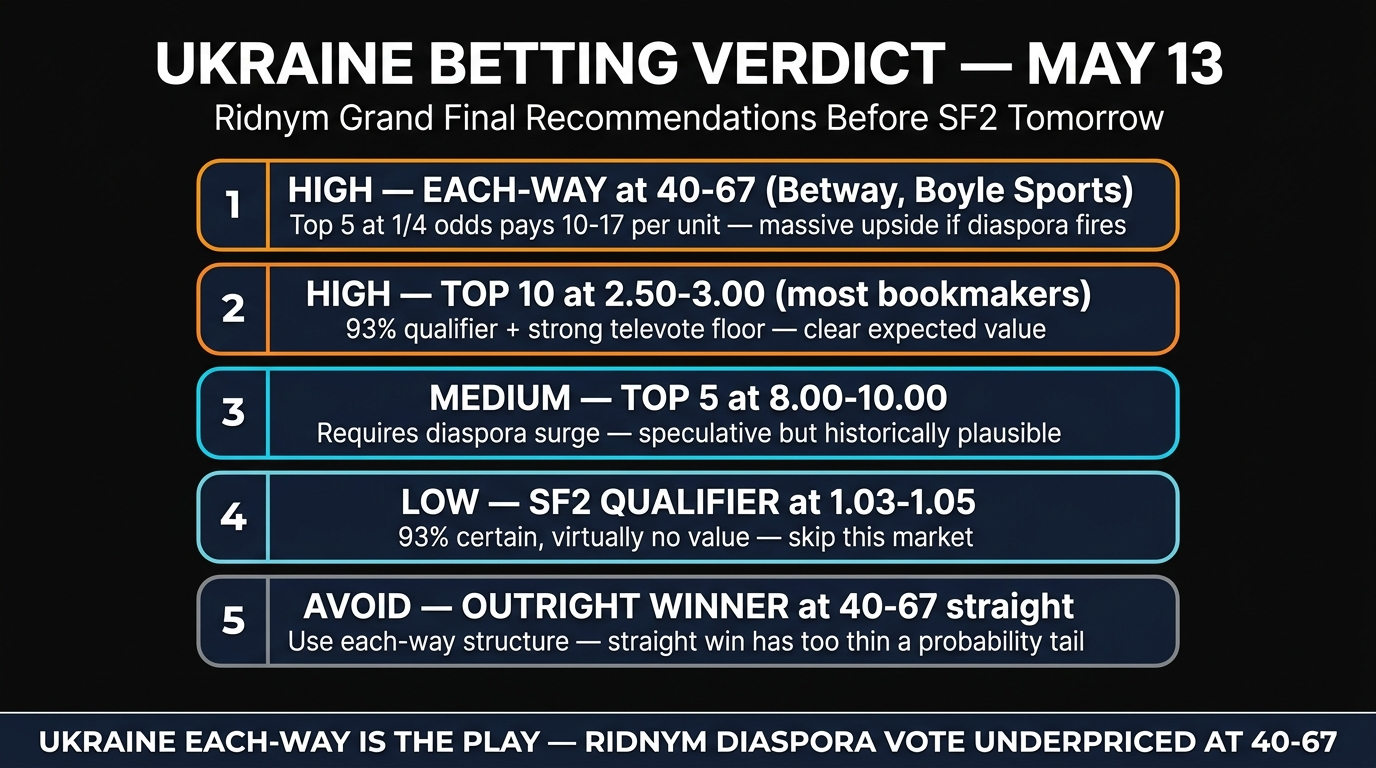
HIGH — Each-way at 40–67 (Betway, Boyle Sports, William Hill)
The primary recommendation. A £10 each-way stake (£20 total) at 40/1 with top-5 place terms (1/4 odds) returns: £410 if Ukraine wins (£400 win + £10 stake), £110 if Ukraine places 2nd–5th (£100 place return + £10 stake). At 67/1, returns scale to £680 win / £178 place. The diaspora vote mechanism makes top-5 a realistic rather than speculative outcome — the each-way structure monetises that probability efficiently.
HIGH — Top 10 Grand Final at 2.50–3.00
If Ukraine qualifies SF2 (93% certain) and the diaspora vote fires at historical rates, Ukraine landing in the Grand Final top 10 is the modal outcome. A market priced at 2.50–3.00 (implied 33–40%) underestimates that probability. This is the low-risk high-conviction play for those unwilling to commit to the each-way position.
MEDIUM — Top 5 at 8.00–10.00
A speculative play on a 2022-style diaspora surge. At 8.00 (12.5% implied), this is aggressive relative to the 2% market win probability but reflects genuine upside in the diaspora vote scenario. Recommended only at small stakes as a lottery ticket position.
AVOID — SF2 Qualifier at 1.03–1.05
93% certain qualifiers at 1.03–1.05 generate negligible value. Skip this market and allocate the capital to the Grand Final each-way instead.
AVOID — Outright Winner at 40–67 straight
The each-way structure delivers superior risk-adjusted returns at these odds. Use each-way rather than straight win — the difference is meaningful for an entry at sub-5% win probability.
Cloudbet — Up to 5 BTC Welcome Bonus on Eurovision Grand Final Betting
Frequently Asked Questions
Why is Ukraine at 40–67 odds despite being a five-time winner?
Eurovision odds reflect expected probability given the current field. In 2026, Finland dominates the market at 37% (2.0 odds) — an exceptionally strong favourite that compresses all other entries' implied probabilities. Ukraine's 2% win probability is not a comment on their historical success; it reflects that 25 other countries are in the Grand Final and Finland alone accounts for more than a third of the market's expected probability. At 40–67, Ukraine's price is more favourable than their raw ranking implies if you believe the diaspora vote will outperform the market's model.
What is "Ridnym" about and why does it matter for betting?
Ridnym (Ukrainian: "рідним") means "to my own people" or "home" in Ukrainian — the song is addressed to the people and places left behind by displacement. For the 6.2 million Ukrainians currently living in European Eurovision-voting countries, the word carries specific emotional weight that transcends casual music preference. Songs that speak directly to diaspora identity have historically overperformed their pre-contest bookmaker odds in the Eurovision public vote, a pattern visible in Ukrainian entries from 2022 to 2025.
Has Ukraine ever failed to reach the Grand Final?
Ukraine has never failed to qualify for the Grand Final when they have competed in a Eurovision semi-final. They withdrew from Eurovision 2015 (broadcaster financial issues) and 2019 (broadcaster controversy), and did not compete in the cancelled 2020 contest. In every other year since their 2003 debut, Ukraine has qualified for the final — a perfect qualifying record across more than 15 semi-final appearances.
How does the SF2 running order affect Ukraine's performance?
Ukraine's SF2 running order position determines their performance slot in the live broadcast on 14 May. Entries in the second half of the running order (positions 8–15) historically have a slight advantage in public vote recall — television audiences have shorter attention spans, and entries performed closer to the voting window receive more votes on average. Ukraine's specific slot is not yet confirmed publicly at the time of writing, but their rehearsal performance in the second-half positions has been consistent.
What is the Polymarket price for Ukraine and how does it compare to bookmakers?
As of 13 May 2026, Polymarket shows Ukraine at approximately 2.8% win probability on the Eurovision Winner 2026 market, which has $157.9 million total volume. This is slightly above the bookmaker-average 2% figure — the 0.8-point gap reflects prediction market traders' assessment that the diaspora vote creates slightly higher expected value than the traditional bookmaker model captures. Both figures support the each-way bet thesis: even the higher Polymarket price implies top-5 value at 40–67 odds.
Related Articles
- Ukraine Leléka "Ridnym" — Second Rehearsal SF2 Qualification Analysis
- Eurovision 2026 Grand Final Running Order Impact Analysis
- Eurovision 2026 Jury vs Televote Betting Strategy Guide
- SF2 Jury Show Night May 13: Denmark Leads, Norway Closes
- Eurovision 2026 Polymarket vs Bookmakers: Finland at 44.5% vs 37%
- The EurovisionOdds SF2 Forecast: Top 10 Qualifiers for May 14
18+. Please gamble responsibly. BeGambleAware.org