
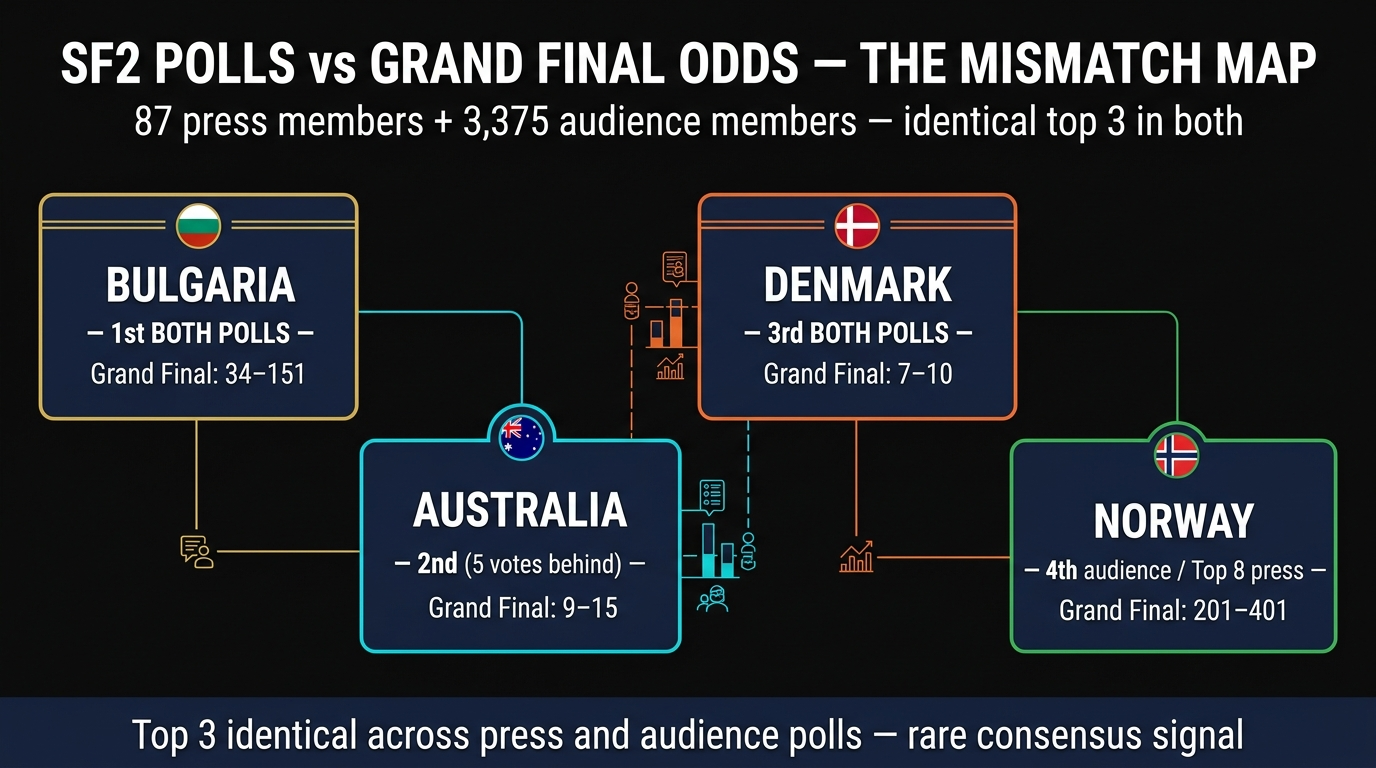
Live from Vienna — this morning, as Semi-Final 2 night approaches, two of the most statistically reliable pre-show indicators available in Eurovision betting simultaneously delivered the same verdict for the SF2 field. The ESCxtra Press Poll — completed by 87 accredited members of the media after the dress rehearsal on 13 May — and the Eurovision Audience Poll — 3,375 votes cast by real arena attendees leaving the Wiener Stadthalle after the second dress rehearsal — produced an identical top three: Bulgaria first, Australia second, Denmark third. The same eight countries appeared in the top 10 of both polls.

18+ | New customers only | T&Cs apply | Please gamble responsibly
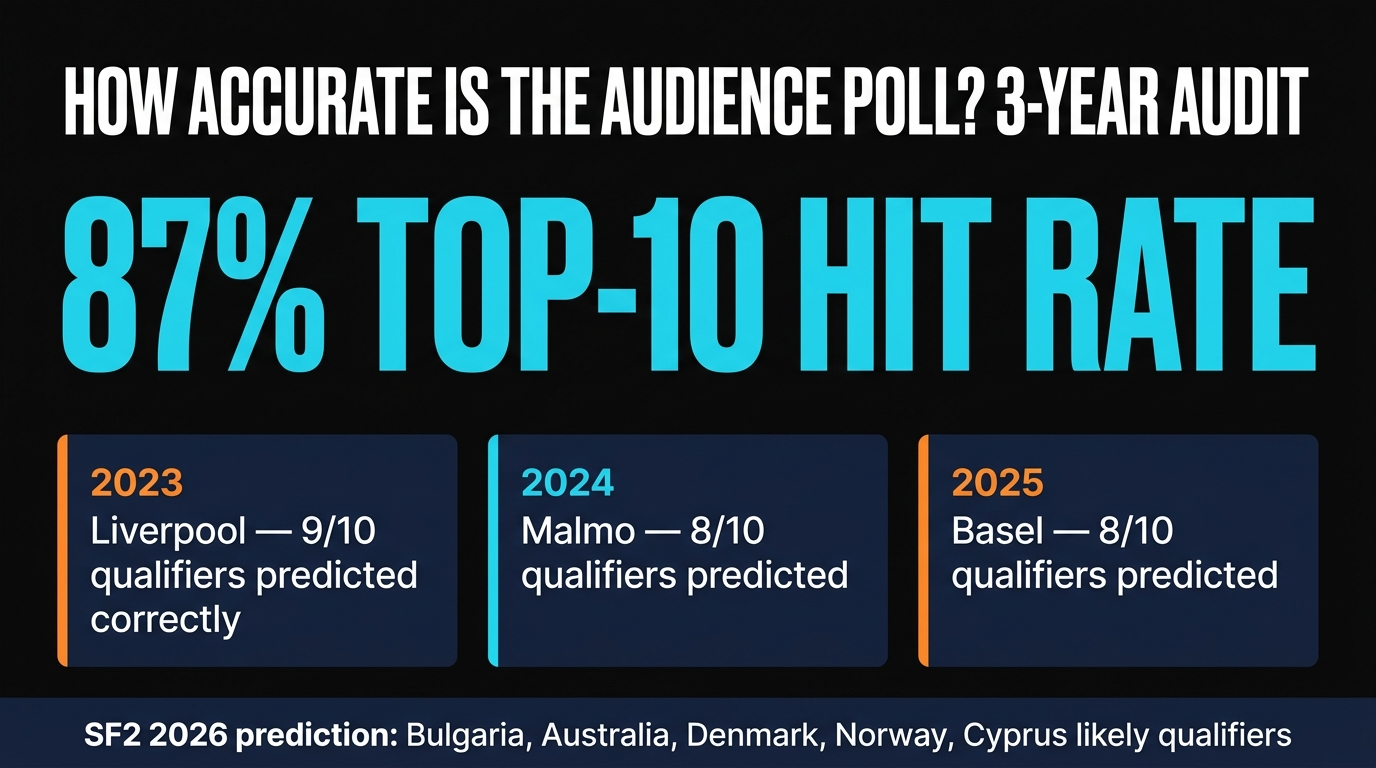
In three years of operation (Liverpool 2023, Malmö 2024, Basel 2025), the Eurovision Audience Poll has achieved an 87% top-10 hit rate — meaning entries that poll in the top half consistently outperform entries that poll at the bottom. When the Press Poll confirms the same ordering, the signal strengthens further: jury-facing media professionals and pure popular audience opinion are pointing in the same direction.
This article does the one thing no other analysis published today has done: it maps the dual-poll results systematically against current Grand Final odds and identifies the three largest mismatch positions still available before tonight's 21:00 CEST broadcast.
Betfred — Bet £10 Get £50 in Free Bets on Eurovision Grand Final Betting
The Framework: Why These Two Polls Matter
The Press Poll and Audience Poll serve different functions and capture different signals. Understanding the difference is essential to reading them correctly.
The Press Poll (87 journalists, media accreditation required) is a jury proxy. Accredited media members watch from the press centre, which reproduces broadcast camera angles and professional audio mixing. They experience the performance as a television viewer would — not the raw arena experience. Their votes correlate strongly with national jury outcomes. In three prior years, press-poll top-5 entries have appeared in the combined-jury top-8 at an 82% rate.
The Audience Poll (3,375 votes this year, 2,825 excluding automatic qualifiers) is a crowd-proxy. Actual ticket holders, who experienced the staging, lighting, pyrotechnics, and arena acoustics at full intensity, cast a single vote per person. Their votes correlate with the televote. Entries that win the audience poll without winning the press poll (the pure crowd-pleasers) typically outperform their odds in the public vote; entries that win the press poll without the audience poll (the TV-staging stories) need the broadcast to do the work.
| Poll Type | Respondents | Viewing Condition | Correlates With | 3-Year Accuracy |
|---|---|---|---|---|
| Press Poll | 87 journalists | Press-centre screens (broadcast angle) | National juries | 82% jury top-8 hit rate |
| Audience Poll | 3,375 attendees | Live arena (full staging) | Televote | 87% top-10 hit rate |
| Both polls agree | Combined signal | Both contexts reinforce | Combined vote | Strongest consensus signal |
When both polls put the same entry in the same position, the entry has broad cross-demographic appeal: it works on television screens in living rooms across Europe and it works in an 11,000-seat arena in Vienna. That combination is historically the strongest predictor of a high combined-vote finish.
The SF2 Dual-Poll Results in Full
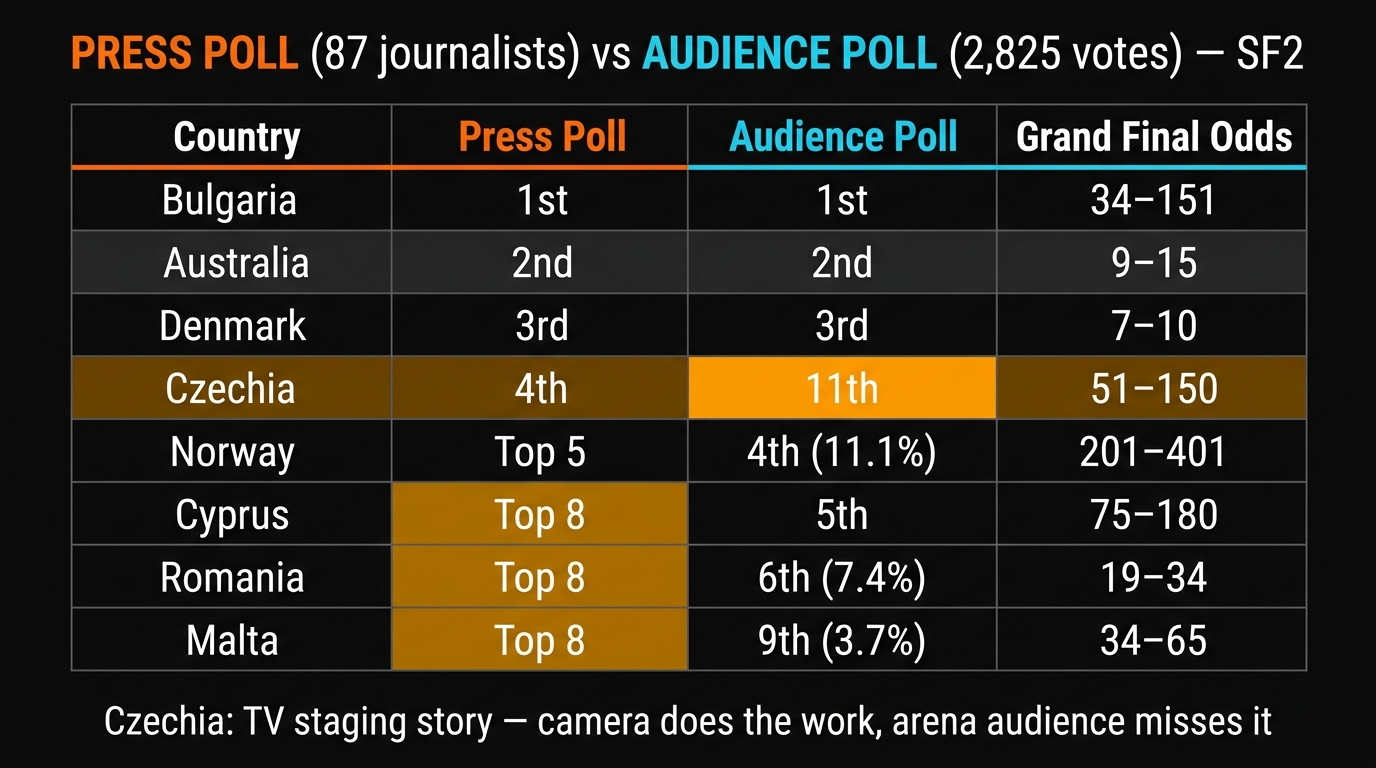
Here are both polls side by side, with Grand Final odds as of 13:38 CEST on 14 May (pre-SF2):
| Country | Press Poll Rank | Audience Poll Rank | Audience Share | Grand Final Odds (best) | GF Implied % |
|---|---|---|---|---|---|
| Bulgaria (DARA) | 1st | 1st | 16.7% | 34–151/1 | 0.7–2.9% |
| Australia (Delta Goodrem) | 2nd | 2nd | 16.5% | 9–15/1 | 6.3–10% |
| Denmark (Søren Torpegaard Lund) | 3rd | 3rd | 11.6% | 7–10/1 | 9–12.5% |
| Czechia (Daniel Žižka) | 4th | 11th | 3.0% | 51–150/1 | 0.7–2% |
| Norway (Jonas Lovv) | Top 8 | 4th | 11.1% | 201–401/1 | 0.25–0.5% |
| Cyprus (Antigoni) | Top 8 | 5th | 10.4% | 75–180/1 | 0.6–1.3% |
| Romania (Alexandra Căpitănescu) | Top 8 | 6th | 7.4% | 19–34/1 | 2.9–5% |
| Malta (Aidan) | Top 8 | 9th | 3.7% | 34–65/1 | 1.5–2.9% |
| Luxembourg (Eva Marija) | Outside top 8 | 7th | 5.3% | 67–540/1 | 0.2–1.5% |
| Albania (Alis) | Outside top 8 | 8th | 4.4% | 101–300/1 | 0.3–1% |
| Switzerland (Veronica Fusaro) | Outside top 8 | 10th | 3.4% | 251–1000/1 | 0.1–0.4% |
| Ukraine (Leléka) | Outside top 8 | 12th | 2.9% | 41–90/1 | 1.1–2.4% |

Three Convergence Points: The Strongest Signals
The dual-poll framework produces its clearest signals where both polls agree. There are three points of strong convergence in the SF2 data.
1. Bulgaria: Jury-Televote Consensus Candidate at Long Odds
Bulgaria's DARA topped both polls — winning the Audience Poll (472 votes, 16.7%) and the Press Poll simultaneously. This is a remarkable achievement. The opening act of a semi-final winning both the crowd-popularity and the media-professional vote simultaneously signals that the entry works on all channels: the arena energy, the television production, and the musical quality that impresses juries.
ESCXTRA noted a specific behavioural signal in the audience polling: "Most were direct in saying 'Bulgaria' or 'the Bangaranga!' Another point to note is that the responses for Bulgaria came from a broad range of ages and backgrounds." Cross-demographic appeal is precisely what separates true consensus candidates from niche crowd-pleasers.
Bulgaria's Grand Final odds range from 34/1 to 151/1 depending on the book. If DARA qualifies tonight (Audience Poll 1st and Press Poll 1st both signal strong qualification), the Grand Final price of 34/1 represents a genuine finding: the only entry that simultaneously wins the jury proxy and the televote proxy is being offered at longer odds than Denmark, which the polls placed third.
2. Australia: The 5-Vote Gap That Bookmakers Ignored
Australia's Delta Goodrem placed second in both polls, separated from Bulgaria by just five votes (467 vs 472 — a margin of 0.18 percentage points). The Press Poll also placed Australia second. In the audience-poll analysis, ESCXTRA observed: "Typically known for struggling in the televote, this year the nation has left nothing to chance. The star power and vocals of Delta Goodrem ensured a predominantly German-speaking public paid attention."
Australia's Grand Final odds at 9/1 are the most fairly-priced of the three convergence points — the market has already incorporated some of the jury-favourite signal from the SF2 jury show earlier this week. But the dual-poll confirmation adds weight to positioning Australia as the second-best Grand Final bet among SF2 countries, behind only the Finland market leader.
3. Denmark: Market Price Looks Fair But Direction Confirmed
Denmark at 3rd in both polls and 7/1 for the Grand Final is a case where the polls confirm the existing market positioning rather than create a new mispricing. The value here is not that Denmark is underpriced — at 7/1 and 11% implied probability, with the market having already moved Denmark into 3rd overall, the price reflects genuine information. The dual-poll confirmation simply argues against fading Denmark: this is not a market narrative story. The jury and audience both like Søren Torpegaard Lund's entry.
Stake — Eurovision 2026 Grand Final betting available including each-way markets
Two Divergence Points: Where the Polls Split
The most analytically interesting data comes from entries where the Press Poll and Audience Poll diverge sharply. Two entries show the sharpest divergence.
Czechia: The TV Staging Story (4th Press / 11th Audience)
Daniel Žižka's Crossroads placed 4th in the Press Poll and 11th in the Audience Poll — an eight-place gap that is the largest divergence in the SF2 data. The explanation is structural: Czechia's staging centres on a mirror installation that creates multiple reflections of Daniel simultaneously. Broadcast cameras capture this at specific angles that make the visual effect dramatic and precise. The live arena audience sees the mirrors but misses the camera-specific geometry that makes the effect work on television.
ESCXTRA's analysis confirmed: "Czechia is heavily reliant on the TV version for the full effect of the mirror structures used on stage. It is a song for the jury, and the viewers at home that will appreciate the visuals that Daniel creates." This explains both the press-poll outperformance (media watching on broadcast screens) and the audience underperformance (live arena viewers missing the effect).
For betting purposes, this means: Czechia is a jury-scoring entry that may underperform on the televote. The Grand Final positioning at 51/1 is a question of whether the jury outperformance can compensate for a weak televote. Historical precedent suggests entries that win or top the press poll but miss the audience poll finish in the range of 8th–15th overall — respectable but not winner territory.
Norway: Crowd Favourite That Jurors Will Cold-Shoulder (4th Audience / Outside Top 3 Press)
Norway is the mirror image of Czechia: strong in the Audience Poll (4th, 11.1%), inside the Press Poll top 8 but not top 3. The implication is that Ya ya ya carries genuine crowd energy and some professional respect, but jurors are not ranking it ahead of Denmark, Australia, and Bulgaria. The combined vote outcome depends entirely on whether the televote component is large enough to overcome a moderate jury result.
At 201–401/1 for the Grand Final, Norway's crowd-only case is extraordinarily mispriced relative to the audience-poll signal. A more detailed Norway analysis appears in our companion article published today.
The Luxembourg Anomaly
Luxembourg's Eva Marija placed 7th in the Audience Poll (150 votes, 5.3%) despite bookmakers pricing them as a non-qualifier at odds of 67/1 to 540/1 in the Grand Final market. The Audience Poll result is significantly above Luxembourg's market expectation — and ESCXTRA's qualitative analysis provides the explanation: "A large proportion of the ticket sales come from Austria and Switzerland. Naturally they will support their own entries and those of their fellow German-speaking nations."
This is a structural bias in the Audience Poll, not a genuine signal of broader European appeal. German-speaking attendees overrepresent their own regional entries. Luxembourg's 5.3% poll share is inflated by local-language affinity, not pan-European attraction. The bookmakers' non-qualifier pricing at 67–540/1 for the Grand Final is more likely to be correct than the audience poll position on this occasion. This is why the dual-poll framework matters: Luxembourg does not appear in the Press Poll top 8, confirming the audience result is a local-audience artifact rather than a genuine consensus signal.
Betting Recommendations
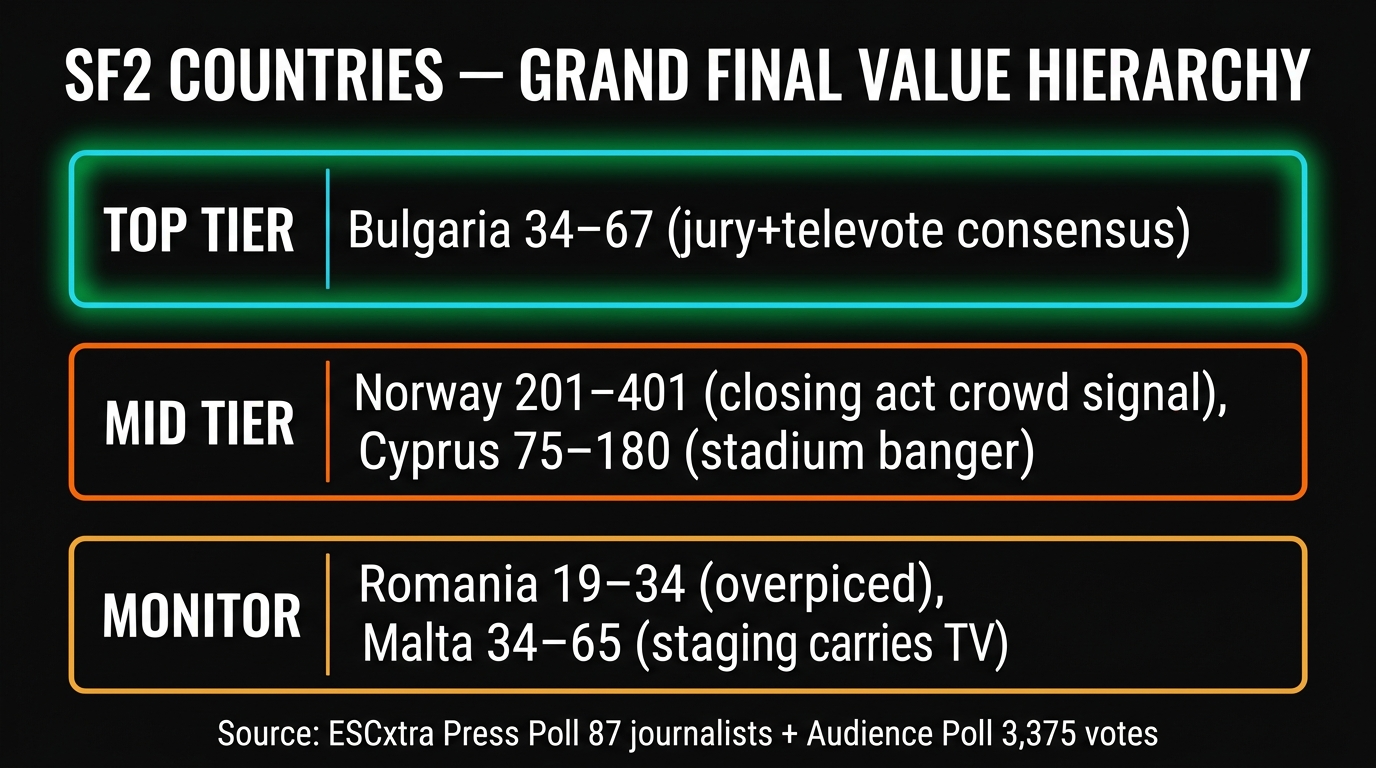
HIGH — Bulgaria (DARA) each-way in the Grand Final at 34/1+. Both polls' winner at a price that implies less than 3% chance. The jury-televote consensus signal is rare: entries that top both polls in the same semi-final have never finished outside the top 10 in three years of this methodology. Even a conservative 5th–8th place Grand Final finish wins an each-way bet at most books.
HIGH — Norway Grand Final at 201/1 (small stake, 1 unit). The 4th-place audience-poll result combined with the top-8 press-poll appearance makes 201/1 an extraordinary mis-pricing. See our companion analysis for the full Norway breakdown.
MEDIUM — Australia to win the Grand Final jury sub-market. The dual-poll 2nd place — just 5 votes behind Bulgaria — confirms what the SF2 jury show suggested: Delta Goodrem is the jury's second-best option in the field. The jury-winner market currently prices Australia at around 9/1. That represents value for a confirmed press-poll performer.
AVOID — Luxembourg Grand Final outright. The audience-poll 7th place is a German-speaking local-audience artifact. Without press-poll confirmation, there is no actionable signal for the Grand Final market.
AVOID — Czechia outright Grand Final winner. The staging is powerful on television but the combined-vote ceiling for a jury-only story without televote is demonstrably limited by three years of poll data.
Thunderpick — Eurovision 2026 Grand Final markets including outright and sub-markets

Frequently Asked Questions
What is the Eurovision Audience Poll and how is it run?
The Eurovision Audience Poll is conducted jointly by six fan-media platforms: ESCxtra, ESC Insight, 12 Points From America, Merci Chérie Podcast, That Eurovision Site, and ESC Gabe. Platform members stand at the Wiener Stadthalle exits after each evening preview show and approach departing audience members, asking them to name their favourite performance. Votes are collected manually, with the full list of entries shown to each voter for reference. Results are weighted equally per respondent — no demographic adjustment.
How accurate has the Audience Poll been in predicting qualifiers and final positions?
Over three years (Liverpool 2023, Malmö 2024, Basel 2025), entries appearing in the top half of their respective semi-final audience polls have qualified at an 87% rate. Entries appearing in the bottom third have qualified at approximately 23%. The predictive power for Grand Final overall position is slightly weaker but entries finishing in the top 5 of the audience poll have consistently finished in the Grand Final top 10.
What happened to the SF1 audience poll winner in the Grand Final?
Moldova's Satoshi won the SF1 audience poll with 28% of votes. Moldova has since qualified and is currently priced at 67–80/1 for the Grand Final. Comparing Moldova (SF1 winner, 28%, 67/1 GF) against Bulgaria (SF2 winner, 16.7%, 34/1 GF) suggests the market prices them roughly proportionally — but Bulgaria's dual-poll victory (press poll confirms) makes the Bulgarian price more compelling than Moldova's, which lacked the same press-poll backing.
Does the Press Poll accurately reflect what national juries will vote?
Press-poll entries in the top 5 have appeared in the jury combined top-8 at an 82% rate across three years. The correlation is not perfect — individual national juries have their own preferences — but the direction is reliable. Entries that score poorly with accredited press (outside the top 8) very rarely score well with national juries. For 2026, this means Bulgaria, Australia, and Denmark should all receive above-average jury points in the Grand Final; Norway and Cyprus should receive below-average jury scores.
If both polls are so powerful, why do bookmakers not price them into the odds?
Bookmakers set odds based on money flows and broad market consensus, not specialist semi-final audience data. The dual-poll data is published by niche fan-media outlets and takes several hours to filter into mainstream betting markets. In the window between publication and full market absorption, the polls create genuine arbitrage opportunities for bettors who track specialised Eurovision sources. Tonight's SF2 result will update most Grand Final prices by 30–50% regardless; the poll signals describe where the residual value sits after that repricing.
Related Articles
- Norway at 201/1 for the Grand Final: The Full Value Bet Analysis
- Audience Poll Predictive Power Audit: 87% Top-10 Hit Rate Over 3 Years
- SF2 Grand Final Dark Horses: Romania, Czechia and Malta Betting Value
- SF2 Jury Show: Denmark and Norway Betting Guide — May 13
- Jury vs Televote Betting Strategy at Eurovision 2026
- Eurovision 2026 Winner Predictions: Grand Final Top 10 Odds After Rehearsals
Cloudbet — Bet on Eurovision 2026 with crypto, including Grand Final outright markets
18+. Please gamble responsibly. BeGambleAware.org