
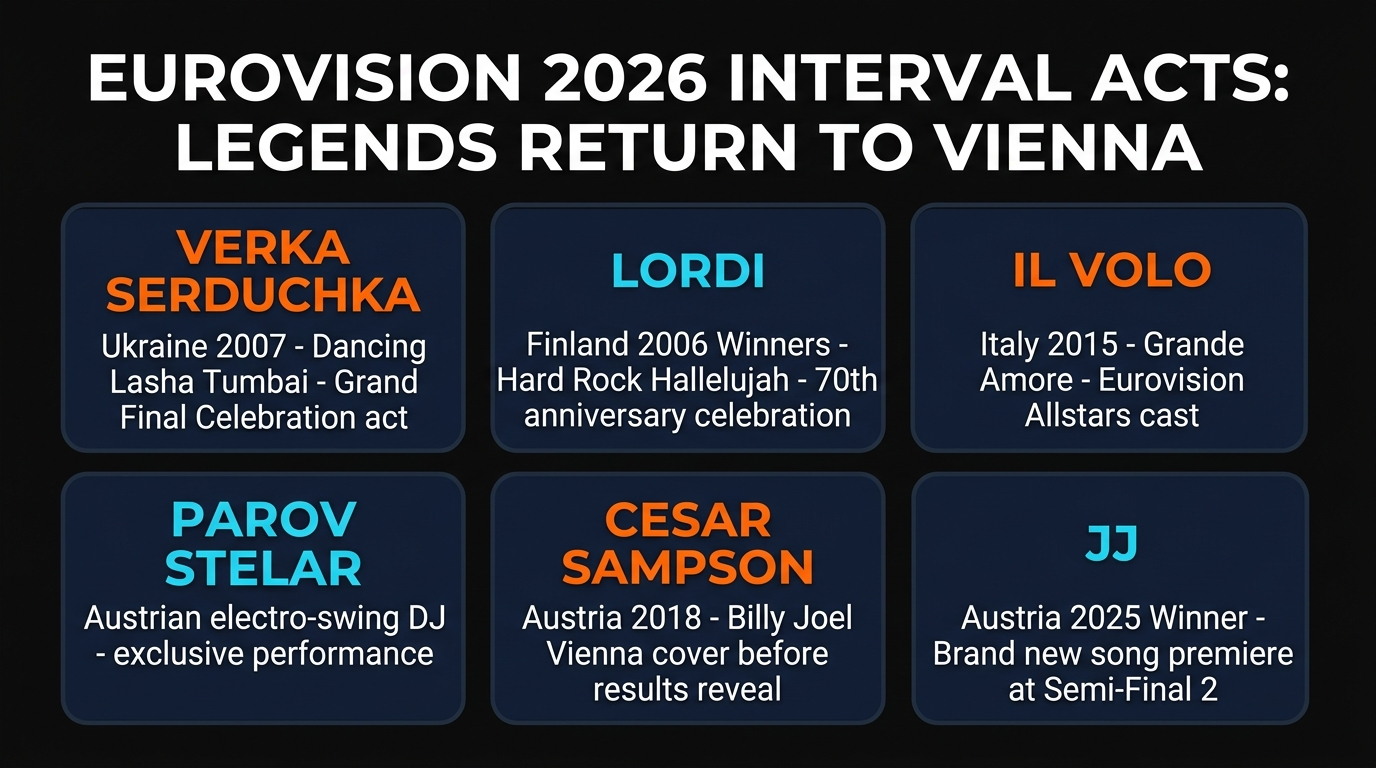
Eurovision's interval acts have produced some of the most memorable moments in television history — from Riverdance in 1994 to Mans Zelmerlow's hologram spectacle in 2016. The 70th edition in Vienna is set to deliver one of the most stacked entertainment lineups the contest has ever assembled, spanning all three live shows from Semi-Final 1 on May 12 through to the Grand Final on May 16.

18+ | New customers only | T&Cs apply | Please gamble responsibly
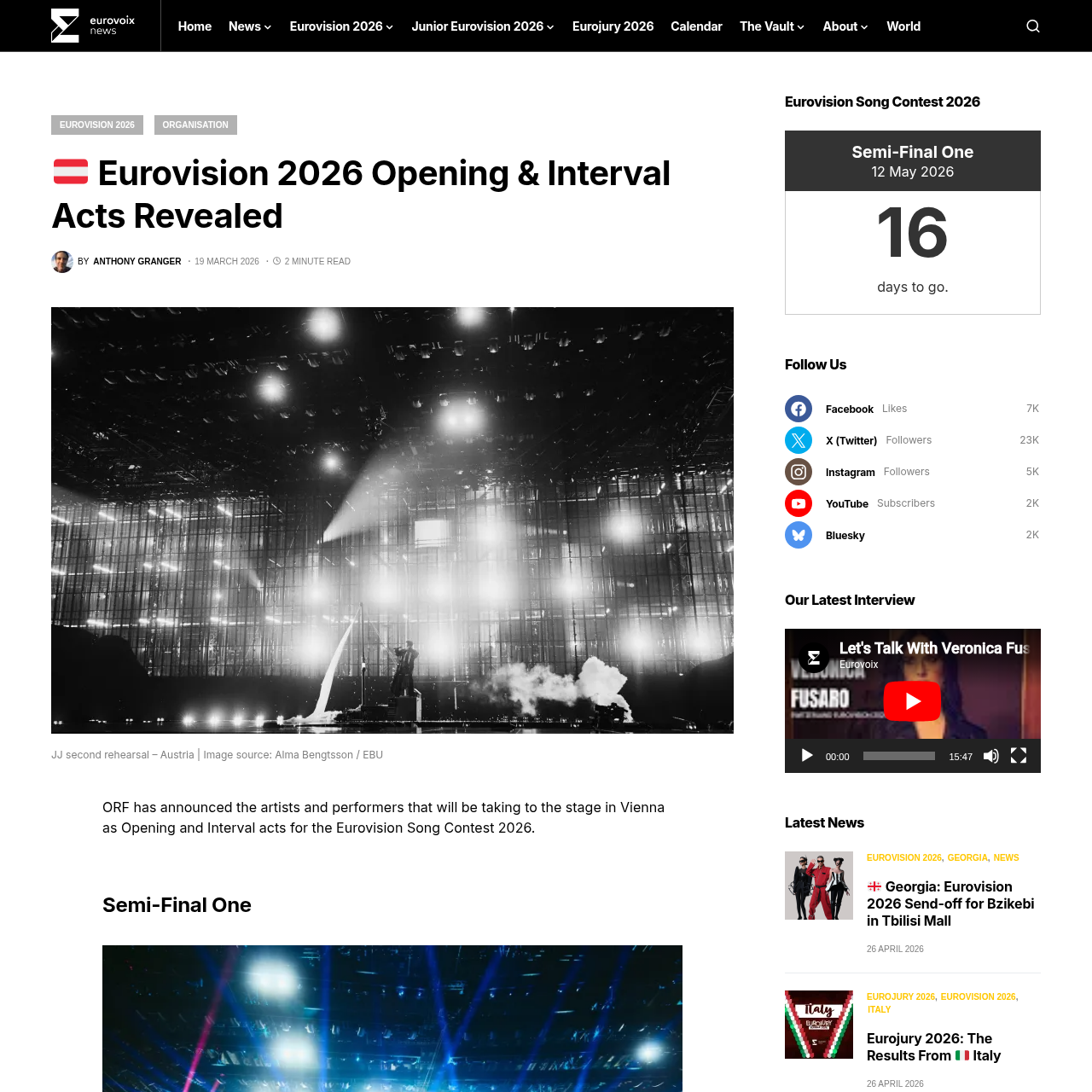
Here is every confirmed interval act, opening performance, and special segment across the entire Eurovision 2026 live show week.
Grand Final — Saturday May 16
The Grand Final carries the heaviest entertainment programme, with three distinct non-competitive performances spread across the evening alongside the opening act.
"Celebration!" — The Eurovision Allstars
The headline interval act is a segment titled "Celebration!" featuring four former Eurovision artists who collectively represent some of the contest's most iconic moments:
- Verka Serduchka (Ukraine 2007) — The drag persona created by Andriy Danylko finished second in Helsinki with "Dancing Lasha Tumbai" and has since become arguably the most beloved performer in Eurovision history. The silver star headpiece, the mirrored costumes, the infectious chaos — Verka's appearance on the Wiener Stadthalle stage will likely produce one of the loudest crowd reactions of the entire evening. Given the ongoing significance of Ukrainian cultural representation, this appearance carries emotional weight well beyond entertainment.
- Lordi (Finland 2006) — Hard Rock Hallelujah changed Eurovision forever. Twenty years after their monster-costumed victory in Athens scored a then-record 292 points, Lordi return to the contest stage with the pyrotechnics, theatrics, and sheer spectacle that made them legends. Their victory proved Eurovision could embrace genres far beyond pop ballads, and their legacy is visible in the diversity of entries competing in 2026.
- Il Volo (Italy 2015) — The operatic pop trio won Eurovision in this exact venue — the Wiener Stadthalle — with "Grande Amore" in 2015. Their return to the same city and same stage 11 years later adds a layer of poetic symmetry that the production team will undoubtedly lean into. Il Volo's powerful vocal harmonies bridge the gap between Vienna's classical heritage and Eurovision's pop sensibility.
- Erika Vikman (Finland 2025) — The most recent addition to the lineup, Vikman brings contemporary energy alongside the heritage acts. Her bold performance style is perfectly suited to the arena environment, and her inclusion signals the contest's commitment to celebrating its present alongside its past.
The combination of these four acts — spanning Ukraine, Finland (twice), and Italy — is extraordinary. From Lordi's monster rock to Verka's camp disco to Il Volo's operatic grandeur to Vikman's modern pop, the "Celebration!" segment covers nearly every genre Eurovision has ever embraced.
Parov Stelar — Electro-Swing Showcase
Parov Stelar (born Marcus Fuereder) is widely credited as the pioneer of the electro-swing genre. The Austrian musician and producer from Linz has built a global following by fusing 1920s and 1930s swing, jazz, and big band sounds with modern electronic production. Tracks like "Booty Swing", "Catgroove", and "The Sun" have accumulated hundreds of millions of streams, and his live shows are legendary for their energy.
As an Austrian artist, Parov Stelar represents the host nation's contemporary music scene at its most innovative. His sound is inherently theatrical and danceable — built for exactly the kind of massive arena setting the Wiener Stadthalle provides. Where the Allstars segment celebrates Eurovision's history, Parov Stelar's set will inject a distinctly Austrian flavour while keeping energy levels at peak intensity between the competition and the voting sequence.
His distinctive visual aesthetic — sharp suits, fedora, and a stage setup that blends vintage and futuristic elements — should translate beautifully onto the cinematic Arri cameras being used for the first time at Eurovision 2026.
Cesar Sampson — "Vienna" (Billy Joel Cover)
Cesar Sampson represented Austria at Eurovision 2018 in Lisbon with "Nobody but You", finishing 3rd overall and winning the jury vote outright — a remarkable achievement that cemented his reputation as one of the finest vocalists to have graced the Eurovision stage. His soulful, powerful delivery drew comparisons to Gregory Porter and earned universal praise from professional jurors.
For the 2026 Grand Final, Sampson will perform a cover of Billy Joel's "Vienna" — a choice so perfectly on-the-nose for a Eurovision hosted in Austria's capital that it borders on destiny. The performance is scheduled for the emotionally charged window before the results reveal, when the audience is at peak anticipation and the atmosphere in the hall is electric with nervous energy.
Joel's "Vienna" — with its themes of slowing down, savouring the moment, and not rushing through life — is a masterclass in mood-setting. In Sampson's hands, backed by whatever production the ORF team has planned, this has the potential to be one of the most goosebump-inducing moments of the entire evening. The jury vote winner covering a song named after the host city, performed in the minutes before Europe discovers who wins — this is Eurovision storytelling at its finest.
Semi-Final 1 — Tuesday May 12
The semi-finals carry lighter interval programming than the Grand Final, but ORF has ensured that even the qualifying rounds feature unique entertainment.
"Kangaroo" — Victoria Swarovski & Michael Ostrowski (feat. Go-Jo)
Co-hosts Victoria Swarovski and Michael Ostrowski will perform a light-hearted musical number called "Kangaroo" during Semi-Final 1's interval. The premise: a playful exploration of the perennial confusion between Austria and Australia — a mix-up that has produced countless jokes, souvenir shop errors, and bewildered tourists since long before Eurovision was invented.
The segment takes on extra significance because it features Go-Jo, who represented Australia at Eurovision 2025 in Basel with the viral hit "Milkshake Man". Go-Jo's involvement turns the concept from a simple comedy sketch into a genuine cross-continental collaboration — an Austrian-Australian musical handshake that plays on the shared history of name confusion.
Swarovski, the crystal empire heiress best known for co-hosting "Let's Dance" on RTL Germany, and Ostrowski, one of Austria's most celebrated actors, have reportedly been rehearsing the number for weeks. Given the scale of the production available to them at the Wiener Stadthalle, expect props, choreography, and the kind of self-aware humour that Eurovision fans adore.

Semi-Final 2 — Thursday May 14
Opening: Hosts Perform JJ's "Wasted Love"
Semi-Final 2 opens with Swarovski and Ostrowski performing JJ's "Wasted Love" — the song that won Eurovision 2025 for Austria in Basel. This is a standard Eurovision tradition: the defending champion's winning song is typically performed during one of the live shows as a celebration of the host nation's victory. Having the hosts perform it rather than JJ himself adds a fresh twist and reinforces their dual role as presenters and performers throughout the week.
JJ — Brand-New Unreleased Song
The biggest musical reveal of the semi-finals: JJ will perform a brand-new, previously unreleased song during Semi-Final 2's interval. No title, no preview, no leaks — the 70th Eurovision Song Contest will host a genuine world premiere from the reigning champion.
This is a significant moment. JJ's trajectory since winning in Basel has been remarkable, and the opportunity to debut new material in front of an estimated 100+ million television viewers is the kind of platform that most artists never receive. The song choice will reveal JJ's artistic direction post-Eurovision — whether they lean into the sound that won them the contest or push into new territory.
For the audience in the Wiener Stadthalle, this is the home crowd getting a world exclusive from their champion. The noise will be extraordinary.
The Historical Significance
The combined interval act lineup across all three shows makes Eurovision 2026 one of the most entertainment-heavy editions in contest history. To put it in perspective:
- 6 distinct non-competitive performances across three shows
- 9 named performers/acts (Verka, Lordi, Il Volo, Erika Vikman, Parov Stelar, Cesar Sampson, JJ, Go-Jo, plus the host duo)
- 5 former Eurovision artists returning to the stage (Verka, Lordi, Il Volo, Vikman, Sampson)
- 1 world premiere (JJ's new song)
- 1 returning previous winner performing in the venue where they won (Il Volo, 2015)
The only modern Eurovision that rivals this entertainment density is the 2015 contest — also in Vienna, also at the Wiener Stadthalle — which featured Conchita Wurst with the Vienna Philharmonic. ORF clearly understands that hosting Eurovision is about more than logistics; it is about creating unforgettable television moments.
What It Means for the Viewing Experience
The quality of interval acts has a subtle but real influence on voter behaviour. A high-energy interval keeps audiences engaged, reduces channel-switching during the broadcast, and puts viewers in a generous, celebratory mood when voting opens. This tends to benefit entries that made a strong emotional impression during the competition.
For bettors watching with their Betfred accounts at the ready, the interval is also prime time for live in-play assessment. The pause between performances and voting gives you breathing room to process how the evening has unfolded, check social media sentiment, and make informed decisions before the results are revealed.
The confirmed lineup suggests that ORF is delivering a show built to keep 150+ million viewers locked in from the first note to the last confetti cannon. With Lordi's pyrotechnics, Verka's chaos, Parov Stelar's beats, and Cesar Sampson's soul, the entertainment surrounding the competition may be almost as memorable as the competition itself.
18+. Please gamble responsibly. BeGambleAware.org
Related Articles
- Eurovision 2026 Hosts: Victoria Swarovski, Michael Ostrowski & Caroline Athanasiadis
- Eurovision 2026 Turquoise Carpet & Opening Ceremony in Vienna
- Eurovision 2026 Schedule & Start Times by Time Zone
- 50 Incredible Facts About Eurovision 2026 in Vienna
- Eurovision 2026 Stage Design: Florian Wieder's Viennese Secession Concept
Frequently Asked Questions
Who are the interval acts at Eurovision 2026?
The Grand Final features three interval segments: "Celebration!" with Eurovision Allstars (Verka Serduchka, Lordi, Il Volo, Erika Vikman), an electro-swing set from Austrian artist Parov Stelar, and a soulful cover of Billy Joel's "Vienna" by Cesar Sampson (Austria 2018, jury vote winner). The semi-finals feature host performances and a brand-new JJ song.
Will JJ perform at Eurovision 2026?
Yes. JJ, who won Eurovision 2025 for Austria with "Wasted Love", will debut a brand-new unreleased song during the Semi-Final 2 interval on May 14. The hosts will also perform JJ's winning song "Wasted Love" to open Semi-Final 2.
What is the "Kangaroo" performance at Semi-Final 1?
"Kangaroo" is a light-hearted musical number performed by hosts Victoria Swarovski and Michael Ostrowski during the Semi-Final 1 interval. It playfully addresses the long-running Austria/Australia confusion and features Go-Jo, who represented Australia at Eurovision 2025 in Basel.
Is Verka Serduchka really returning to Eurovision?
Confirmed. Verka Serduchka (the stage persona of Ukrainian comedian Andriy Danylko, who finished second at Eurovision 2007) will perform as part of the "Celebration!" Eurovision Allstars segment during the Grand Final on May 16. This marks Verka's first appearance on a Eurovision stage since their original performance 19 years ago.