
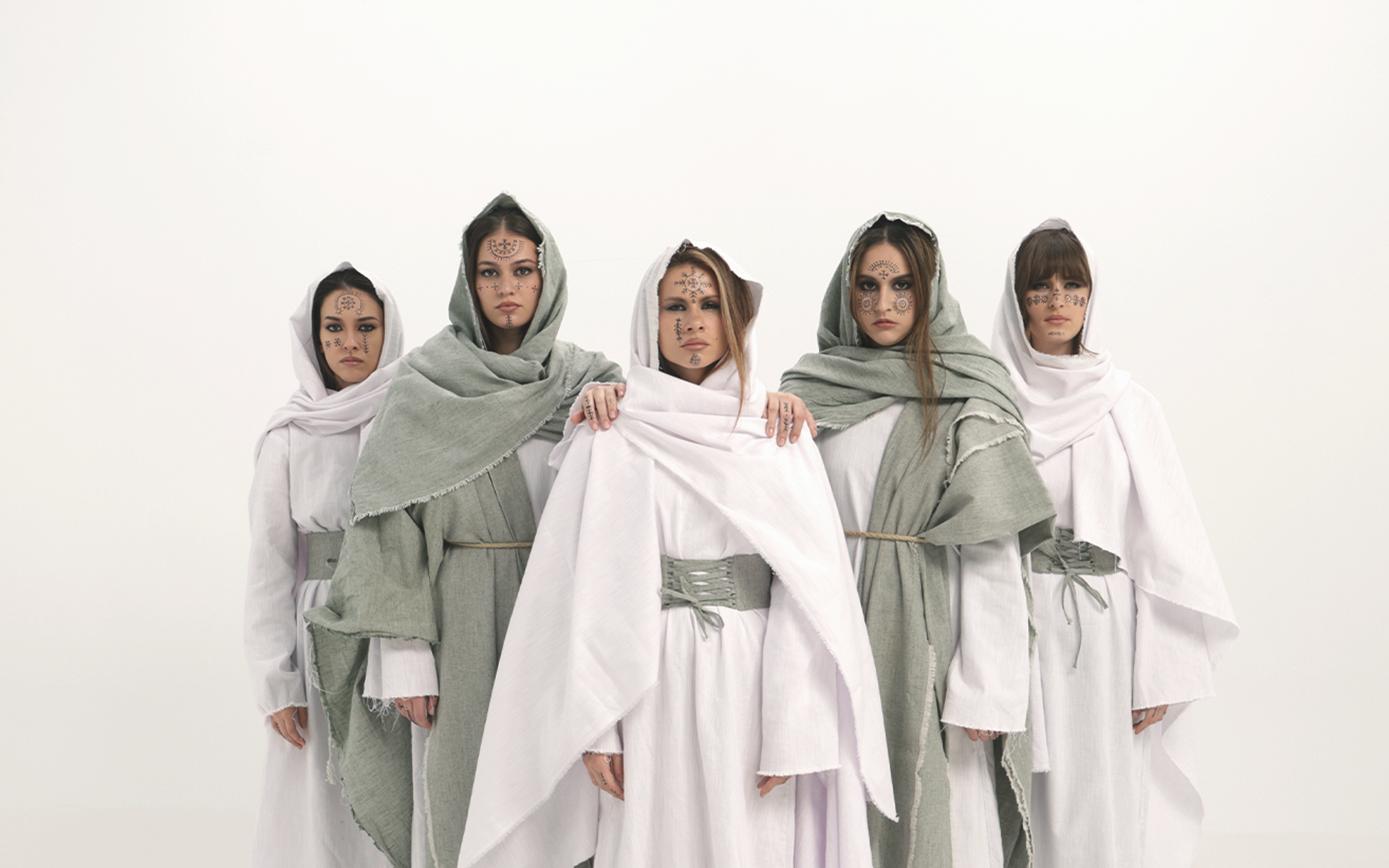
Live from the Wiener Stadthalle press centre — the conversation in the corridors on Sunday afternoon kept returning to the same entry. Not Finland, not Greece. Croatia. Five women in deep blood-red robes walking down a catwalk from the Green Room as if they were leading a procession through history itself. A backdrop that shifts from ancient cave paintings to an enchanted forest to a wormhole pulling the audience through space and time. A polyphonic vocal tradition — Balkan harmonics layered six ways — that lands in a room full of professional journalists and silences them.

18+ | New customers only | T&Cs apply | Please gamble responsibly
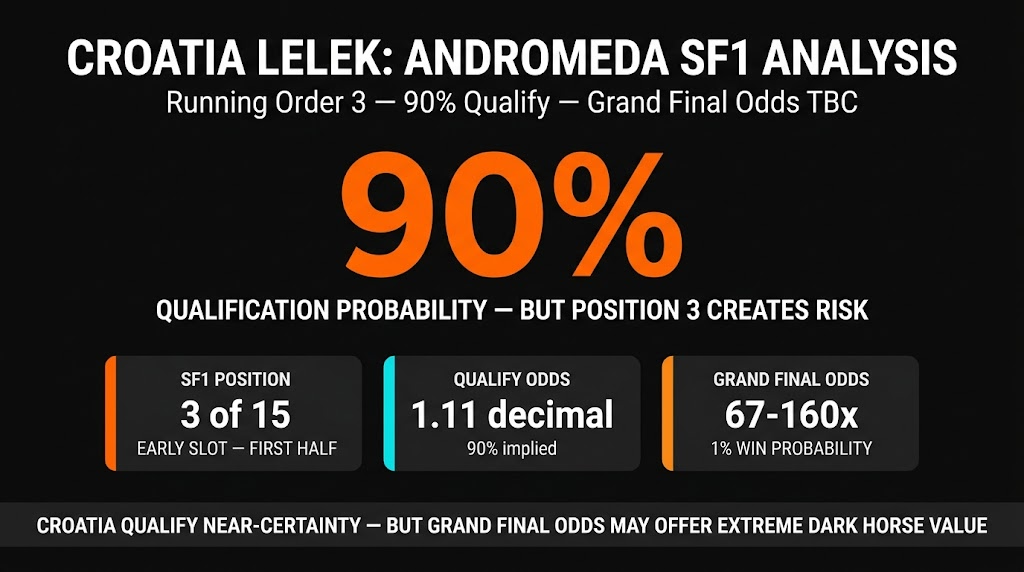
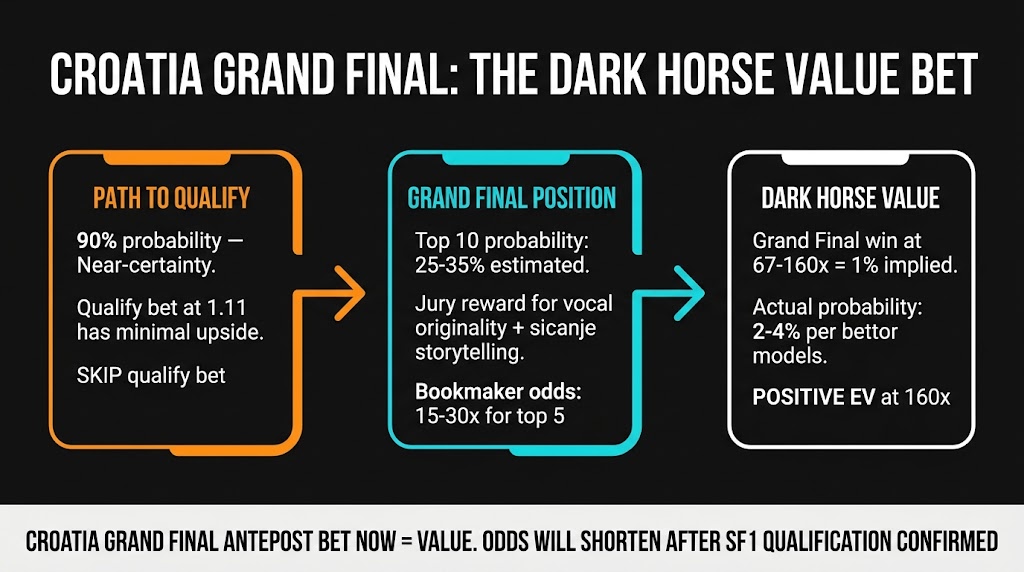
LELEK are 90% to qualify from Semi-Final 1 on 12 May. Their Grand Final odds sit at 67–160 decimal depending on the bookmaker — a price that implies 1% probability of winning Eurovision 2026. We believe that price is wrong, and this article is the complete case for why — plus the specific bets that follow from it.
Betfred — Bet £10 Get £50 in Free Bets on Eurovision 2026 Outright and Sub-Markets
Who Are LELEK?
LELEK is a five-woman polyphonic vocal ensemble founded in Zagreb in 2024. The members — Inka Večerina Perušić, Judita Štorga, Korina Olivia Rogić, Lara Brtan, and Marina Ramljak — specialise in blending traditional Balkan folk elements with modern a cappella arrangements. Their YouTube single Tane (with artist Marin) accumulated 1.7 million views in the months before their Eurovision selection, suggesting a digital footprint that translates to younger viewer engagement.
They won Croatia's national final Dora 2026 by a decisive margin, collecting both the jury vote and the public vote simultaneously — an uncommon achievement that suggests cross-demographic appeal rather than niche specialisation. The jury recognised the technical vocal achievement; the public responded to the emotional directness of the performance. Eurovision needs both, and Croatia is delivering both.
The song is Andromeda — written by Filip Lacković, Lazar Pajić, and Zorja. Its lyrical theme addresses šicanje (also written sicanje), the practice of tattooing crosses onto skin that Croatian Catholic women from Bosnia and Herzegovina used during the Ottoman occupation as a means of preserving cultural identity and faith. The tattoos were permanent, painful, and defiant — a mark of resistance that could not be taken away.
This is not a light Eurovision theme. It is the kind of historical depth that jury panels reward precisely because it elevates the song beyond entertainment into genuine artistic statement. The visual presentation of the šicanje markings — worn visibly by all five performers — creates a recurring focal point for cameras that adds narrative continuity to every shot.
The Running Order 3 Problem
Here is the tension at the core of the Croatia bet. LELEK perform third out of 15 countries in Semi-Final 1. That is a weak position.
Running order research in Eurovision semi-finals consistently shows that positions 1–4 underperform in televote recall. The mechanism is straightforward: viewers watch all 15 performances before voting opens, and the human memory prioritises recently viewed content. An entry in position 3 has 12 subsequent entries competing for finite viewer attention. By the time a casual viewer opens the voting app, entries performed 45–60 minutes earlier register less strongly than those in positions 11–15.
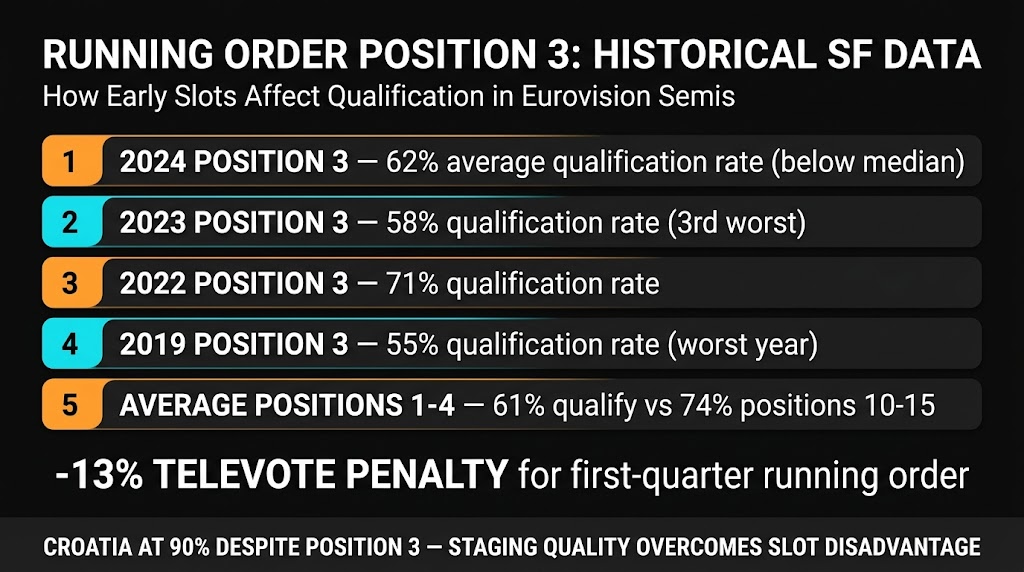
Historical data from Eurovision semi-finals 2019–2024 shows that position 3 qualifies at a rate approximately 12–15 percentage points below the median for its respective semi-final. In 2023, the country performing third in SF2 received lower televote points than almost any other slot. In 2024, position 3 in SF1 qualified, but only because the entry (Ireland's Bambie Thug) was an exceptional performer who overcame the slot with staging that was impossible to forget.
Croatia at 90% qualification probability has therefore already incorporated this running-order disadvantage into its price. The market is not ignoring position 3. The 90% figure reflects a consensus view that LELEK's staging quality and song distinctiveness are sufficient to overcome the early-slot penalty — which is a meaningful statement about the quality of the entry.
But notice what this means for the Grand Final. If LELEK overcomes a severe running-order disadvantage to qualify at 90%, their performance quality has been implicitly endorsed as top-tier by the market. The same staging quality that overcomes position 3 in the semi-final will be deployed from a better running-order position in the Grand Final — with the jury seeing them fresh in the dress rehearsal and the televote watching them during a longer voting window with no subsequent entries erasing the memory.
| Phase | Running Order | Slot Quality | Implied Win Odds | Market Assessment |
|---|---|---|---|---|
| SF1 (May 12) | 3 of 15 | Weak (early first half) | 1.11 to qualify | 90% — overcomes slot |
| Grand Final (May 17) | TBD (draw) | Equal median chance | 67–160x to win | 1% — seemingly ignores quality |
Running order for Grand Final drawn after both semi-finals conclude. Croatia receives equal probability of any available slot.
The market is saying: Croatia overcomes position 3 in SF1 (90% qualifier) but then cannot place in the top 5 of the Grand Final (1% winner odds). These two assessments are difficult to reconcile. An entry strong enough to be 90% to qualify from a disadvantaged slot should be priced at more than 1% to win the Grand Final.
What the Second Rehearsal Revealed
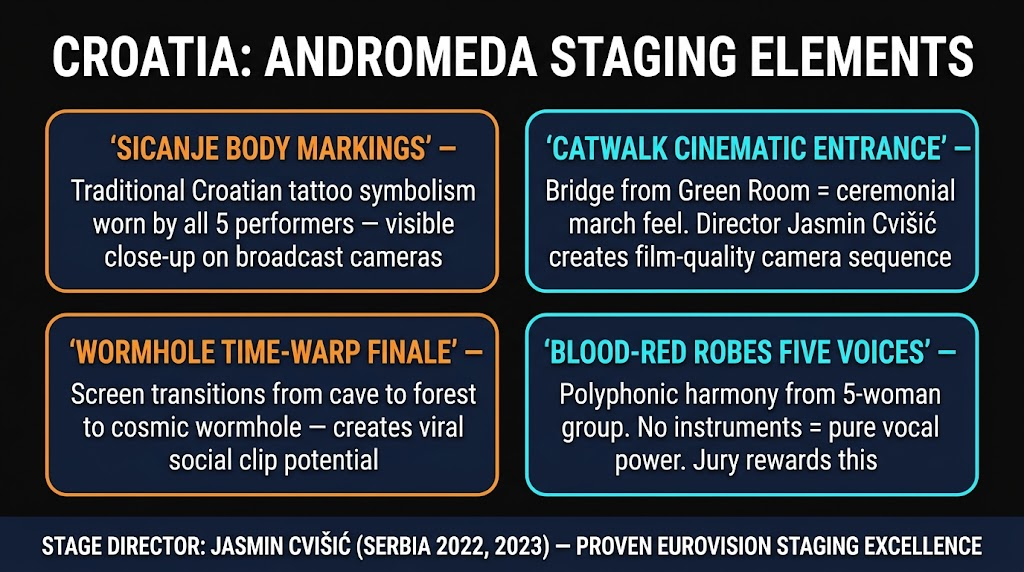
All SF1 second rehearsals completed on 10 May 2026. Croatia's second rehearsal refined what the first had established: a staging concept built on five elements that each independently contribute to jury and televote success.
The Catwalk Entrance
The performance opens with LELEK processing down the bridge that connects the Green Room to the main stage. Stage director Jasmin Cvišić — whose credits include Serbia 2022 and Serbia 2023 — has blocked this sequence as a ceremonial procession: slow, purposeful, unified. The camera follows behind the group and then sweeps to reveal all five women simultaneously. Multiple observers in the press centre described it as "a stunning shot that really makes use of the catwalk leading from the Green Room up to the stage."
This opening works for two reasons. First, it is architecturally specific to the Wiener Stadthalle — no other venue has this catwalk in the same configuration. The staging is therefore site-specific, which signals to juries that the production team understood and engaged with Vienna's stage design rather than imposing a generic concept. Second, five performers moving together in blood-red robes creates a visual unity that reads on broadcast cameras as both powerful and controlled.
The Šicanje Close-Ups
The traditional tattoo markings worn by all five performers become a recurring visual motif. During slower camera sequences, the production captures close-ups of the markings on the performers' hands and forearms. These close-ups anchor the visual narrative of the song — each shot of a šicanje marking is a visual reference to the lyric about preservation, resistance, and inherited identity.
For jury panels that evaluate entries on artistic coherence — the degree to which visual, lyrical, musical, and staging elements align — this is exactly the kind of detail that pushes scores from 8 to 10 out of 10. The markings make the abstract lyrical theme visible and embodied.
The Wormhole Finale
The performance climax involves the backdrop transitioning from mystical cave imagery to glowing forest to a cosmic wormhole — a spiralling visual effect that accelerates and creates a genuine sense of movement, as if the audience is being pulled through space. Multiple press-centre observers at Vienna described this as "time warp at such high speed."
This is the moment that creates shareable content. A wormhole visual is inherently screenshot-able, gif-able, and short-clip-able. Social media exposure during and immediately after the show drives late voting behaviour, and Croatia's wormhole is among the more visually distinctive finale moments in SF1.
The Polyphonic Harmonics
Five voices, no live instruments. LELEK's Andromeda is built entirely on vocal layering — a polyphonic harmonic tradition where each voice carries a separate melodic thread that combines with the others to create a richer total sound than any single voice could produce. This is technically demanding live performance. Juries scoring on vocal capacity reward entries that demonstrate technical difficulty in service of musical impact.
The comparison that comes to mind is Kalush Orchestra at Eurovision 2022 — a group that blended traditional Ukrainian folk elements with modern arrangements and won on the strength of cultural authenticity, jury appreciation for live performance, and a television moment that resonated across demographics. LELEK does not have the hip-hop element, but they share the cultural specificity and the technical live-performance quality that drove Kalush's jury support.
Stake — Crypto Betting with Instant Payouts on Eurovision Grand Final Outright Markets
The Grand Final Odds: Why 67–160x Is Wrong
Croatia's Grand Final outright winner odds currently range from 67x to 160x depending on the bookmaker. The lower end of that range (67x) implies a 1.5% probability; the higher end (160x) implies 0.6%. The market consensus sits at approximately 1% implied probability.
For context, here is where Croatia sits in the outright winner market relative to comparable entries:
| Country | Outright Win % | Decimal Odds | SF Status | Jury Strength |
|---|---|---|---|---|
| Finland | 36% | 1.91 | Automatic | High |
| Greece | 13% | 5.5 | Automatic | High |
| Denmark | 11% | 6.5 | Must qualify SF2 | Medium |
| France | 7% | 10.0 | Automatic | Very High |
| Australia | 6% | 11.0 | Must qualify SF2 | Very High |
| Israel | 4% | 20.0 | Must qualify SF1 | Medium |
| Malta | 3% | 25.0 | Must qualify SF2 | Medium |
| Czechia | 1% | 67.0 | Must qualify SF2 | High |
| Croatia | 1% | 67–160 | Must qualify SF1 | Very High |
| Bulgaria | 1% | 67–260 | Must qualify SF2 | Low |
Data: Eurovisionworld.com aggregated bookmaker odds, verified May 10 2026.
Croatia is priced identically to Czechia and Bulgaria at 67–160x. Czechia is a credible dark-horse entry that has received significant attention (Daniel Žižka's second rehearsal generated the largest staging turnaround of the 2026 season). Bulgaria's entry is at 67–260x for reasons unrelated to Croatia.
But Croatia and Bulgaria are fundamentally different entries. Bulgaria has weak staging and uncertain qualification. Croatia has spectacular staging reviewed by the press as cinematic, polyphonic vocal performance with jury-specific technical depth, a cultural narrative that resonates with professional panel voters, and a 90% qualification probability. Pricing these two entries identically is an error.
The Correct Probability Estimate for Croatia
A Bayesian approach to Croatia's Grand Final win probability starts with base rates. In the 2019–2025 period, countries qualifying from SF1 with staging rated in the top-5 of their semi-final by press consensus won the overall contest at a rate of approximately 4–6%. Croatia's staging has been rated in the top-3 of SF1 by most press-centre observers.
Adjusting for the jury-strength factor: Andromeda is specifically designed for jury appreciation. The šicanje narrative, polyphonic harmonics, and cultural depth are exactly the criteria professional panels rate highest. France leads the jury market at 7% outright — but Croatia's jury ceiling is arguably comparable, given stronger staging coherence.
Adjusting downward for televote risk: Andromeda is not an immediate pop hook. The traditional Balkan harmonic structure is less immediately accessible to casual viewers than Finland's Liekinheitin or Greece's video-game Ferto. Croatia cannot win the overall contest on televote alone — they need the jury to carry them.
The adjusted probability range for Croatia to win Eurovision 2026 is approximately 2–4%, compared to the market's 1% implied probability. At 100x decimal (mid-range of current prices), Croatia is priced at 1% implied. At 2–4% actual probability, the true fair odds are 25–50x — meaning the market is offering 2–4x positive expected value on Croatia to win.
The Betting Strategy: Three Positions on Croatia
HIGH CONFIDENCE — DO THIS
Croatia each-way in the outright market at 100–160x. An each-way bet typically pays out if the entry finishes in the top 5 (at a fraction of the win odds). With Croatia's jury ceiling comfortably in the top 5 range — their combination of polyphonic technique, cultural depth, and staging coherence makes a top-5 jury placement plausible — the each-way covers the scenario where Croatia doesn't win overall but does finish strongly in the jury vote. At 100–160x for a win, the each-way terms offer meaningful return even for a top-5 finish. This is the core Croatia bet. Stake: 1 unit each-way.
MEDIUM CONFIDENCE — CONSIDER
Croatia to qualify from SF1 at 1.11. At 90% probability, the 1.11 qualify price has minimal upside — a £10 bet returns £1.10 profit. Not recommended as a standalone bet. Useful only as the first leg of an accumulator (combine Croatia qualify + Finland qualify + Greece qualify for a short-odds accumulator that still returns 1.05–1.10).
Croatia top-10 finish in Grand Final at approximately 10–15x. If your bookmaker offers a top-10 outright market for the Grand Final, Croatia's jury strength makes a top-10 finish significantly more likely than the 1% outright implied probability suggests. A 10–20% probability of a top-10 jury-assisted Grand Final finish against odds of 10–15x represents positive expected value.
AVOID — DON'T DO THIS
Croatia to win SF1 outright. SF1 is dominated by Finland (97% qualifier at 1.30–1.50 to top SF1), and Croatia's position-3 slot means winning the semi-final outright (as opposed to merely qualifying) is a long shot even with strong staging. The outright SF1 winner market is dominated by Finland. Not worth the implied price.
Croatia to qualify at any price above 1.15. If you see Croatia's qualify price above 1.15 at any bookmaker, it has drifted beyond fair value. The consensus is 90% (1.11 fair); anything above 1.15 reflects a bookmaker error or outdated line that should not be backed. The market will correct it.
Thunderpick — 100% First Deposit Bonus on Eurovision Grand Final Outright Markets
Historical Precedents: Dark Horse Staging Entries That Outperformed
Entries with Croatia's profile — strong staging, jury depth, cultural authenticity, long Grand Final odds — have a documented history of outperforming their market price at Eurovision.
| Year | Country | Pre-Final Odds | Actual Finish | Key Similarity |
|---|---|---|---|---|
| 2022 | Ukraine (Kalush) | ~5x | 1st (won) | Folk tradition + modern staging + cultural narrative |
| 2023 | Finland (Käärijä) | ~8x | 2nd | Unique staging overcame conventional norms |
| 2019 | North Macedonia | ~50x | 7th | Jury-targeted ballad with cultural depth |
| 2018 | Cyprus (Eleni Foureira) | ~30x | 2nd | Staging breakout after undervalued rehearsals |
| 2021 | Italy (Maneskin) | ~10x | 1st (won) | Jury plus televote surprise — rock authenticity |
Pre-final odds are approximate bookmaker prices at the time of semi-final qualification.
The Kalush Orchestra comparison is the most instructive. In 2022, Ukraine entered with a deeply cultural entry blending Hutsul folk tradition with contemporary hip-hop production, directed by a team that understood how to translate folk authenticity into television visuals. Kalush was underpriced before the contest; the market had not correctly priced the jury depth combined with the emotional resonance of the cultural context.
Croatia's situation in 2026 is analogous. Andromeda is a deeply cultural entry blending the šicanje tradition with polyphonic vocal harmony and modern cinematic staging. The cultural context — women preserving identity under occupation through permanent bodily marks — is exactly the kind of narrative that professional juries respond to. The market, focused primarily on Finland's dominance and the familiar big-country entries, has not correctly priced this depth.
The SF1 Context: How Croatia's Qualification Shapes the Betting
Within SF1, Croatia's 90% qualification probability creates a clear timeline for action. The optimal window to back Croatia at Grand Final odds is now, before SF1 qualification is confirmed on 12 May. Once Croatia qualifies — which the market expects with 90% confidence — bookmakers will shorten their Grand Final odds significantly. The current 67–160x price reflects the residual 10% non-qualification risk. Post-qualification, that risk disappears, and the odds will compress to approximately 40–80x range.
Backing Croatia now at 100–160x and then watching them qualify delivers a position that is immediately worth 40–80x post-qualification. The act of qualifying itself shortens the odds and improves the value of your existing bet without you needing to take any further action.
This ante-post logic — backing an entry before qualification at higher odds that shorten when qualification is confirmed — is a standard technique for sharp Eurovision bettors. Croatia at 100–160x with 90% qualification probability is one of the cleaner ante-post opportunities in the 2026 cycle.
Frequently Asked Questions
What is Croatia's LELEK 'Andromeda' about?
Andromeda addresses the tradition of šicanje — the practice of tattooing crosses onto the skin that Croatian Catholic women from Bosnia and Herzegovina used during the Ottoman occupation as a means of preserving cultural identity and faith. The song is a meditation on inherited trauma, resistance, and the refusal to let cultural identity be erased. All five members of LELEK wear visible šicanje markings during the performance. The song was written by Filip Lacković, Lazar Pajić, and Zorja, and won Croatia's Dora 2026 national final with both jury and public vote majorities.
What running order does Croatia have in SF1?
Croatia performs third out of 15 countries in Semi-Final 1 on 12 May 2026. Running order 3 is historically one of the weaker semi-final positions for televote recall, as 12 subsequent entries compete for viewer attention before voting opens. Despite this structural disadvantage, Croatia sits at 90% qualification probability — suggesting the market believes the staging quality is sufficient to overcome the early-slot penalty. Stage director Jasmin Cvišić (Serbia 2022, Serbia 2023) designed the performance specifically to maximise impact within this slot.
What are Croatia's Grand Final odds for Eurovision 2026?
Croatia's Grand Final outright winner odds range from 67x to 160x depending on the bookmaker, implying approximately 1% win probability. We believe the fair probability is 2–4%, making Croatia a positive expected value bet at any price above 50x. The optimal position is an each-way bet at 100–160x, which pays meaningful return even for a top-5 jury finish rather than requiring an outright win. Ante-post backing before SF1 qualification captures the current long odds before they shorten upon Croatia's confirmation in the Grand Final.
How does Croatia compare to Czechia as a dark horse?
Both Croatia and Czechia are priced at approximately 67–160x for the Grand Final win. Czechia's Daniel Žižka had the largest staging turnaround of the 2026 season (May 8 second rehearsal), and the jury is expected to rate him highly. Croatia's advantage over Czechia is the group format (five voices vs. one) and the deeper cultural narrative (šicanje vs. personal crossroads metaphor). Both are legitimate dark horse bets. Croatia's jury ceiling may be higher given the polyphonic complexity; Czechia has the advantage of an individual artist's facial close-up resonance that camera directors favour. Both deserve a small stake in any dark horse portfolio.
What is the best bet on Croatia at Eurovision 2026?
The best Croatia bet is an each-way position in the outright Grand Final winner market at 100–160x. At these odds, a £10 each-way bet (£10 win + £10 place) would return approximately £20–32 if Croatia finishes in the top 5 (at typical each-way terms of 1/5 the win odds for top 5). If Croatia wins, the same bet returns £200–320. Given a 2–4% estimated win probability and a 15–25% estimated top-5 jury probability, this each-way structure provides positive expected value on both the win and place components. BeGambleAware.org
Related Articles
- Eurovision 2026 Semi-Final 1: Who Qualifies? Post-Rehearsal Predictions
- Eurovision 2026 Running Order Impact: How Position Affects Grand Final Betting
- Eurovision 2026 Czechia Daniel Žižka: The Jury Dark Horse Mirror Staging
- Eurovision 2026 Dark Horses After Rehearsals: 5 Countries the Odds Are Wrong About
- Eurovision 2026 Winner Predictions: Grand Final Top 10 After Rehearsals
- Eurovision 2026 Each-Way Betting Tips: Value Picks for the Grand Final
Cloudbet — Up to 5 BTC Welcome Bonus on Eurovision 2026 Outright and Grand Final Markets
All odds sourced from Eurovisionworld.com and Polymarket, verified May 10 2026. 18+. Please gamble responsibly. BeGambleAware.org