
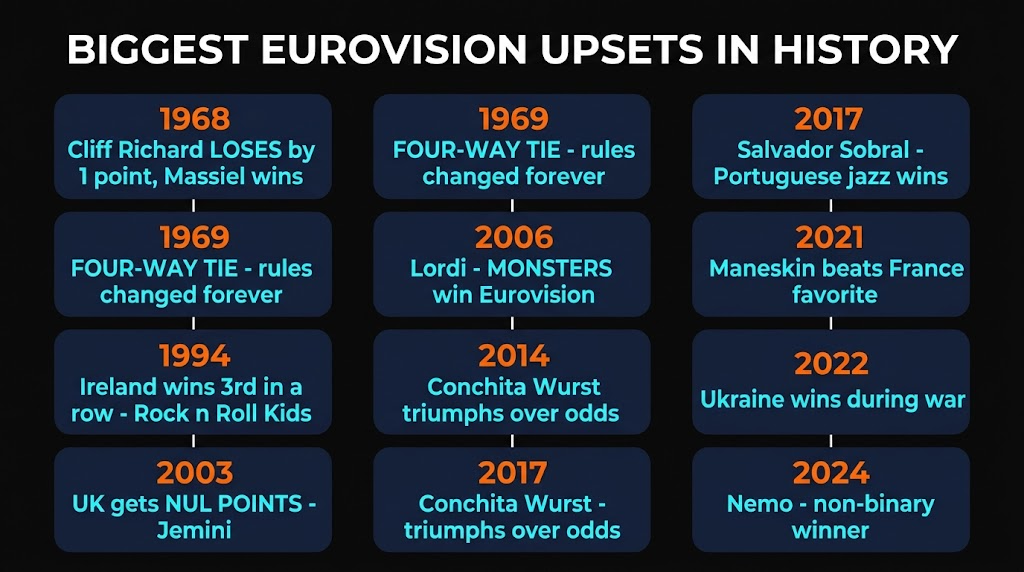
Eurovision has a perfect record for delivering moments no one saw coming. Bookmakers can study patterns, juries can rank performances, and fans can debate for months — but every year, the contest finds a way to surprise everyone. Here are the 10 biggest shocks in Eurovision history, ranked for dramatic impact and betting relevance, and what each one teaches us about the unpredictability heading into Eurovision 2026.

18+ | New customers only | T&Cs apply | Please gamble responsibly
1. Cliff Richard Loses by One Point — 1968
In 1968, Britain's Cliff Richard seemed destined to win Eurovision with 'Congratulations'. The song had topped charts across Europe, Cliff was at the peak of his fame, and the UK was the bookies' favourite.
Then came Spain's Massiel with 'La, la, la...'. In one of the most dramatic voting sequences ever, Spain edged Britain by a single point. Decades later, a Spanish documentary alleged that dictator Francisco Franco's regime had bought votes to engineer a Spanish victory — a claim that remains disputed but adds to the mystique of the upset.
Betting lesson: Favourites can lose by the narrowest margins. In Eurovision, even a single point can be decisive.
2. The Four-Way Tie — 1969
The 1969 contest produced a genuinely unprecedented result: four countries tied for first place. France (Frida Boccara), the Netherlands (Lenny Kuhr), Spain (Salomé), and the United Kingdom (Lulu) all finished on 18 points with no tiebreaker in place.
Four separate trophies were awarded, and Eurovision's rulebook was rewritten immediately. This led to the modern tiebreaker system where televote is used to separate tied jury scores — the exact mechanism that will decide Eurovision 2026 if the final vote is close.
Betting lesson: Rules matter. Always understand the tiebreaker scenarios when placing bets on close contests.
3. Ireland Wins Three in a Row — 1992, 1993, 1994
Eurovision history's greatest dynasty. Ireland won Eurovision in 1992 (Linda Martin), 1993 (Niamh Kavanagh), and 1994 (Paul Harrington & Charlie McGettigan) — the first and only country to win three consecutive contests in the modern era.
The 1994 contest in Dublin produced another shock: the interval act 'Riverdance' — a seven-minute showcase of Irish dance — became a global phenomenon that arguably outshone the contest itself. Charlie McGettigan, co-winner of 1994, has pledged to return his trophy to the EBU in 2026 in solidarity with the Israel boycott.
Betting lesson: Momentum matters. A country riding a winning streak can exceed its song-by-song expected performance.
4. Jemini's Nul Points — 2003
The United Kingdom's darkest Eurovision moment. In 2003, Jemini performed 'Cry Baby' and received zero points — the first nul points for the UK in Eurovision history. The performance was marred by vocal technical issues, and the result sparked years of UK soul-searching about its Eurovision strategy.
The real shock was not just the result but the speed of the decline. The UK had finished in the top five as recently as 2002. Going from contender to nul points in a single contest illustrated how quickly Eurovision fortunes can reverse.
Betting lesson: Live performance quality trumps pre-show analysis. A good song with a bad live performance can finish last.
5. Lordi: Monsters Win Eurovision — 2006
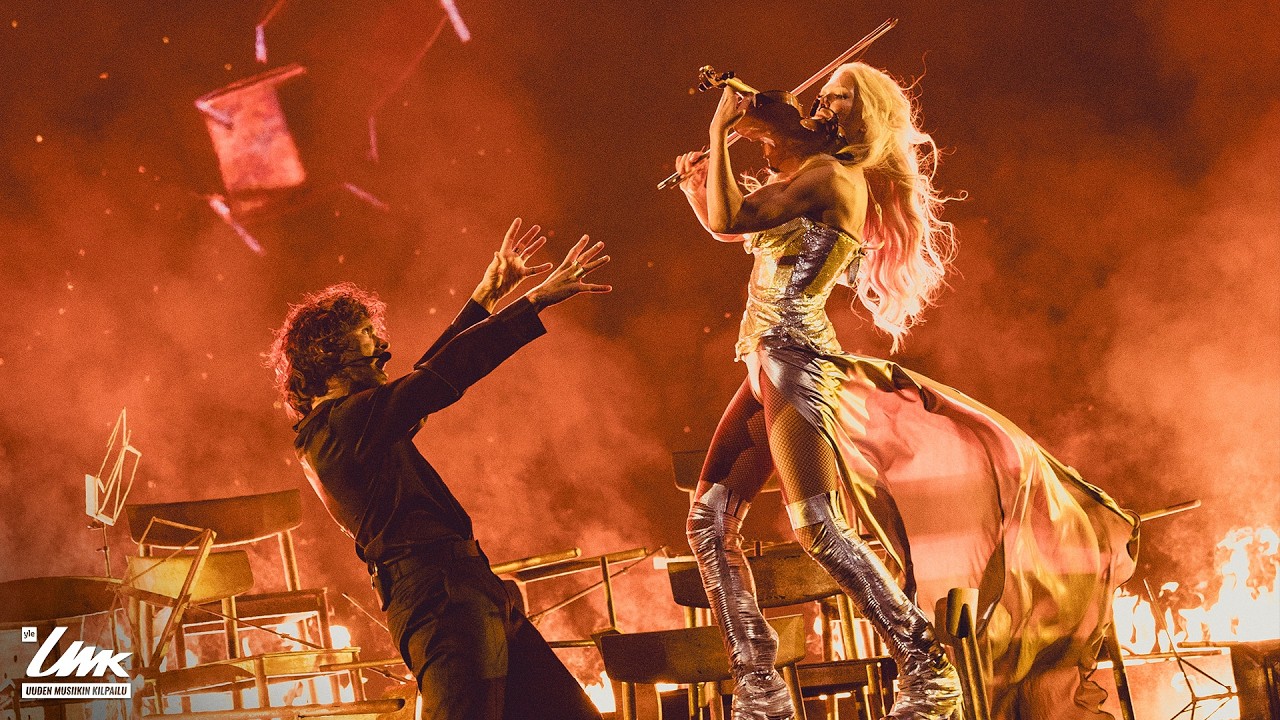
The greatest Eurovision image of the 21st century. On May 20, 2006 in Athens, Finland's Lordi — dressed in full monster costumes — performed 'Hard Rock Hallelujah' and won Eurovision with 292 points, a new contest record.
Before 2006, Eurovision was considered terrain for ballads and Europop. Lordi shattered that assumption. The victory proved that hard rock, spectacle, and full-on theatrical production could triumph — and opened the door for everything from Måneskin's rock triumph in 2021 to genre-bending winners ever since.
Betting lesson: Eurovision rewards spectacle. Pre-contest odds consistently underprice theatrical entries that stand out from the ballad crowd.
6. Conchita Wurst Triumphs — 2014
Austria's Conchita Wurst, the drag persona of Tom Neuwirth, won Eurovision 2014 with 'Rise Like a Phoenix'. The victory was historic on multiple levels: an LGBTQ+ icon winning Europe's biggest music contest, set against the backdrop of rising anti-LGBTQ+ sentiment in parts of Europe.
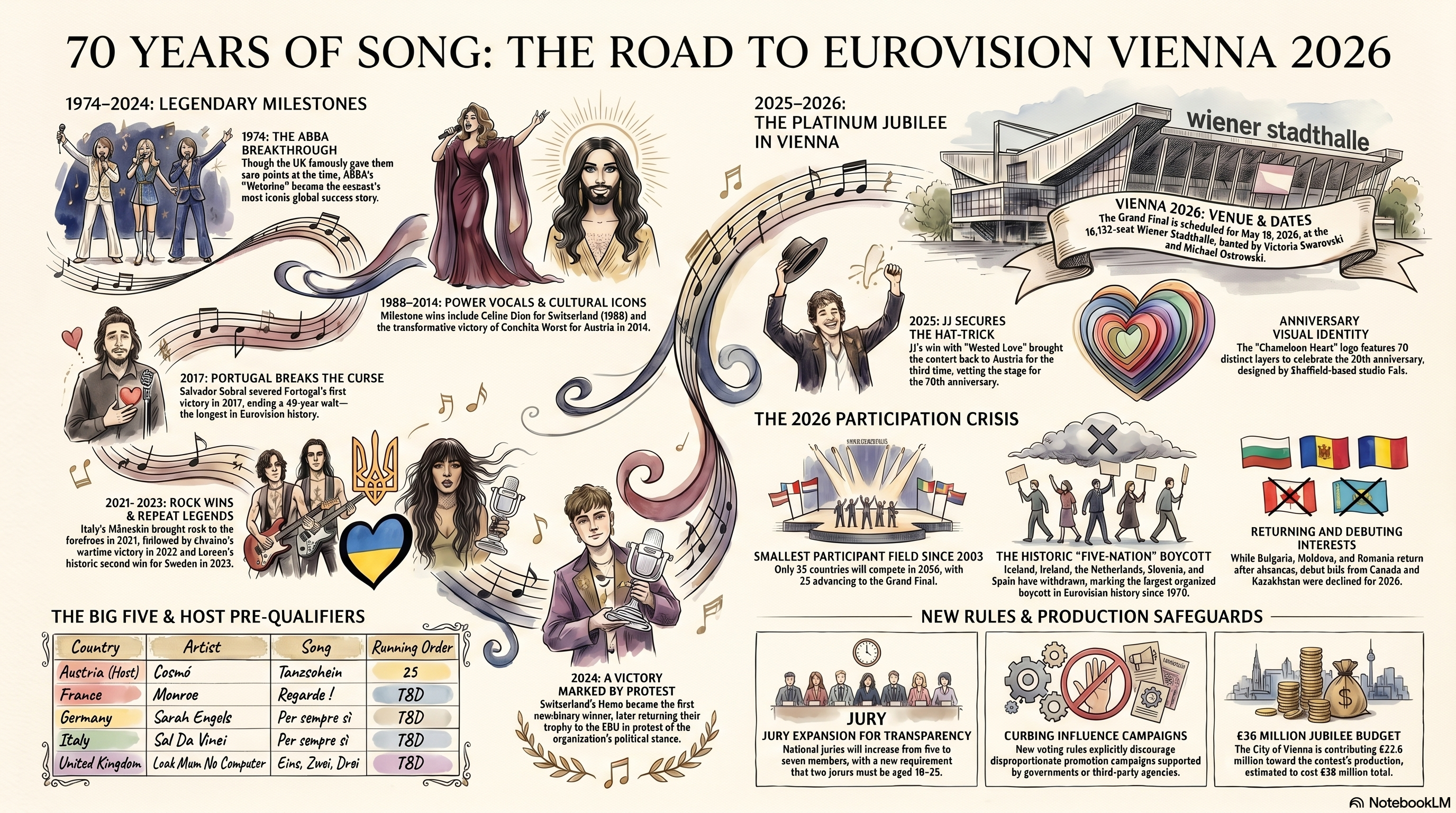
The shock was the margin. Conchita was not a pre-contest favourite — Sweden's Sanna Nielsen was tipped to win — but Austria surged to victory on both jury and televote power, winning with 290 points. This victory brought Eurovision back to Austria for 2015, and Austria's hosting that year at the Wiener Stadthalle directly set the stage for Eurovision's return to the same venue in 2026.
Betting lesson: Authentic cultural moments can transcend pre-contest predictions. Songs with strong emotional narratives often outperform their odds.
7. Salvador Sobral's Jazz Triumph — 2017
Portugal had never won Eurovision in 52 years of competing. Then came Salvador Sobral with 'Amar pelos dois' in 2017 — a delicate jazz ballad performed with extraordinary restraint and emotional depth. Portugal won with 758 points (under the then-new voting system), the highest score in Eurovision history at the time.
The victory was a shock because Portugal had previously never finished higher than sixth place. That one of Eurovision's perennial also-rans could deliver such an emotionally overwhelming winner rewrote everyone's expectations of what Eurovision could be.
Betting lesson: Artistry can triumph over spectacle. A genuinely moving, vocally flawless performance can beat flashier production.
8. Måneskin Beats the French Favourite — 2021
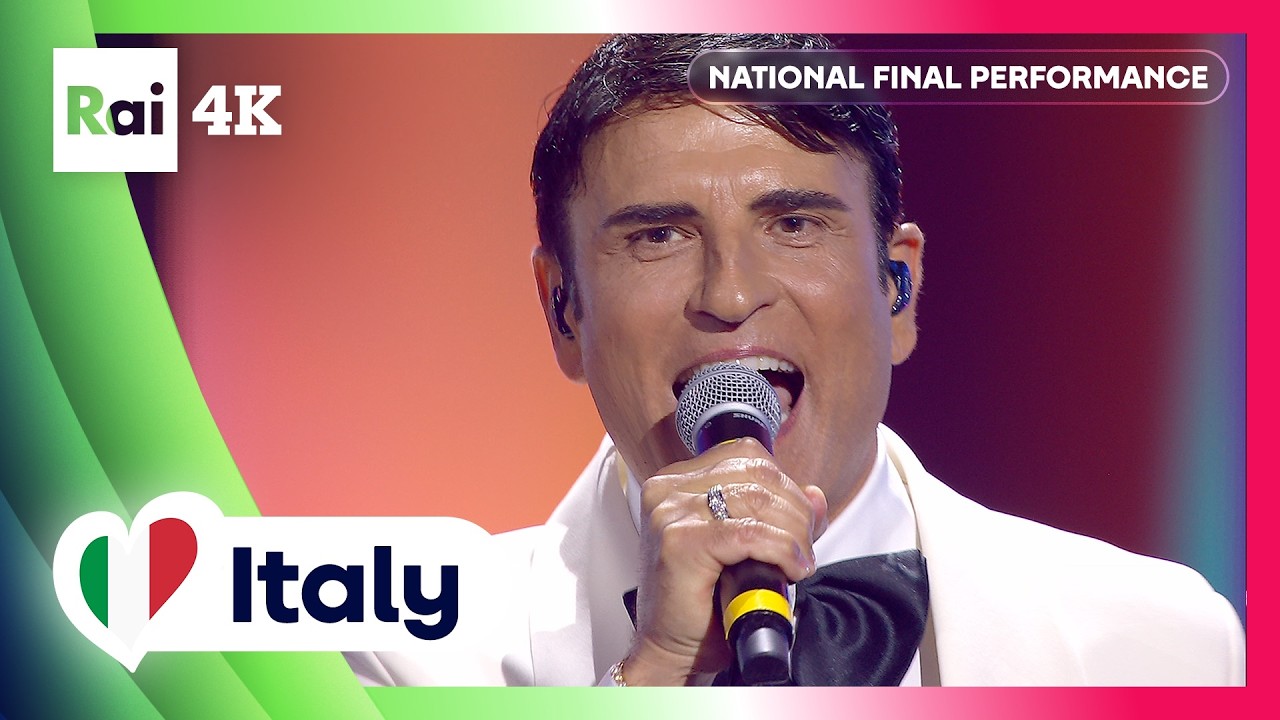
The 2021 contest in Rotterdam had a clear favourite: France's Barbara Pravi with 'Voilà' — a sweeping chanson that seemed destined to win. At the last moment, Italy's Måneskin surged past with 'Zitti e buoni', a rock song that combined Italian panache with modern production.
Måneskin won with 524 points, Barbara Pravi finished second with 499. In retrospect, Måneskin's victory was the start of one of the biggest rock band emergences of the 2020s — they have since sold millions of records worldwide. Barbara Pravi had a successful career but no comparable global breakthrough.
Betting lesson: Rock and guitar-driven entries consistently outperform their pre-show odds. The market underprices them.
9. Ukraine Wins During the War — 2022
On May 14, 2022, less than three months into Russia's full-scale invasion of Ukraine, Kalush Orchestra won Eurovision with 'Stefania'. The shock was not that Ukraine won — they were favourites due to the enormous wave of European sympathy — but the scale of the televote victory.
Ukraine received 439 televote points — a record at the time — on top of strong jury support. The victory was as much a political statement as a musical one, and it exposed the political dimension of Eurovision voting that the EBU officially denies exists.
Betting lesson: Political sympathy and narrative momentum can drive televotes to extraordinary totals. This is particularly relevant for 2026, where the Israel boycott controversy shapes every voting dynamic.
10. Nemo Wins for a Non-Binary Artist — 2024
Switzerland's Nemo won Eurovision 2024 in Malmö with 'The Code' — a genre-defying combination of rap, opera, and pop celebrating non-binary identity. The victory was historic as the first win by an openly non-binary artist and as Switzerland's first Eurovision win since Céline Dion in 1988.
In December 2025, Nemo returned the winning trophy to the EBU in protest at Israel's participation in Eurovision 2026, declaring the trophy no longer belonged on their shelf. Reports suggest the trophy was damaged in transit. This gesture has become one of the defining images of the Eurovision 2026 pre-contest period.
Betting lesson: Eurovision rewards artists who push boundaries. Genre-defying entries that don't fit obvious categories have an edge in an era that values originality.
What These Shocks Mean for Eurovision 2026
The history of Eurovision shocks holds clear lessons for anyone betting on Eurovision 2026:
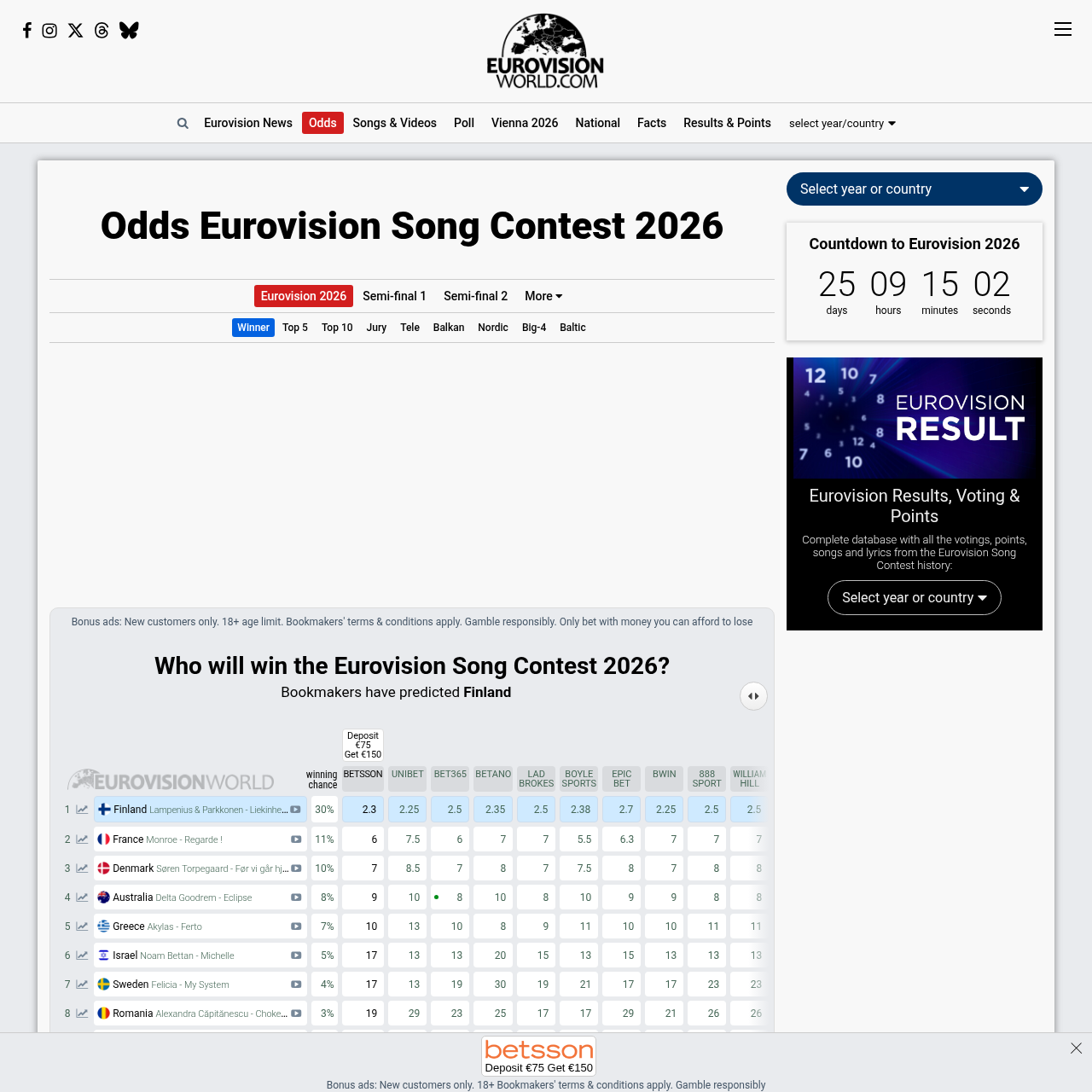
- Favourites often lose — Finland is currently the favourite at Betfred, but history shows pre-contest favourites win less than half the time
- Underdog countries can win — Portugal never won before 2017, Ukraine had 18 years of attempts, Switzerland hadn't won since the 1980s
- Spectacle trumps safety — Lordi, Måneskin, and Conchita all pushed creative boundaries
- Televote can dominate — Political narratives (Ukraine 2022, Israel 2024/2025) can deliver massive televote margins
- The final performance matters most — Jemini's nul points prove that a bad live performance can destroy a strong pre-contest position
Dark Horses to Watch for Eurovision 2026
Based on these historical patterns, here are the Eurovision 2026 dark horses that could produce a shock:
- Greece (Akylas — 'Ferto') — Has surged from 15th to 5th in the betting. Mediterranean uptempo songs have a strong Eurovision televote record.
- Estonia (Vanilla Ninja comeback) — Nostalgic returning acts occasionally produce shock results.
- San Marino (Senhit feat. Boy George — 'Superstar') — Global star + micro-nation is exactly the kind of narrative Eurovision rewards.
- Luxembourg (returning country) — First return after 31 years. Returning countries can surprise with fan support.
Placing Bets on Eurovision 2026 Shocks
For bettors looking to position for a potential 2026 upset, Betfred offers:
- Outright winner — with longer odds on dark horses
- Top 10 finish — safer bet for value dark horses
- Non-favourite to win — anti-favourite combined bets
- Biggest shock of the contest — sometimes available as a specialist market
The best time to lock in value prices on dark horses is before rehearsals begin in late April. Once staging reveals begin, the market tightens quickly and shock-candidate odds shorten.
For the latest Eurovision 2026 odds including dark horses, favourites, and every competing country, visit Betfred.
18+. Please gamble responsibly. BeGambleAware.org
Related Articles
- Every Eurovision Winner 1956-2025
- Countries That Have Never Won
- Does the Favourite Win Eurovision?
- 15 Most Controversial Eurovision Moments
- Eurovision 2026 Dark Horses
Frequently Asked Questions
What was the biggest Eurovision upset ever?
Arguably Lordi's 2006 win for Finland — the first heavy rock/monster costumed act to win, with a then-record 292 points.
Has the betting favourite ever lost by one point?
Yes. In 1968, UK favourite Cliff Richard lost to Spain's Massiel by a single point — one of the tightest and most disputed results ever.
Are there any 2026 dark horses with a shot at a shock result?
Greece (Akylas — 'Ferto'), Estonia (Vanilla Ninja's comeback), and San Marino (Senhit feat. Boy George) all have shock potential according to current betting patterns at Betfred.