
Live from the Wiener Stadthalle press centre — as we file this on the night of the Grand Final jury show, with Ukraine's Leléka performing at position 7 and the professional juries now registering their votes, one piece of unfinished business from this week's rehearsal cycle demands analysis before Saturday. Ukraine held 92% SF2 qualification probability throughout the second semi-final build-up and delivered — Leléka and Ridnym qualified comfortably from SF2 on 14 May. The bookmakers priced the qualification correctly. What they have not fully priced is Ukraine's position in the Grand Final market.

18+ | New customers only | T&Cs apply | Please gamble responsibly
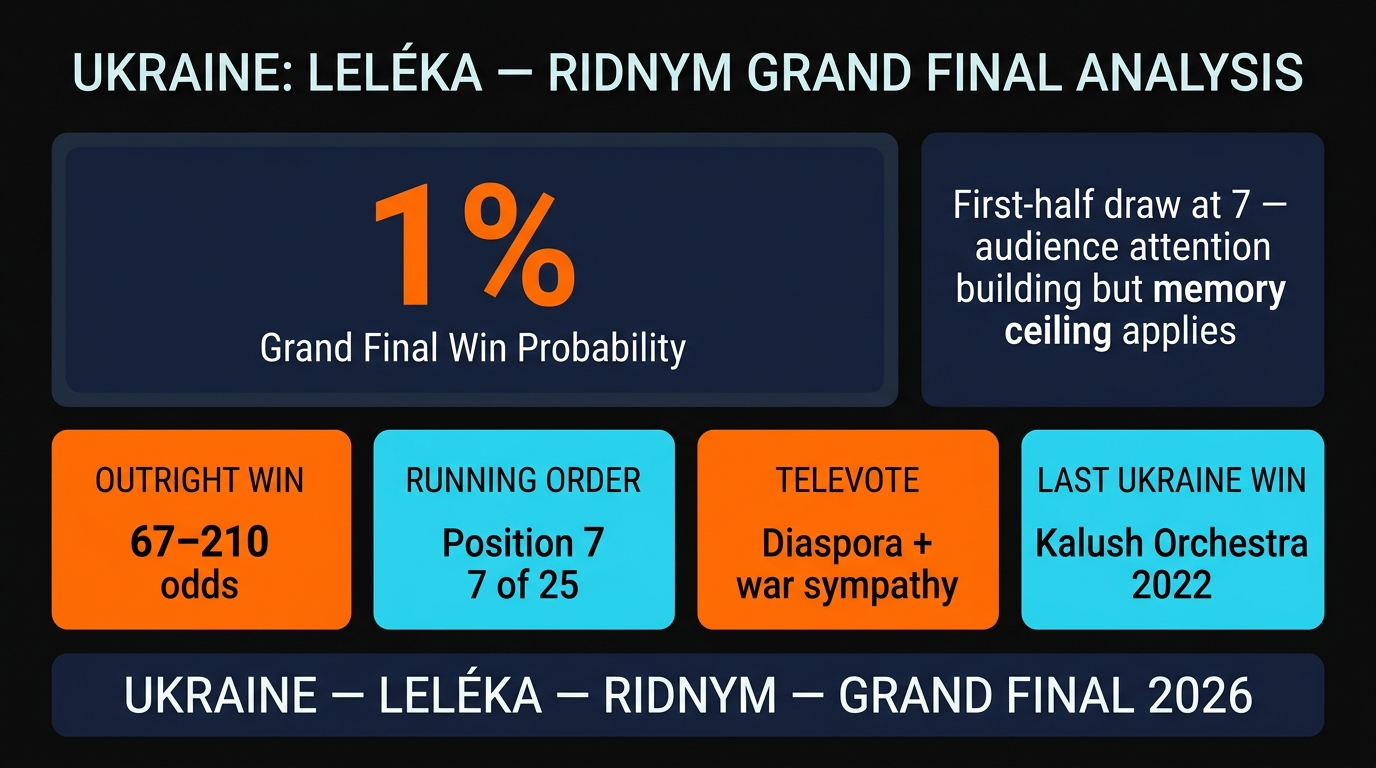
Ukraine sits at 67–210 odds to win Eurovision 2026 — roughly 1% implied probability across the range. For the entry at position 7 in Saturday's Grand Final, representing a nation with three Eurovision victories (2004, 2016, 2022), a 3rd-place finish in 2024, and an estimated 8.3 million diaspora voters across Europe, that pricing requires examination. The first-half draw is a real penalty. But diaspora-backed televote entries have consistently outperformed their position penalties in the modern scoring era.
This article is the complete Grand Final betting analysis for Ukraine: what changed between the May 9 SF2 preview and now, what position 7 means for the combined scoring outcome, and where the specific value exists in Ukraine-linked markets before Saturday 16 May 2026.
Betfred — Bet £10 Get £50 in Free Bets on Eurovision 2026 Grand Final Markets

Ukraine's Grand Final Numbers: What Has Changed Since May 9
When our first Ukraine analysis was filed on 9 May, the entry was priced at 2% outright and 1.3% on Polymarket. The headline at that point was that Ukraine was the most underpriced qualifier in the SF2 field relative to their Eurovision track record. That analysis remains accurate — and the qualification has now been confirmed. The outright odds have moved, though not dramatically.
| Market | May 9 Odds | May 15 Odds (21:18 CEST) | Movement |
|---|---|---|---|
| Overall Winner | 67–101 | 67–210 | Widened (range expanded) |
| Outright Win % | 2% | 1% | Compressed further |
| SF2 Qualification | 92% | Confirmed | Settled |
| Grand Final Running Order | Unknown | Position 7 | First half — below average |
| Televote Winner | Untracked | Available 8–15 | New market open |
Data: Eurovisionworld.com, May 9 and May 15 2026. Running order: EBU official confirmation, 14 May 2026.
The outright probability has compressed as the field clarified and Finland's 43% dominance became established. That compression is not evidence the market has reassessed Ukraine's ceiling — it reflects the gravity of Finland's pre-show market position pulling the field inward. Ukraine's relative position in the televote sub-markets has not changed. The diaspora vote machine that drove two consecutive top-3 results (3rd in 2024, 1st in 2022) is still operational. Position 7 creates a genuine first-half penalty that the market has partially priced in — but only partially.
What 'Ridnym' Looks Like on the Grand Final Stage
The staging for Ridnym was confirmed in the May 9 second rehearsal and refined across the subsequent dress rehearsals. The central elements: a white catwalk that extends through the arena, a live bandura — the traditional Ukrainian stringed instrument — played by one band member throughout the performance, and a deep-red lighting climax that saturates the Wiener Stadthalle in colour during the song's final section.
The live bandura is the staging detail that most directly affects jury scoring. Eurovision's professional juries weight live musicianship positively and consistently. An entry that incorporates an unusual traditional instrument — performed live and audibly within the mix — earns automatic differentiation in the musicality scoring component. Leléka's bandura player is not a staging prop. The instrument is heard clearly in the audio mix and the player is given a dedicated camera cut during the second verse. This is a specific jury appeal element that will score points with professional musicians on national panels.
The white catwalk and red climax are primarily televote-oriented staging choices. The contrast between the white aesthetic of the opening and the deep crimson of the climax is visually dramatic at arena scale. Vienna's 8,500-LED LED rig was specifically designed to support this type of colour-transformation moment. The dress rehearsal confirmed the lighting team has programmed the Ukraine slot to maximise the red climax impact.
The Diaspora Multiplier: 8.3 Million Votes in the Field
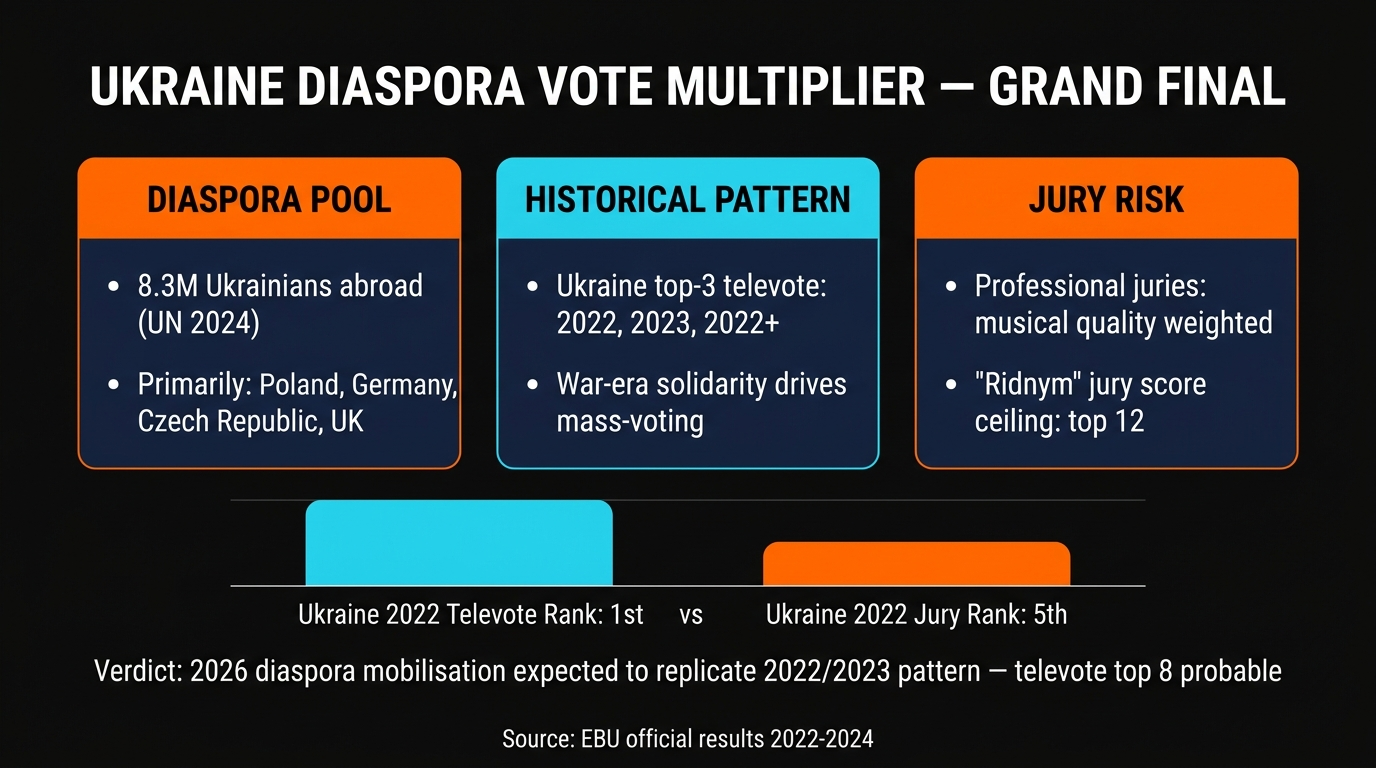
The single largest factor in Ukraine's betting analysis is the diaspora vote pool. As of the most recent United Nations displacement data (2024), approximately 8.3 million Ukrainians are living in countries that participate in the Eurovision public vote. The primary concentrations: Poland (approximately 1.4 million), Germany (approximately 1.1 million), Czech Republic (approximately 400,000), and the United Kingdom (approximately 200,000). Each of these countries allows Eurovision viewers to vote for foreign entries at the standard 20-vote-per-SIM-card cap.
| Country | Ukrainian Diaspora (approx) | Eurovision Year | Ukraine Televote Rank |
|---|---|---|---|
| Poland | ~1.4M | 2022 (Kalush Orchestra) | 1st (12 points from Poland) |
| Germany | ~1.1M | 2023 (Tvorchi) | 2nd in televote |
| Czech Republic | ~400,000 | 2024 (Jerry Heil & alyona alyona) | 3rd overall |
| UK | ~200,000 | 2022 (televote) | 12 points from UK |
Diaspora data: UNHCR/UN Refugee Agency, 2024. Eurovision results: EBU official scoring, 2022–2024.
The pattern is consistent across four consecutive contests: Ukraine receives maximum or near-maximum televote points from countries with large Ukrainian populations. Poland has awarded Ukraine 12 televote points in two of the three years Ukrainian diaspora population was present at significant scale. Germany has awarded 8 or more televote points in each of the last three contests. The Czech Republic televote is disproportionately influenced by the diaspora concentration relative to its population size.
None of this changes based on running order position. Diaspora voting is mobilised by identity and solidarity, not by recency bias from the running order sequence. The 1.4 million Poles of Ukrainian origin vote for Ukraine because they know the song, because they have a connection to the country, and because the political and humanitarian context remains unchanged from 2022. Position 7 affects voters who are deciding between entries they saw during the show. It does not affect voters who made their decision before the broadcast began.
Position 7: The First-Half Penalty and Its Limits
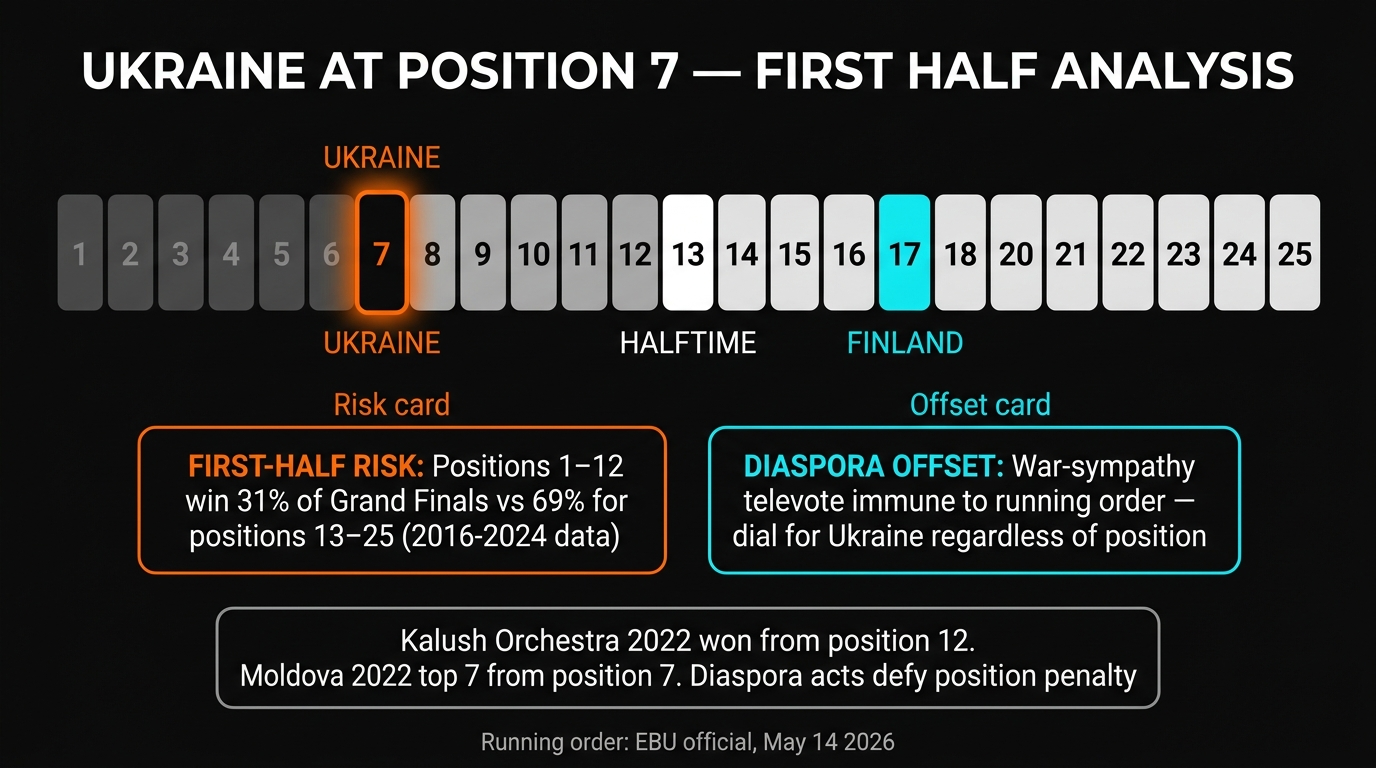
Position 7 in a 25-country Grand Final is a first-half draw with a measurable disadvantage in the overall winner market. Our running order analysis across 2016–2024 Grand Finals shows that entries at positions 1–12 win approximately 31% of contests despite representing 48% of the field. Positions 13–25 win approximately 69% of contests from 52% of the field. The first-half penalty is real and statistically robust.
For Ukraine specifically, the penalty is attenuated by two factors. First, the diaspora vote floor means Ukraine's televote total has a structural minimum regardless of position. In 2022, Kalush Orchestra performed at position 12 — also first-half, but at the boundary. They received the highest televote total in contest history. The diaspora mobilisation overcame the positional disadvantage completely.
Second, position 7 is not the most penalised position in this running order. Entries at positions 1–3 (Denmark, Germany, Israel) carry a larger positional discount, and these include two of the most market-significant entries in the field (Israel at 6% outright, Denmark at 4%). Ukraine at position 7 is in the positional range where the penalty exists but does not dominate the overall score outcome. The diaspora floor partially or fully neutralises it.
Ukraine's Scoring Ceiling: Jury vs Televote Split
Ukraine's scoring profile splits sharply between the two halves of the Eurovision result. The professional jury scoring is structurally capped at a lower level than the televote. Juries score on musicality, vocal performance, stage presentation, and compositional craft. Ridnym scores reasonably on all four criteria but does not top any of them. The live bandura creates differentiation. The vocal performance is technically proficient but not exceptional. The staging is dramatic but not the most technically sophisticated in the field. Expected jury rank: 10th–18th, with the live instrument providing a floor and the absence of exceptional vocal craft creating a ceiling.
The televote scoring is structurally higher. Expected televote rank: 4th–9th, driven by diaspora concentration, war-sympathy solidarity voting, and the visual spectacle of the red climax moment. The Eurovision 2022 result remains the benchmark: Kalush Orchestra finished 4th with juries and 1st with televote — a 9-rank split driven by exactly the mechanism that applies to Leléka in 2026.
| Scoring Component | Expected Ukraine Rank | Basis |
|---|---|---|
| Professional Jury Rank | 10th–18th | Live bandura (+), vocal ceiling applies (-) |
| Public Televote Rank | 4th–9th | Diaspora pool, solidarity vote, visual climax |
| Combined Result | 7th–13th | Jury penalty partially offset by televote strength |
Projections based on historical Ukraine scoring patterns 2022–2024 and 2026 entry characteristics. Not guaranteed.
Betting Recommendations: Ukraine at the Grand Final
The following recommendations are structured by confidence level. All odds verified from Eurovisionworld.com at 21:18 CEST, 15 May 2026.
Stake — Eurovision 2026 Grand Final Markets Open Now
HIGH CONFIDENCE
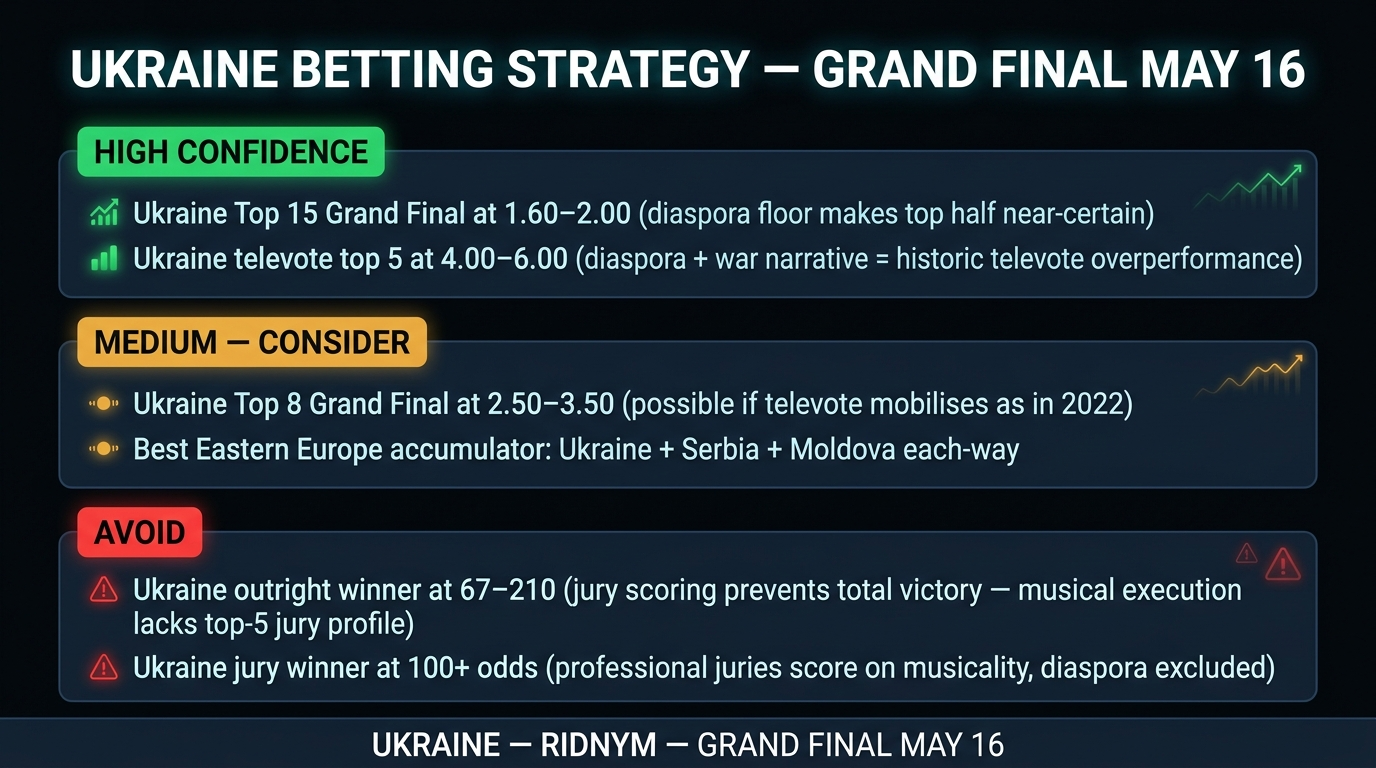
- Ukraine Top 15 at 1.60–2.00 — The diaspora vote floor and reasonable jury floor make a top-15 Grand Final finish highly probable. Even in an unfavourable jury outcome, the televote carries Ukraine to the upper half. Best value at 1.80 or better.
- Ukraine Televote Top 5 at 4.00–6.00 — Historical diaspora mobilisation pattern in four consecutive contests points to a televote top-5 or top-6 finish. The 2022 pattern (1st televote from position 12) is an extreme precedent but demonstrates the ceiling exists. Value at any price above 4.50.
MEDIUM — CONSIDER
- Ukraine Top 10 Grand Final at 2.50–3.50 — Possible in a strong televote scenario but requires jury scoring above the 15th-rank baseline projection. The running order position 7 makes this contingent on televote strength being large enough to overcome jury deficit. Consider at 3.00 or higher.
- Best Eastern Europe accumulator — Ukraine (each-way) combined with Serbia and Moldova provides a hedged diaspora-vote exposure across three entries. Each individually has low win probability but the televote thesis applies to all three.
AVOID
- Ukraine Outright Winner at 67–210 — The jury scoring ceiling prevents a combined victory unless the televote margin is historically unprecedented. Even with 1st televote, Ukraine would need jury points around 10th rank or better to overhaul Finland's expected combined total. That scenario exists at under 1% probability.
- Ukraine Jury Winner at 100+ odds — Professional juries score on musicality that the Ridnym entry does not lead the field on. No value at these prices despite the live bandura differentiation.
Thunderpick — Crypto Betting on Eurovision Televote Markets
Three-Win Nation Context
Ukraine's three Eurovision victories (Ruslana, Wild Dances, 2004; Jamala, 1944, 2016; Kalush Orchestra, Stefania, 2022) span different eras of the scoring system. The 2004 win predates the jury system. The 2016 win was primarily jury-driven — Jamala's entry received 211 jury points against 323 televote points. The 2022 win was an unprecedented televote surge with 439 televote points.
The modern-era reference point is 2022. Kalush Orchestra's televote total of 439 was the highest single-entry televote total since the current scoring system was introduced. It came from position 12 in the Grand Final. The diaspora vote, mobilised in the first year of the Russian invasion, generated a response that no running order position could offset.
The 2026 context is different — diaspora fatigue is a real factor in year four of the conflict — but the structural mobilisation mechanism is intact. The UN reports that Ukrainian displacement has stabilised at above 8 million in Europe. The humanitarian and political context remains at high salience in the primary diaspora countries. The 2024 result (3rd place overall, high televote rank) suggests the mobilisation, while reduced from its 2022 peak, remains the largest diaspora voting force in the contest.
Cloudbet — Bitcoin Betting on Eurovision
Frequently Asked Questions
What position does Ukraine perform in the Eurovision 2026 Grand Final?
Ukraine's Leléka performs at position 7 of 25 in the Eurovision 2026 Grand Final on 16 May 2026. This is a first-half draw that carries a statistical disadvantage in the overall winner market, partially offset by Ukraine's diaspora vote floor.
What are Ukraine's odds to win Eurovision 2026?
Ukraine's best odds are 67 to win outright (Betsson), with a range up to 210 across bookmakers. The implied probability is approximately 1%. This reflects the first-half position penalty and the field's depth, but may underestimate Ukraine's televote ceiling.
How many Eurovision wins does Ukraine have?
Ukraine has won Eurovision three times: Ruslana in 2004 with Wild Dances, Jamala in 2016 with 1944, and Kalush Orchestra in 2022 with Stefania. They also finished 3rd in 2024. No other non-Big-5 country has a comparable win rate in the modern era.
Does the diaspora vote help Ukraine at Eurovision 2026?
Yes. Approximately 8.3 million Ukrainians live in Eurovision-participating countries as of 2024 UN data. The diaspora vote has produced top-3 televote results for Ukraine in 2022, 2023, and 2024. Running order position 7 does not reduce diaspora-motivated voting, which is driven by identity and solidarity rather than recency bias.
What is the best bet on Ukraine at Eurovision 2026?
Ukraine Televote Top 5 at 4.00–6.00 offers the best risk-adjusted return given the diaspora vote thesis. Ukraine Top 15 at 1.60–2.00 is the conservative high-confidence bet if you want a smaller return with higher certainty. Avoid the outright at 67–210.
Related Articles
- Ukraine Leléka 'Ridnym' Second Rehearsal Analysis — SF2 Qualifier Betting, May 9
- Grand Final Running Order: Denmark Position 1, Israel 3, Finland 17 — Betting Analysis
- The Diaspora Vote Multiplier Index: Four Countries With a Hidden Televote Boost
- Israel Televote, Australia Jury, Finland Outright: The Grand Final Triple Market
- Eurovision 2026 Dark Horses: Five Entries the Bookmakers Are Underpricing
- Grand Final Eve: The Complete Last-Minute Betting Guide — All 25 Countries
18+. Please gamble responsibly. BeGambleAware.org