
Live from the Wiener Stadthalle press centre — with Semi-Final 1 exactly 48 hours away, the bubble battle occupying the press room is fierce. The top four locks — Finland (97%), Greece (97%), Sweden (96%), Israel (95%) — are settled. The near-locks — Croatia (89%), Moldova (89%) — are almost settled. What remains genuinely open is the race for the remaining four Grand Final places, with seven countries priced between 37% and 77%. Lithuania's Lion Ceccah sits at 68% with Sólo quiero más, which translates to "I only want more" — sung entirely in Spanish, from a country whose official language is Lithuanian.

18+ | New customers only | T&Cs apply | Please gamble responsibly
That language choice is the defining characteristic of Lithuania's 2026 Eurovision campaign. Sólo quiero más is the first Spanish-language entry from a Baltic state in Eurovision history. It is an intentional decision — a bet that relatability to Spanish-speaking audiences across Western Europe (and the Spanish diaspora worldwide) outweighs the national identity signal that a Lithuanian-language song would send. Whether that bet lands in 48 hours determines whether Lion Ceccah goes to the Grand Final or goes home.
This article is a complete analysis of the Lithuania betting position — what the qualification odds mean, what the Spanish-language strategy implies for the televote, and where the value sits across the available markets.
Betfred — Bet £10 Get £50 in Free Bets on Eurovision SF1 Markets
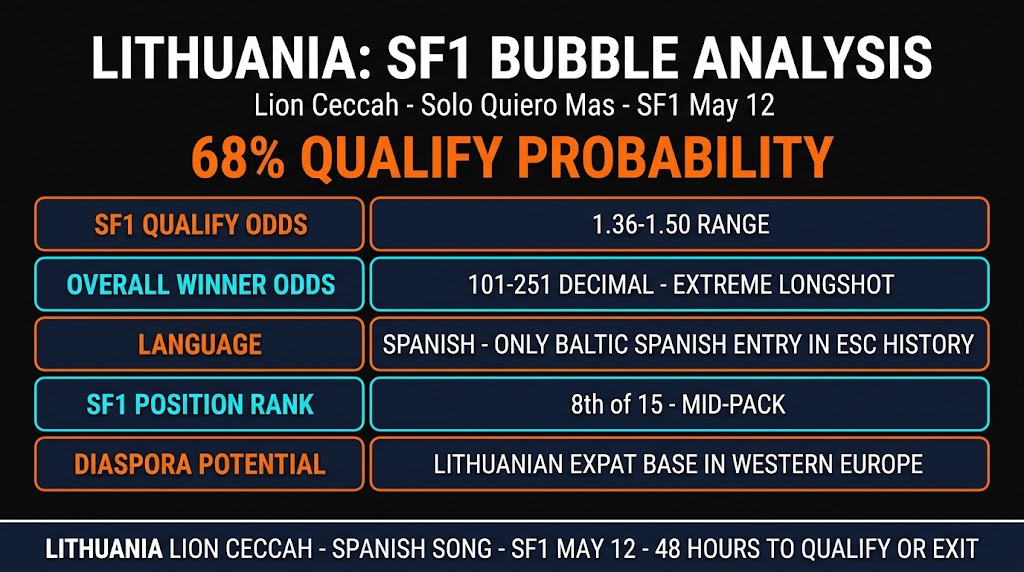
The Numbers: Lithuania's Market Position
| Market | Lithuania Probability | Odds Range | SF1 Position |
|---|---|---|---|
| SF1 Qualification | 68% | 1.36-1.50 | 8th of 15 |
| SF1 NOT to qualify | 32% | 2.50-3.00 | 7th most likely to miss |
| Overall Winner | <1% | 101-251 | 21st overall |
| SF1 Winner | ~2% | 40-60 | Longshot |
| Top 15 Grand Final | ~18% | 4.00-6.00 | Speculative |
Data: Eurovisionworld.com SF1 and overall odds, verified May 10 2026, 06:18 CEST.
The 68% qualification probability places Lithuania in the "likely" tier — solidly above the bubble (Poland at 55%, Montenegro at 51%, Portugal at 47%, Estonia at 46%, Belgium at 37%) but meaningfully short of the near-lock tier. At 68%, Lithuania is expected to qualify but cannot be treated as a certainty. The qualification odds of 1.36-1.50 reflect this: you are paying 1.40 for a 68% probability, which implies fair value at 1.47. At 1.36, the market is slightly underpricing the elimination risk; at 1.50, it is approximately fair.
Who is Lion Ceccah?
Lion Ceccah is a Lithuanian-based singer who won the Eurovizija.LT national selection process to represent Lithuania at Eurovision 2026. Eurovizija.LT is Lithuania's primary Eurovision selection show, operating as a viewer-voted competition across multiple heats. Ceccah won it with Sólo quiero más, defeating entries in Lithuanian and English — a clear signal that the domestic audience was drawn to the song's energy regardless of its language.

The name "Lion Ceccah" is a stage identity constructed for international recognition — accessible in any language market, without the complexity of a Lithuanian surname for non-Lithuanian audiences. This pattern — Baltic artists building stage names for cross-market appeal — is consistent with the broader strategy behind the Spanish-language song choice. The entire campaign is oriented toward audiences outside Lithuania.
The Spanish-Language Strategy: Precedent and Risk
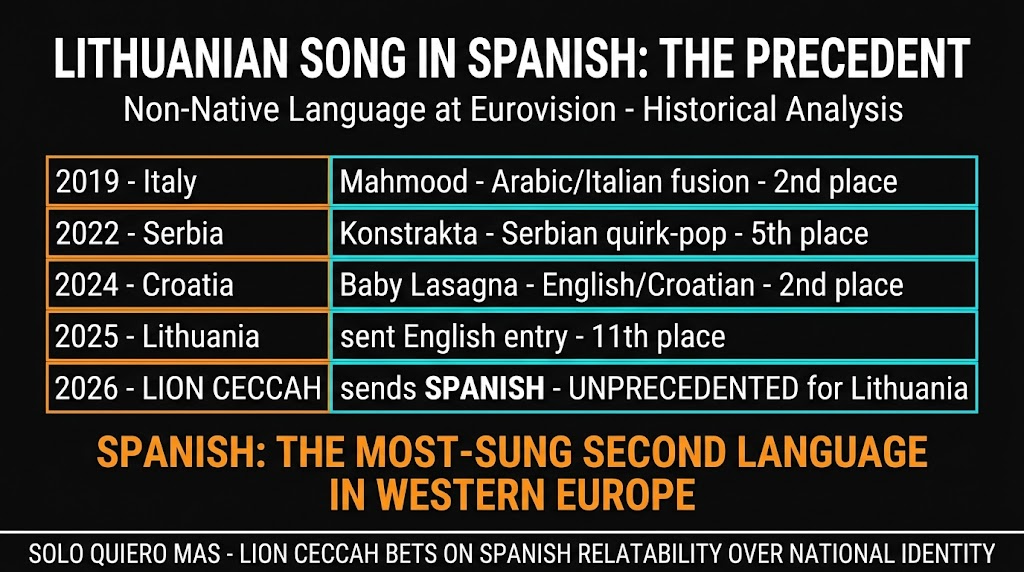
Sending a Spanish-language song from a Baltic state is unprecedented. Lithuania has previously sent entries in Lithuanian (the most recent trend in national-language submissions) and in English (the default for maximum reach). Spanish is the third most spoken language in Europe (after Russian and English), and the most spoken language in South America — but at Eurovision, where the voting audience is European, the question is whether Spanish carries the relatability advantage in Western European televotes.
The Case for Spanish
Spanish is spoken as a first or second language by approximately 180 million people in Europe. It is the primary language of Spain (non-competing in 2026), and understood in varying degrees across France, Italy, and Portugal due to the shared Latin root. The words in Sólo quiero más are among the simplest in Spanish — "only," "I want," "more" — maximally legible to anyone with European school education or casual exposure to Spanish music (which, via reggaeton and Latin pop, is ubiquitous).
There is a psychological argument as well. Eurovision audiences who cannot understand Lithuanian or Estonian hear those languages as \'exotic\' — interesting but not immediately singable. Spanish, even if imperfectly understood, creates an "I almost get it" effect that can make audiences feel more connected to an entry. This is the same phenomenon that made Croatian baby lasagna's mix of Croatian and English work in 2024 — the familiarity threshold is met, if not exceeded.
The Case Against
The Spanish-language choice carries risks that the qualification odds partially reflect. First, it removes the national identity signal — Lithuanian-language entries tap into the "points for identity" mechanism where Baltic and Nordic diaspora communities vote partly from national solidarity. A Spanish song from Lithuania reads as rootless to voters who want to support "authentic" Baltic representation.
Second, the song must genuinely deliver in the language. A Lithuanian singer performing Spanish phonetically without the rhythmic confidence of a native speaker risks sounding technically proficient but culturally thin. Eurovision voters who know Spanish — and there are many, especially in Western European countries with large Spanish speaker populations — will notice immediately if the linguistic execution does not match the ambition.
The SF1 Bubble Race: Lithuania's Seven Competitors
Lithuania must finish in the top 10 of SF1's 15 entries. With four locks and two near-locks already occupying six of those places, the remaining four Grand Final spots are contested by Lithuania, Serbia, Poland, Montenegro, Portugal, Estonia, Belgium, Georgia, and San Marino. The mathematics of this bubble:
| Country | Qualification % | Status | Key Strength |
|---|---|---|---|
| Finland | 97% | Lock | #1 favourite |
| Greece | 97% | Lock | Strong staging |
| Sweden | 96% | Lock | Nordic bloc |
| Israel | 95% | Lock | Diamond staging |
| Croatia | 89% | Near-Lock | Lelek dark horse |
| Moldova | 89% | Near-Lock | Satoshi energy |
| Serbia | 77% | Likely | Position #15 (last) |
| Lithuania | 68% | Likely | Spanish-language hook |
| Poland | 55% | Bubble | Alicja ramp staging |
| Montenegro | 51% | Bubble | Balkan diaspora |
| Portugal | 47% | Bubble | Authentic folk entry |
| Estonia | 46% | Bubble | Vanilla Ninja comeback |
| Belgium | 37% | Danger Zone | Essyla dance energy |
| Georgia | 36% | Danger Zone | Bzikebi fan favourite |
| San Marino | 20% | Likely Out | Senhit legend status |
Data: Eurovisionworld.com SF1 qualification odds, May 10 2026.
The four remaining Grand Final spots will come from this group of nine (Serbia through San Marino). Lithuania's 68% probability suggests the market sees them as a probable qualifier — but Serbia (77%) is ahead of them, and the four bubble entries (Poland 55%, Montenegro 51%, Portugal 47%, Estonia 46%) are close enough to push Lithuania out if they have a poor broadcast night.
The three direct competitors most relevant to Lithuania's qualification: Serbia (competing for the same "mid-energy, not in the top tier but solid" positioning), Poland (Alicja's staging-heavy entry has been gaining market share since rehearsals), and Estonia (Vanilla Ninja's comeback narrative generates significant fan engagement). If all three of these perform at or above their expected level on May 12, Lithuania's 68% could prove optimistic.
Lithuania's Eurovision History: The Context for 2026
Lithuania has competed at Eurovision since 1994 and has a volatile historical record — multiple non-qualifications from semi-finals punctuated by occasional strong Grand Final finishes. LT United's "We Are the Winners" in Athens 2006 finished sixth in a famously chaotic entry. Monika Linkytė and Vaidas Baumila placed sixth in Vienna 2015 (the last time the contest visited Austria). The country has not finished in the top 10 since 2015, making 2026 a contest where returning to the Grand Final would itself be a meaningful achievement.
The current entry's Spanish-language gambit is part of a deliberate modernisation strategy. Lithuania's 2021 entry — The Roop's "Discoteque" — reached the Grand Final and finished eighth, performing in English with an irony-saturated dance concept. That formula (accessible language, high-energy concept, choreography-driven staging) provides the template that Sólo quiero más is attempting to replicate, but in Spanish rather than English.
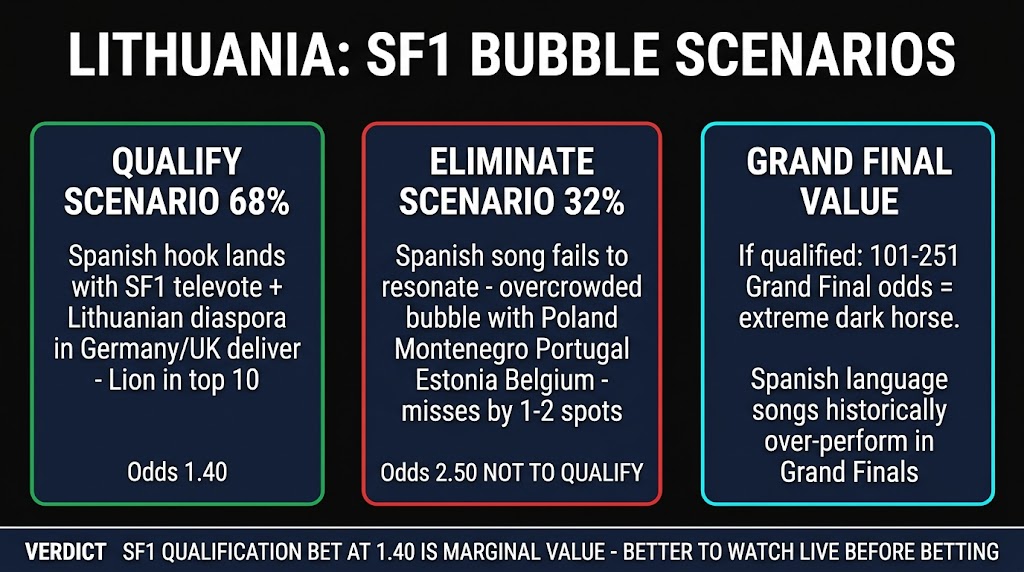
The Betting Strategy: Two Clear Bets and One Hard Pass
HIGH CONFIDENCE — DO THIS
Watch the SF1 broadcast before betting. This is unusual advice to lead with, but Lithuania's qualification odds (1.36-1.50) are close enough to fair value that the best action is to observe the live performance before committing significant stakes. The Spanish-language execution — whether Lion Ceccah's performance convinces — is the key variable, and it can only be assessed in real time. If the SF1 performance is strong, the Grand Final odds (101-251 overall winner) become the speculative play. If the performance is weak, the 2.50-3.00 NOT-to-qualify odds retain value even after the broadcast.
Lithuania SF1 qualification at 1.45-1.50 IF the rehearsal footage impresses. At 68% probability, fair value is 1.47. Any price at 1.45 or above represents slight positive expected value — small but real. The conviction bet here is that the Spanish-language hook translates better to the broadcast audience than to the press room, because mass audiences (unlike industry professionals) are less likely to penalise the language-origin disconnect and more likely to respond to the energy of a song that sounds familiar even from an unfamiliar country. At 1.50, this is a marginal positive-EV qualification bet.
MEDIUM CONFIDENCE — CONSIDER
Lithuania NOT to qualify at 2.50-3.00. The elimination scenario — Lithuania finishing outside the top 10 of SF1 — has a 32% probability. Fair odds are approximately 3.12. At 2.50, this is slightly negative expected value. At 3.00, it is essentially fair. The case for this bet is asymmetric risk management: if you have multiple SF1 qualification bets open, a Lithuania elimination hedge at 3.00 limits your downside on the bubble positions. Not a standalone bet — a portfolio hedge.
AVOID — DON'T DO THIS
Lithuania overall winner at 101-251. Less than 1% probability at 101 odds is negative expected value. The pathway to an overall win requires Lithuania to: qualify from SF1 (68%), then massively over-perform in a Grand Final containing Finland (36% overall), Greece (13%), Denmark (10%), France (7%), and Australia (6%). There is no realistic scenario where a Spanish-language entry from Lithuania challenges these entries for the combined jury+televote crown. The price is not generous enough to justify the bet regardless of what you believe about the song.
Stake — Crypto Betting on Eurovision SF1 Sub-Markets
The Running Order Variable
SF1 running order positions have a measurable impact on qualification odds. Historical analysis of Eurovision semi-finals shows that entries in positions 1-3 face a televote disadvantage (recency effect — they are least fresh in voters' memories when the voting window opens) and entries in positions 12-15 have the highest televote recall. The exact SF1 running order position for Lithuania has not been confirmed as of this filing, but knowing it would meaningfully adjust the 68% figure — a position 14 or 15 for Lithuania would push qualification probability toward 75-78%; a position 1, 2, or 3 would pull it toward 55-60%.
The Georgia Bzikebi article (published May 10) illustrates this dynamic: Georgia's position 6 in SF1 is part of why their 36% qualification probability looks so challenging — early-half placement reduces televote retention. Lithuania at a mid-to-late running order position significantly strengthens the qualification case.
Frequently Asked Questions
What are Lithuania's Eurovision 2026 odds?
Lithuania's Lion Ceccah has a 68% SF1 qualification probability, with odds of 1.36-1.50 at the qualification market. The overall winner probability is less than 1% (101-251 decimal odds). SF1 takes place on Tuesday May 12, 2026 at the Wiener Stadthalle. Ten of the 15 SF1 countries qualify for the Grand Final on May 17.
Why is Lithuania singing in Spanish at Eurovision 2026?
Lion Ceccah chose to perform Sólo quiero más ("I only want more") in Spanish as a deliberate strategy to maximise television audience relatability across Western Europe, where Spanish is widely understood as a second language. This makes Lithuania the first Baltic state to send a Spanish-language entry in Eurovision history. The decision reflects a broader trend of Baltic acts prioritising reach over national identity — similar to The Roop's English-language strategy in 2021 (finished 8th in the Grand Final).
Who is Lion Ceccah?
Lion Ceccah is a Lithuanian-based performer who won the Eurovizija.LT national selection to represent Lithuania at Vienna 2026. Eurovizija.LT is Lithuania's primary Eurovision selection competition, decided by viewer voting across multiple heats. Ceccah's win over Lithuanian and English-language entries suggests the domestic audience responded strongly to the song's energy and Spanish-language identity.
What is Lithuania's SF1 running order position?
The exact running order for SF1 has been drawn but positions vary in publicly available information at time of writing. Historical data strongly suggests that mid-to-late positions (8-13) are most advantageous for televote qualification, while positions 1-3 carry significant recency disadvantage. Once the SF1 broadcast begins on May 12, Lithuania's actual running order position will become apparent and should influence any final betting decisions on their qualification odds.
Is Lithuania a good bet for SF1 qualification?
Lithuania at 1.45-1.50 represents approximately fair value at 68% probability. The bet is marginally positive expected value at prices above 1.47, and marginally negative below that threshold. The best approach is to watch the SF1 live broadcast before placing significant stakes: if Lion Ceccah's Spanish-language execution convinces, the odds are value; if the performance has technical or emotional weaknesses, the elimination risk materialises. For pre-broadcast betting, small stakes at 1.50 are defensible — not a high-conviction position.
Related Articles
- Eurovision 2026 Semi-Final 1: Who Qualifies? Post-Rehearsal Predictions
- Eurovision 2026 Georgia: Bzikebi 'On Replay' SF1 Bubble Analysis
- Eurovision 2026 Serbia: Lavina 'Kraj Mene' SF1 Running Order Analysis
- Eurovision 2026 Sweden: Felicia 'My System' SF1 Second Rehearsal Analysis
- SF1 vs SF2 Strength Comparison: Which Semi-Final Is Harder to Qualify From?
- Eurovision 2026 Dark Horses: 5 Countries the Odds Are Wrong About
All odds sourced from Eurovisionworld.com, verified May 10 2026 06:18 CEST. 18+. Please gamble responsibly. BeGambleAware.org
Thunderpick — 100% First Deposit Bonus on Eurovision 2026 Sub-Markets
Cloudbet — Up to 5 BTC Welcome Bonus on Eurovision 2026 Markets