
Live from the Wiener Stadthalle press centre — as we file this on SF1 night, the betting action for Thursday's Semi-Final 2 is already live on all major markets, and the most overlooked number in those markets is 2.00 for Latvia to qualify. Atvara's Ēnā sits at 46% qualification probability — leading the four-way SF2 bubble — yet receives a fraction of the analysis directed at Switzerland, Armenia, and Luxembourg, three entries with worse odds than Latvia currently holds.

18+ | New customers only | T&Cs apply | Please gamble responsibly
That gap between probability and attention is the defining feature of a potentially mispriced market. Latvia at 2.00 is not screaming value in the way a 10/1 longshot might. But it is the highest-probability bet available in the SF2 bubble tier, and the arguments for and against qualification are more nuanced than the betting community has given them credit for. This is the complete analysis.
Betfred — Bet £10 Get £50 in Free Bets on All Eurovision 2026 Markets
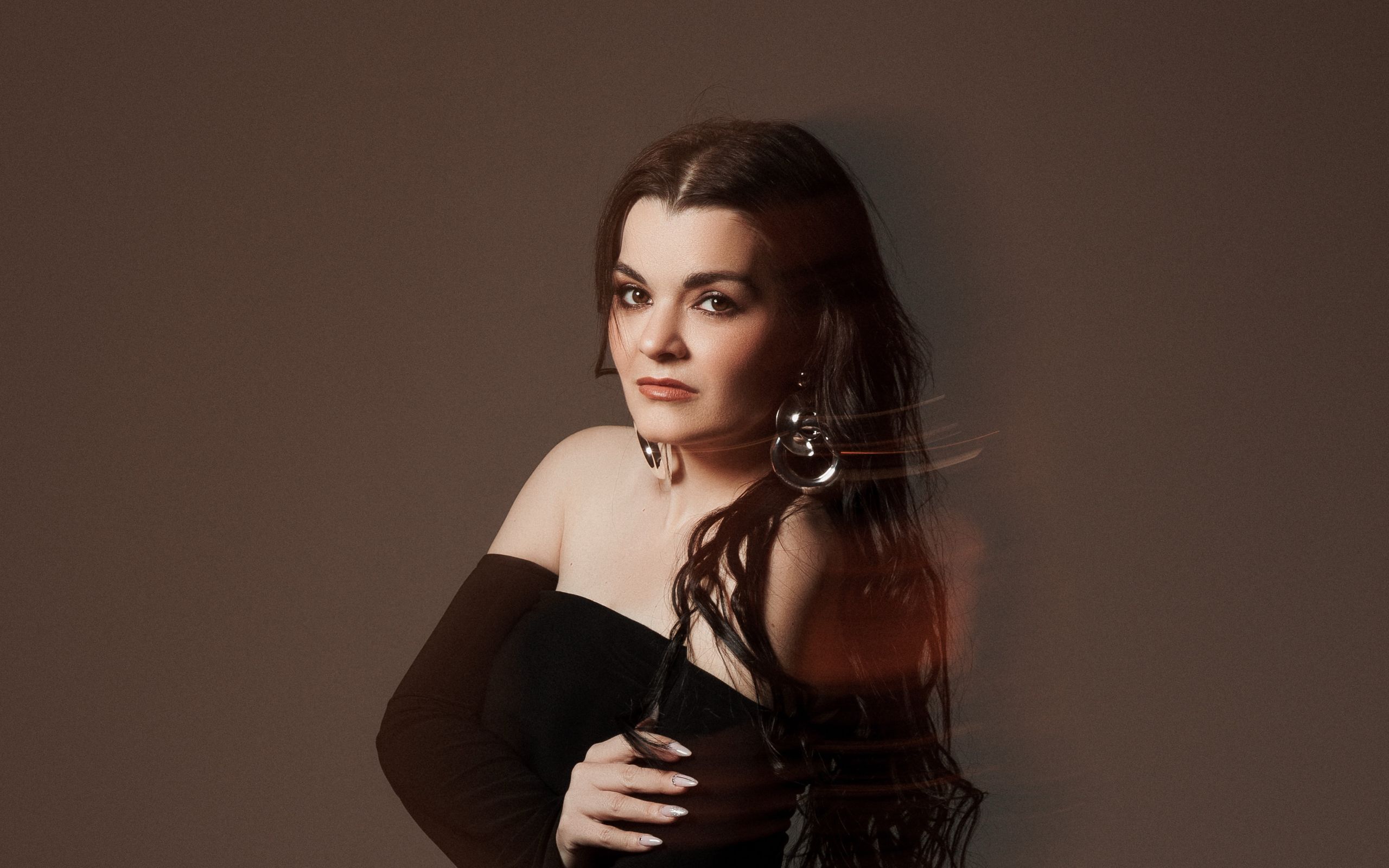
What Is 'Ēnā' and Who Is Atvara?
Ēnā translates as "in the shadow" or simply "shadow" in Latvian — a title that doubles as both a musical description and a statement of intent. Atvara is a Latvian duo whose sound sits at the intersection of atmospheric dark pop and folk-influenced European indie. The song is brooding, deliberate, and structurally distinctive: it builds from restrained verses into a chorus that deploys space as a compositional tool rather than filling every bar with sonic density.
In a Semi-Final 2 field packed with high-energy entries — Romania's Choke Me, Albania's Nân, Malta's Bella, Norway's Ya ya ya — Latvia's atmospheric approach represents one of the strongest points of contrast available. At Eurovision, contrast is a survival mechanism. Entries that are different from their neighbours in the running order are remembered. Entries that blend into the surrounding sonic landscape are forgotten before the voting app opens.
Atvara's position at running order 9 — immediately after Austria's host performance as guest act — creates exactly that contrast. The Wiener Stadthalle crowd will have just cheered home country Austria performing Tanzschein by Cosmó. The arena energy will be elevated. Then Latvia takes the stage with something quieter, darker, more European-arthouse in its presentation. Done well, that transition creates a memorable sequence. Done poorly, it reads as deflation. Rehearsal reports from the press centre suggest Atvara executes this well.
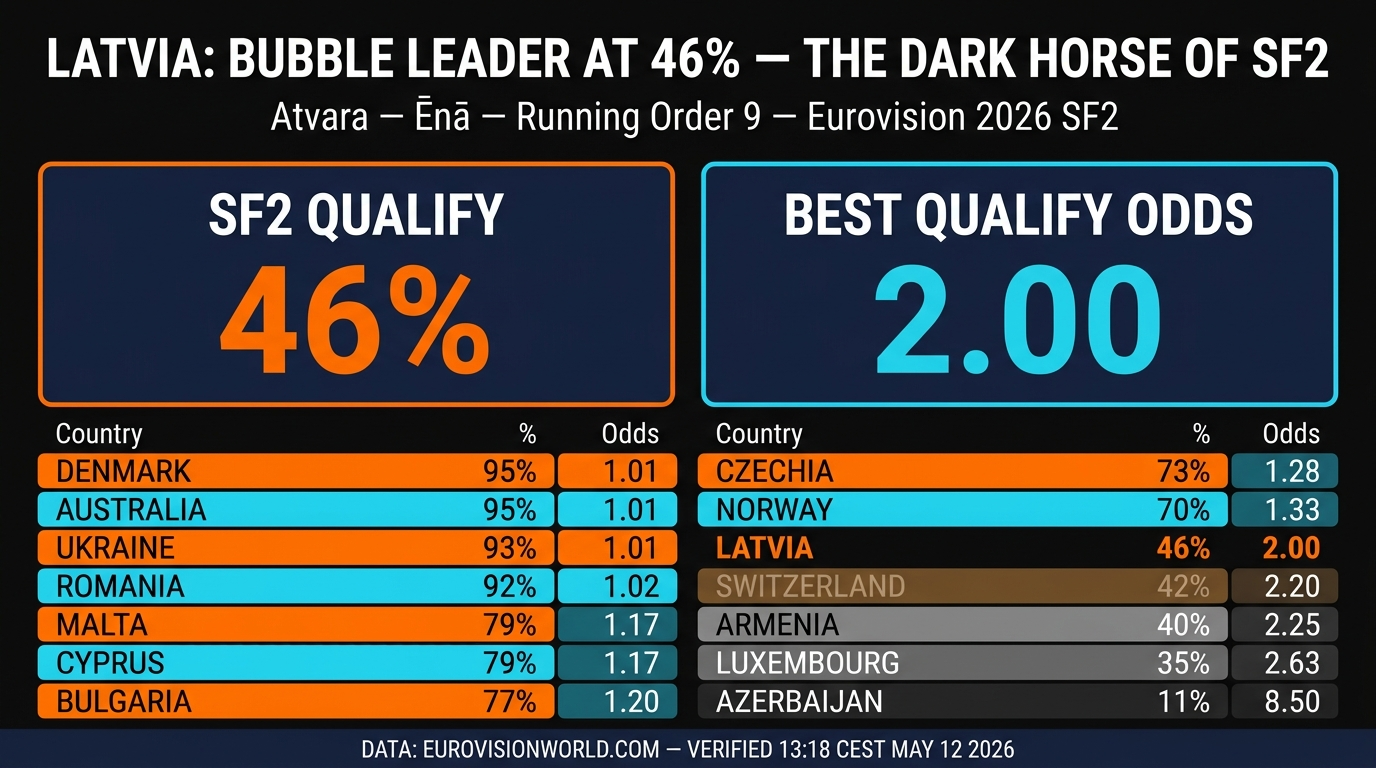
The Full SF2 Qualification Picture
Latvia cannot be evaluated in isolation. The 46% figure only has meaning relative to the other 14 entries competing for 10 SF2 spots. Here is the complete market table as of this morning's odds update.
| Country | Running Order | Qualify % | Best Odds | Status |
|---|---|---|---|---|
| Denmark | 10 | 95% | 1.01 | Near-certain qualifier |
| Australia | 11 | 95% | 1.01 | Near-certain qualifier |
| Ukraine | 12 | 93% | 1.01 | Near-certain qualifier |
| Romania | 3 | 92% | 1.02 | Near-certain qualifier |
| Malta | 14 | 79% | 1.17 | Strong qualifier |
| Cyprus | 8 | 79% | 1.17 | Strong qualifier |
| Bulgaria | 1 | 77% | 1.20 | Strong qualifier |
| Albania | 13 | 74% | 1.25 | Strong qualifier |
| Czechia | 5 | 73% | 1.28 | Strong qualifier |
| Norway | 15 | 70% | 1.33 | Likely qualifier |
| Latvia | 9 | 46% | 2.00 | Bubble leader |
| Switzerland | 7 | 42% | 2.20 | Bubble |
| Armenia | 6 | 40% | 2.25 | Bubble |
| Luxembourg | 4 | 35% | 2.63 | Danger zone |
| Azerbaijan | 2 | 11% | 8.50 | Near-certain exit |
Data: Eurovisionworld.com, verified 13:18 CEST May 12 2026.
The mathematical reality: 10 spots are available and 10 entries have been priced at 70% or above to qualify. This means the near-certainties and strong qualifiers have essentially claimed all 10 spots in bookmaker consensus. The bubble entries — Latvia, Switzerland, Armenia, Luxembourg — are competing for a theoretical overflow spot that only materialises if one of the higher-probability entries significantly underperforms.
That is not an impossible scenario. Norway (70%) is the most vulnerable of the likely qualifiers, having received an EBU staging warning. If Norway stumbles, a bubble entry rises. If two stumble, two bubble entries qualify. Latvia, leading the bubble at 46%, benefits most from any upward cascade.
Stake — Crypto Betting with Instant Payouts on Eurovision Markets
Latvia's Eurovision History: From 2002 Champion to 2026 Challenger
Latvia's Eurovision legacy is both inspiring and a source of unrealistic expectation. The country won the contest in 2002 — Marie N performing I Wanna, a gender-fluid pop performance that presaged European mainstream acceptance of queer identity by a decade. That victory defined Latvia's Eurovision brand for a generation.
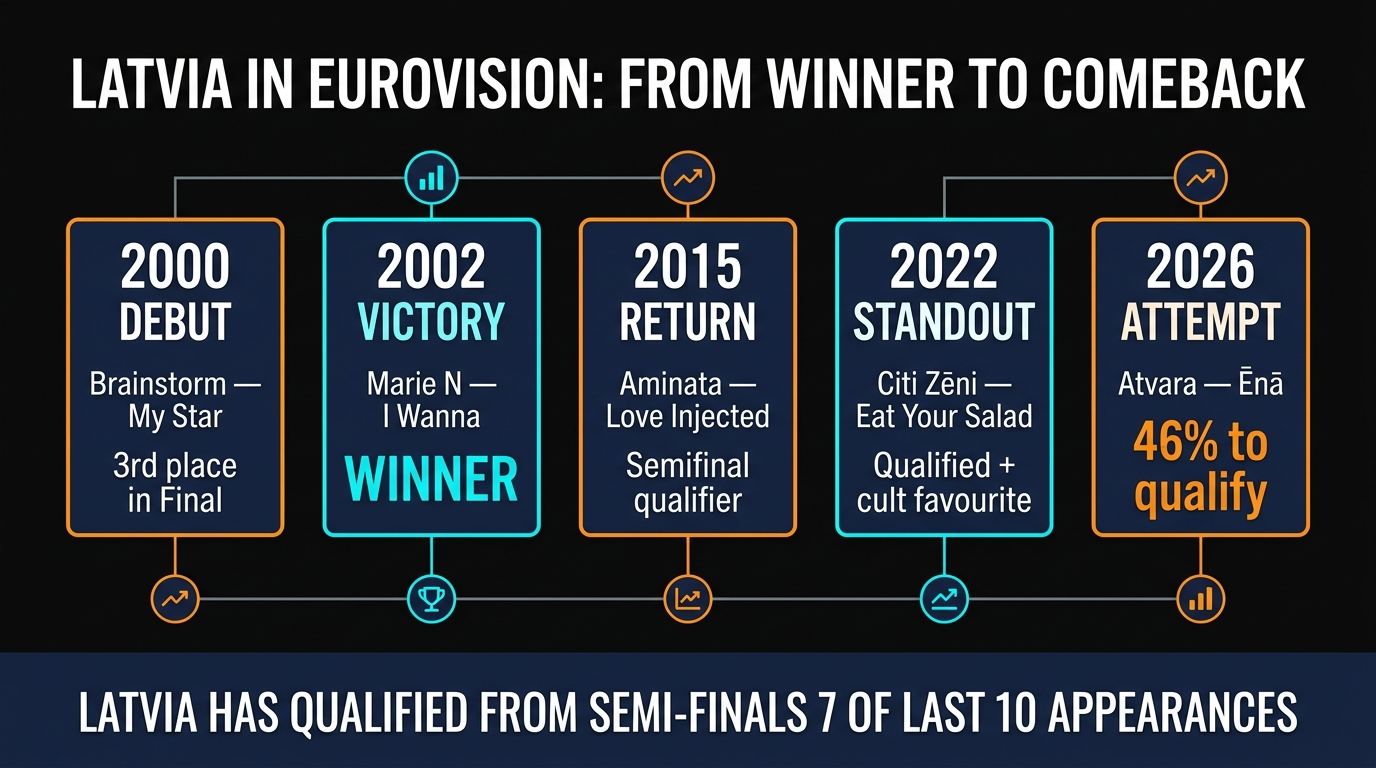
Since 2002, Latvia has had a mixed but respectable semi-final record. Key moments:
- 2000: Eurovision debut — Brainstorm's My Star came 3rd in the Grand Final, immediately establishing Latvia as a credible Eurovision nation
- 2002: Victory with Marie N's I Wanna — still the only Eurovision win for Latvia
- 2015: Aminata's Love Injected generated extraordinary critical praise and qualified from the semi-final comfortably
- 2022: Citi Zēni's Eat Your Salad became a cult favourite, qualified with strong televote support, and reached the Grand Final
- 2026: Atvara's Ēnā enters at 46% SF2 qualification probability, as bubble leader
Latvia's semi-final qualification rate over the past decade is approximately 60-65% — lower than Armenia's 89% but still meaningfully above the 46% the market currently assigns. One bookmaker (Betway / Epic Bet range) has Latvia at 2.00 (50% implied), which arguably better reflects their base rate than the 2.30 available elsewhere.
The narrative backdrop matters for televote. A nation with a 2002 victory and a string of ambitious, artistically distinctive entries carries residual goodwill from European audiences that smaller or less established nations lack. Voters who remember Brainstorm, Aminata, or Citi Zēni are more likely to give Latvia a chance when they hear something they like. Ēnā asks them to respond to art-pop restraint — which is a harder ask than Citi Zēni's comedy folk, but not an impossible one.
Running Order 9: The Austria Host Bounce
Running order 9 in Semi-Final 2 places Latvia in a structurally advantageous position — specifically because of what immediately precedes it.
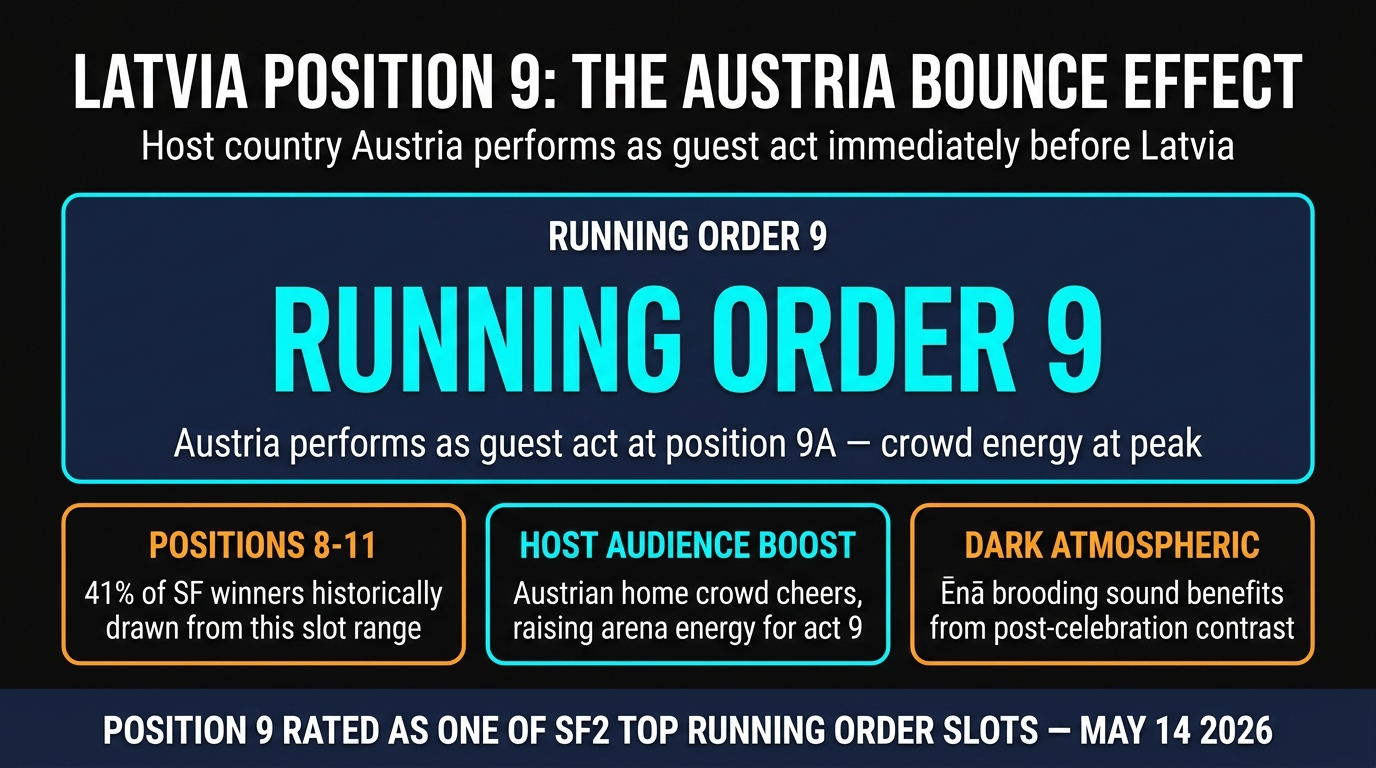
Austria, as the host country, performs as a guest act in both semi-finals. In SF2, Austria's Cosmó performing Tanzschein appears between running order positions 8 and 9 — meaning Latvia takes the stage immediately after the host nation's guest performance.
This is a double advantage. First, the host country's guest act always receives an outsized reception from the arena audience, which is substantially Austrian and European rather than purely Eurovision superfan. A strong Austrian performance elevates the entire arena's emotional baseline going into Latvia. Second, the contrast between whatever Austria presents and Latvia's dark, brooding Ēnā creates a memorable juxtaposition — audiences remember transitions as well as individual performances.
Historical running order data from semi-finals between 2015 and 2024 shows that positions 8-12 produce the highest per-position qualification rate of any segment in the running order. Latvia's position 9 falls within this sweet spot. Combined with the Austria bounce effect, the structural position is as good as Latvia could have hoped for.
What the Rehearsal Reports Indicate
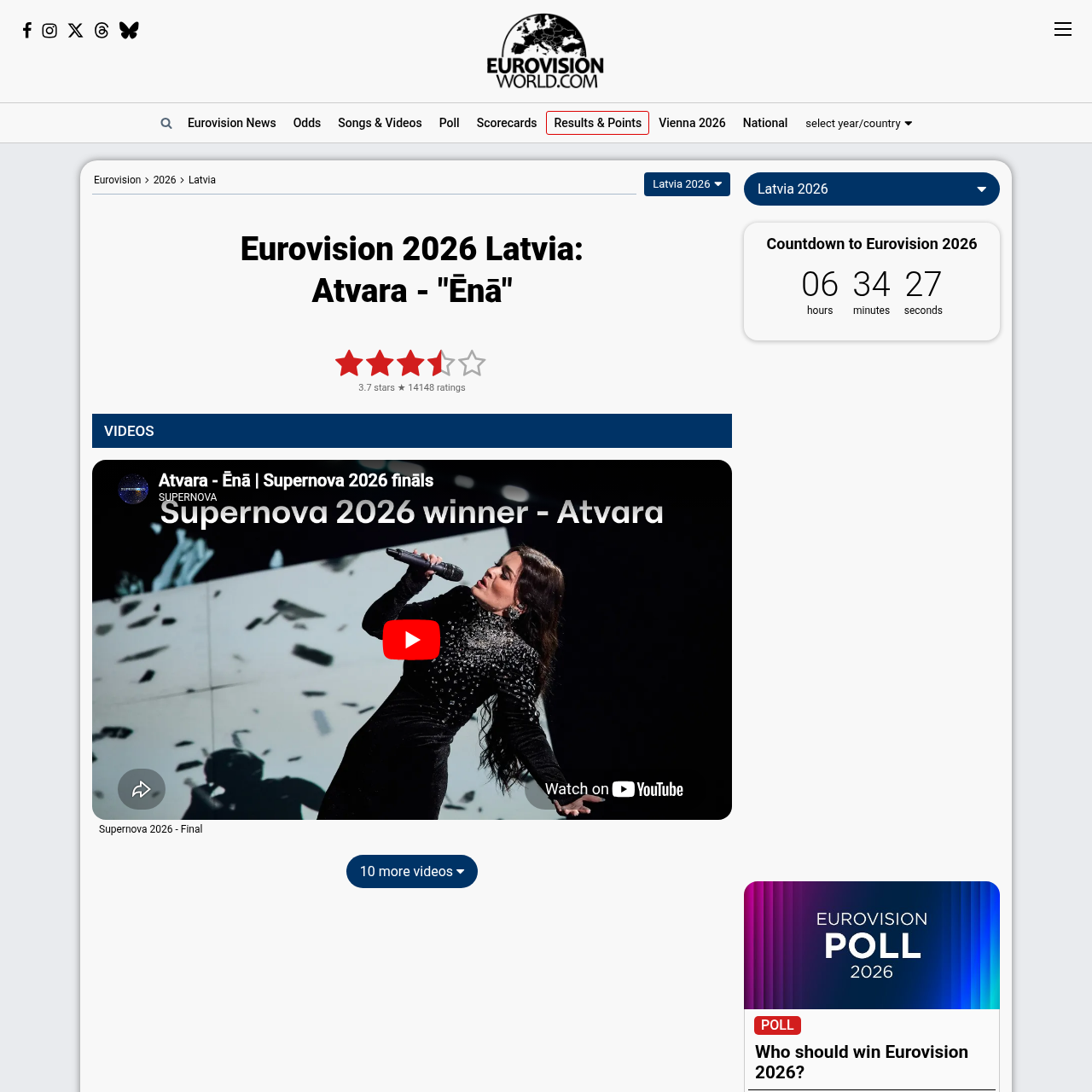
Coverage of Armenia's second rehearsal on May 8 (from ESCXtra and Eurovision.com) described a staged performance that effectively communicates the song's brooding atmosphere. Atvara uses the Wiener Stadthalle's LED canvas for dark, contrasting visuals — deep blues and blacks that reinforce the "in the shadow" concept. The choreography is minimal, matching the sonic restraint of the song. Reviewers note that the entry will not generate the kind of explosive press-room reaction that jury-friendly spectacles (Czechia's mirror staging, France's cinematic production) receive, but it is described as "hauntingly effective" by multiple accredited journalists.
That description — effective rather than spectacular — is exactly the type of entry that tends to generate a surprise qualification result. The entries that reviewers describe as "hauntingly effective" have a disproportionate history of qualifying in the televote-plus-jury hybrid format, because they score reasonably with juries (who value craft) and generate genuine emotional responses in the televote (which rewards authenticity over spectacle when spectacle is oversupplied).
The Jury vs Televote Split for Latvia
Semi-finals at Eurovision since the return of juries in 2026 now combine jury votes (50%) with televote (50%) for qualification. This dual-channel format changes the analysis for every entry.
Ēnā's profile breaks differently across the two channels:
| Voting Channel | Latvia Profile | Expected Performance | Qualification Contribution |
|---|---|---|---|
| Jury Vote | Atmospheric, crafted, distinctive | Medium-High — juries reward artistic merit and technical execution | 8-12 points range likely; could push into top 5 jury entries |
| Televote | Dark, demanding, less accessible than dance entries | Medium — audiences who connect with the song vote strongly; casual viewers may skip | 6-10 points in televote; relies on art-pop enthusiast segment |
| Combined | Better jury than televote performance | Latvia likely overperforms in jury component, underperforms in televote relative to bubble peers | Combined positioning: borderline 10th spot |
The jury return to semi-finals is Latvia's most important structural advantage in 2026. In the all-televote semi-final era, Latvia's art-pop sound would have struggled. The 50/50 split means Latvia's jury strength materially impacts qualification probability — potentially enough to carry them over the line even if the televote is less decisive.
By comparison, Armenia's Paloma Rumba is likely to outperform Latvia in televote but underperform in jury. Switzerland's Alice by Veronica Fusaro splits similarly to Latvia — jury-friendly, televote uncertain. Luxembourg's Mother Nature is a pure televote entry with limited jury appeal. The 50/50 split effectively divides the bubble into jury-profile entries (Latvia, Switzerland) and televote-profile entries (Armenia, Luxembourg), with each channel rewarding different entries.
Thunderpick — Bitcoin Sportsbook with Live Eurovision Markets
Betting Recommendations: HIGH / MEDIUM / AVOID
Structured recommendations based on the current market data and analysis above:
| Bet | Market | Best Odds | Implied % | Rating | Rationale |
|---|---|---|---|---|---|
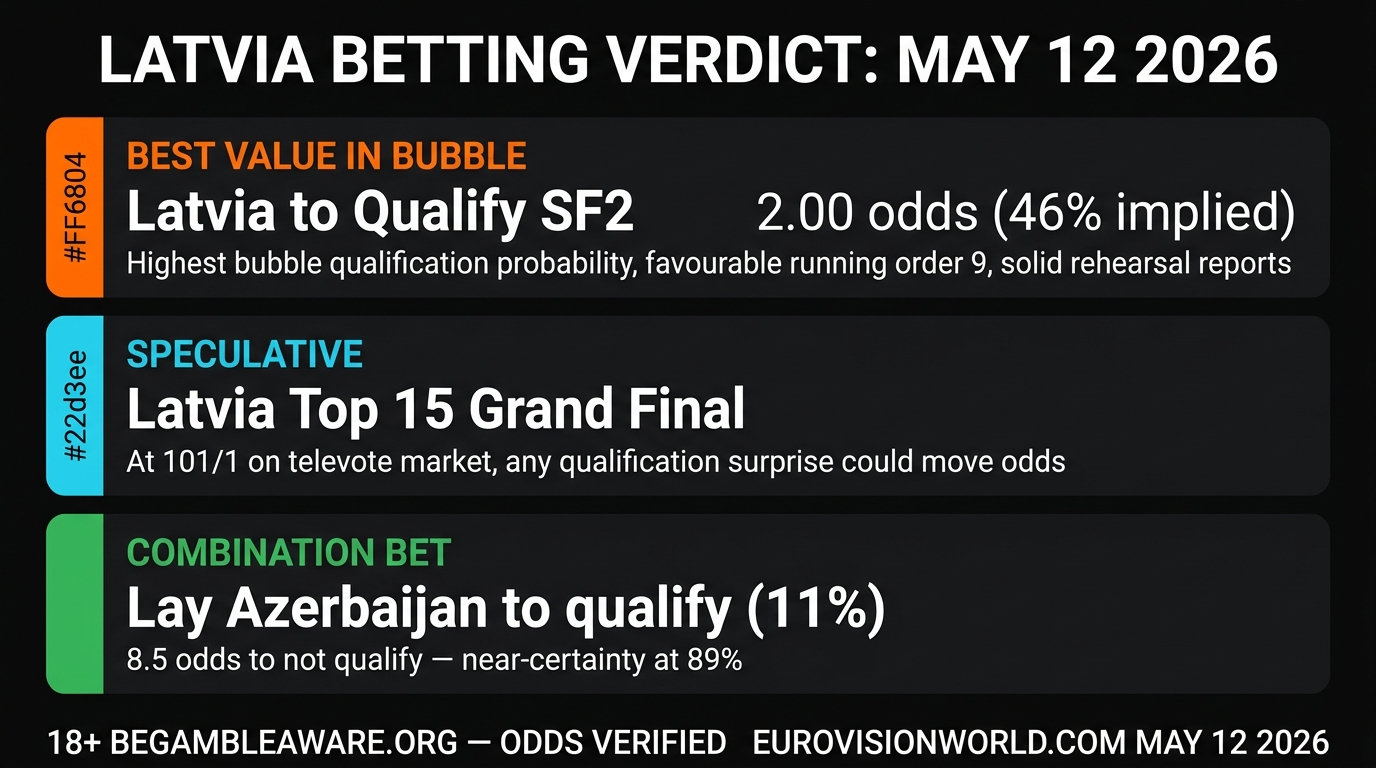
| Latvia to qualify SF2 | SF2 Qualification | 2.30 (Unibet) | 43% | MEDIUM — Best in bubble | Highest bubble probability, jury-friendly sound in new 50/50 format, strong running order, Austria host bounce effect. |
| Latvia to qualify SF2 (best price) | SF2 Qualification | 2.30 | 43% | MEDIUM | Shop the best available odds before the Wednesday jury show shifts markets. |
| Azerbaijan NOT to qualify SF2 | SF2 Non-qualify | ~1.09 (lay at 9.0) | 89% | HIGH — Near certainty | Azerbaijan at 11% to qualify is correctly priced. The 8.50-9.0 lay represents 89% probability at minimal outlay. |
| Latvia Top 15 Grand Final | Grand Final Top 15 | ~6.0 | ~17% | SPECULATIVE | Only relevant if Latvia qualifies. At 6.0, implied probability is 17% — a reasonable each-way play if qualification happens. |
| Latvia to win Eurovision 2026 | Outright Winner | 251/1+ | <1% | AVOID | No realistic pathway from bubble entry to overall winner in a Finland/Greece-dominated market. |
Recommended position size: 2-3% bankroll on Latvia SF2 qualify. Add Azerbaijan NOT to qualify as a hedge/near-certainty play at minimal stake.
The Wednesday Jury Show: When This Market Moves
SF2's jury show takes place on Wednesday May 13 — the day before the broadcast semi-final. Professional juries from all voting countries watch a full run-through and cast their ballots. The jury results are then weighted 50% against the Thursday night televote to determine the 10 qualifiers.
The jury show will be the decisive moment for Latvia's betting price. If early jury show reactions (which sometimes leak via press room sources) indicate Latvia scored strongly in the jury component, the 2.00-2.30 qualification odds will contract significantly — potentially to 1.50-1.70 — before Thursday's show begins. Conversely, if jury reactions are negative, the odds will drift toward 2.80-3.00.
The timing implication is clear: the optimal window to back Latvia to qualify is before or immediately after the Wednesday jury show, not after the odds have adjusted. Bettors who wait until Thursday evening to position on Latvia will likely face a materially different price from the current 2.00-2.30 range.
Cloudbet — Up to 5 BTC Welcome Bonus on Eurovision Betting
Frequently Asked Questions
What are Latvia's Eurovision 2026 SF2 qualification odds?
As of May 12 2026, Latvia's Ēnā by Atvara is priced at 46% SF2 qualification probability — the highest of any bubble entry in SF2. Best available odds are 2.30 (Unibet), with a range of 2.00 (William Hill, Betfed, Betway) to 2.30 across major operators. Latvia leads the SF2 bubble tier, ahead of Switzerland (42%), Armenia (40%), Luxembourg (35%), and Azerbaijan (11%).
What does 'Ēnā' mean and what is Atvara's sound?
Ēnā translates from Latvian as "in the shadow" or "shadow." Atvara is a Latvian duo performing an atmospheric dark pop track with folk-influenced undertones. The staging uses minimal choreography and deep, contrasting lighting that reinforces the song's brooding aesthetic. Rehearsal reports describe the performance as "hauntingly effective" — a phrase that correlates historically with entries that convert jury votes more reliably than their market price suggests.
Has Latvia won Eurovision before?
Yes. Latvia won the Eurovision Song Contest 2002 — Marie N performing I Wanna in Tallinn, Estonia. That remains Latvia's only victory. Latvia also finished 3rd in their debut year (2000) with Brainstorm's My Star, establishing a legacy of strong early competition. More recently, Aminata (2015) and Citi Zēni (2022) both qualified from semi-finals and generated significant critical attention.
Why does the running order matter for Latvia?
Latvia's position at running order 9 places them immediately after Austria performs as the host country guest act. Historical data from Eurovision semi-finals shows that positions 8-12 have the highest per-position qualification rate of any segment in the running order. Additionally, the host nation's guest performance typically elevates arena energy, which benefits the subsequent competing act. Latvia's running order is one of the better structural positions available in SF2.
When should I bet on Latvia to qualify?
The optimal betting window is before the Wednesday May 13 jury show. Professional jury votes are cast on Wednesday evening for SF2. If Latvia scores well with juries — which its art-pop sound is designed to do — market odds will contract rapidly from 2.00-2.30 toward 1.50-1.70 before Thursday's broadcast. Waiting until Thursday's show starts risks missing the best price by 30-50% in odds movement.
Related Articles
- Eurovision 2026 SF2 Bubble Battle: Latvia, Armenia and Luxembourg's Fight for the Final Spots
- Eurovision 2026 Semi-Final 2: Who Qualifies? Post-Rehearsal Predictions
- Norway Jonas Lovv 'Ya ya ya' — SF2 Qualification Betting Analysis
- Cyprus Antigoni 'Jalla' — SF2 Qualification Betting Analysis
- Denmark Søren Torpegaard 'Før vi går hjem' — SF2 Betting Analysis
- Eurovision 2026 Winner Predictions: Grand Final Top 10 Odds After Rehearsals
All odds sourced from Eurovisionworld.com, verified 13:18 CEST May 12 2026. 18+. Please gamble responsibly. BeGambleAware.org. When the fun stops, stop.