
Live from the Wiener Stadthalle press centre — the story we are filing today has been simmering since the opening of Eurovision 2026 rehearsals, and it has just escalated in a way that matters for the Semi-Final 2 betting market.

18+ | New customers only | T&Cs apply | Please gamble responsibly
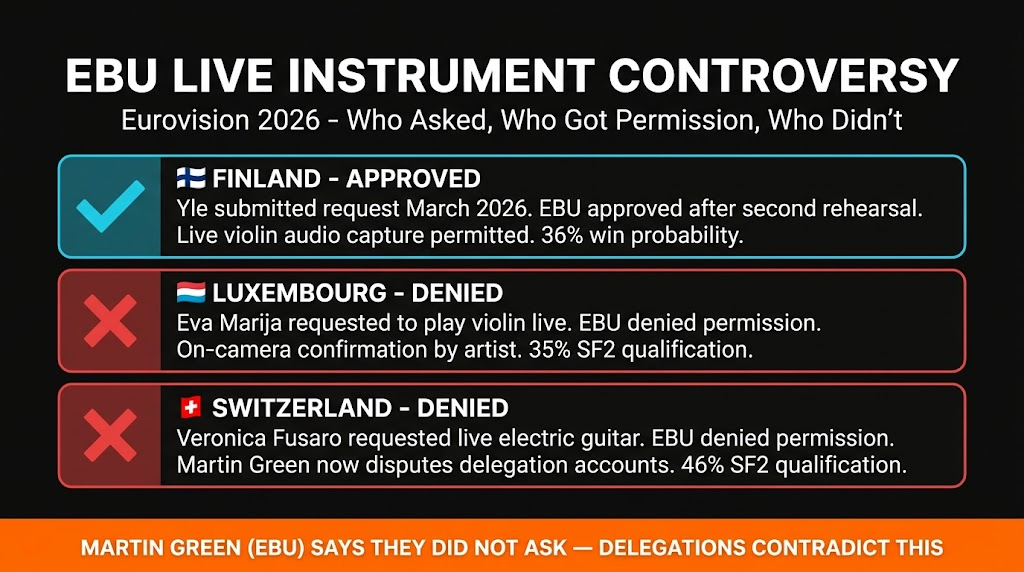
On the morning of Monday 11 May 2026, Eurovision Creative Director Martin Green gave an interview to the Euro Trip Podcast. When asked about Finland's special permission to play live violin — an exception that has dominated press-centre discussion since the contest week opened — Green offered a characterisation of the other delegations' behaviour that directly contradicts statements made on camera by Luxembourg's representative two days earlier.
Green's position, as reported from the podcast: Luxembourg and Switzerland did not ask to play live instruments. They were not denied. They simply did not request the exception that Finland received.
The problem with that account is this: Luxembourg's representative has confirmed, on camera, in a widely circulated interview, that she was denied permission to play her violin live. The Eurovision community has been watching these two positions develop simultaneously, and the contradiction is now the loudest story in the press centre on a day when the SF1 jury show is scheduled for tonight.
This is the full analysis of what the controversy means for SF2 bettors — and why it is worth acting on before bookmakers price in the narrative effect.
Betfred — Bet £10 Get £50 in Free Bets on Eurovision 2026 Semi-Final 2 Markets
The Background: How the Controversy Began
Finland's Linda Lampenius has been playing her violin live during Eurovision 2026 rehearsals, with audio that is audibly different — brighter, more present — from the pre-recorded backing tracks used by other instrument-featuring acts. Questions circulated almost immediately after the first rehearsals opened on May 6. Why does Finland's violin sound live? Why not Switzerland's guitar? Why not Luxembourg's violin?
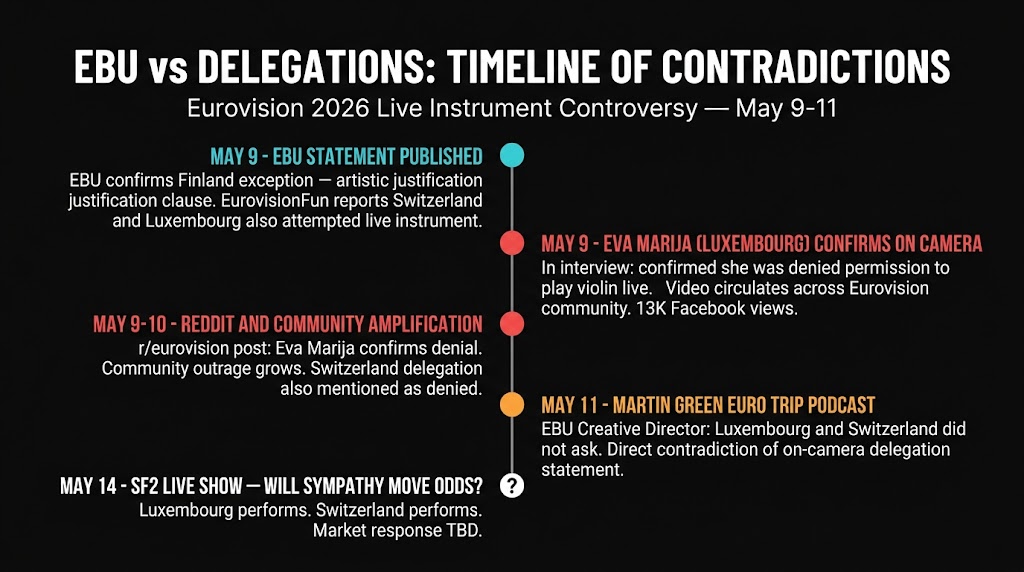
On May 9, the EBU issued an official statement explaining Finland's position. The key passage:
"In close conversation with ORF we granted the request made by Yle some months ago to play parts of the violin solos in the Finnish entry as a live audio capture into a microphone. This decision is in accordance with the Rules of the Eurovision Song Contest 2026 which say that live audio capture of instruments may exceptionally be permitted where artistically justified."
That statement, reported by EurovisionFun on May 9, 2026, confirmed two things that the fan community had suspected: first, that Finland had been granted a specific exception to the standard rule treating all instrument audio as pre-recorded backing track; and second, that the EBU's rules do allow live instruments where there is sufficient "artistic justification." The EBU also noted that every request is reviewed individually and that final approval is only given after rehearsals, once production teams can assess whether the live element works both technically and artistically for the TV broadcast.
The same EurovisionFun article noted that Switzerland was denied permission for a live electric guitar performance, and that Luxembourg's representative had confirmed she was not allowed to perform violin live during her act.
Eva Marija's On-Camera Statement
What turned this from a background conversation into a live press-centre story was what came next. Luxembourg's 2026 representative — in an interview that circulated widely across Eurovision community channels on May 9 and 10 — confirmed on camera that she had been denied permission to play violin live. She discussed the situation starting at around 2:06 of the interview, with enough specificity to make clear this was not a passive observation but a direct account of her delegation's experience with the EBU's approval process.

The interview was posted to the Eurovision Fans Facebook page, where it accumulated 13,000 views. On Reddit's r/eurovision community — one of the fastest-moving aggregators of Eurovision press-centre news — a dedicated thread flagged with the Social Media flair attracted significant discussion, with community members noting the contrast between the EBU's stated process and what the delegation was describing.
The Reddit comments included this observation from one verified community contributor: "There are recorded videos of both representatives literally saying EBU didn't approve their request so I am not sure how this is the reporters' fault." That framing — referencing both Luxembourg and Switzerland — suggests the Swiss delegation had also made comparable statements, though Switzerland's account has received less direct video circulation than Eva Marija's.
Martin Green's Podcast Statement: The Escalation
On the morning of May 11, Martin Green gave an interview to the Euro Trip Podcast in which he addressed the live instrument controversy directly. Green's account, as reported by the Eurovision community: Luxembourg and Switzerland had not asked for live instrument permission. The clear implication is that the EBU did not deny requests that were never made.
The Eurovision community's reaction was immediate and sceptical. One community contributor summarised the technical context Green provided: "Green says you must request to play a live instrument by a certain deadline (in March), but the final decision is made after the second rehearsals, when the production team is sure everything works properly. They have a world-class crew working on the production and wouldn't allow live instruments unless they were absolutely sure that it sounded excellent."
Green also characterised the overall controversy's significance with a phrase that drew considerable community pushback: "It doesn't fundamentally affect anybody's songs." That position — delivered on the morning of the SF1 jury show with live instrument discussions still dominating the press centre — did not land well with the Eurovision community, which had spent the preceding 48 hours watching delegation representatives describe a different experience.
The Factual Contradiction at the Centre of the Story
To be precise about what is in dispute: Martin Green says Luxembourg and Switzerland did not submit requests by the applicable March deadline. Eva Marija's on-camera account indicates she was denied permission. These two positions are not straightforwardly reconcilable.
There are several possible resolutions to this apparent contradiction. First, Green may be technically correct that no formal written request was filed by the March deadline — but Luxembourg and Switzerland may have approached the EBU informally or verbally, received a negative response, and are now characterising that informal denial as a formal refusal. Second, Green may be correct and Eva Marija may be mischaracterising a different conversation (for example, a technical-feasibility discussion that she experienced as a denial of permission). Third, Green's account may be incorrect or incomplete, and the delegations did file requests that were not processed or were declined.
From a betting perspective, the most important thing is not which account is technically accurate — it is that the contradiction is now public and circulating in the Eurovision community, and that public contradictions between the EBU and delegations have a documented pattern of affecting voting behaviour through narrative mechanisms.
Eurovision audiences — particularly casual viewers who encounter the contest through social media — respond to stories about fairness, disadvantage, and EBU overreach. The 2024 story of the Netherlands' Joost Klein disqualification demonstrated how quickly a perceived EBU injustice can generate emotional engagement that influences voting. The 2024 Eric Saade keffiyeh intervention, Norway's Jonas Lovv staging warning in 2026, and now the instrument controversy all follow a similar pattern: an EBU intervention generates press-centre discussion that reaches casual viewers and may activate sympathy votes.
Who Are Eva Marija and Veronica Fusaro?
For bettors assessing whether the narrative boost is worth pricing in, it helps to understand what the entries actually look like and what their instrument elements would have meant for performance quality.
Eva Marija (Luxembourg): Luxembourg returns to Eurovision 2026 after their notable absence in previous years, sending a violinist-vocalist whose staging integrates her instrument into the performance architecture. The violin is not a prop — it is a central visual and sonic element of the entry. The denial of live audio means audiences hear a pre-recorded violin track while watching Eva Marija move with an instrument that is effectively muted in the broadcast. Whether casual viewers notice this distinction is debatable; whether it matters to the jury — who score on originality and composition — is a more interesting question.
Veronica Fusaro (Switzerland): Switzerland's entry 'Alice' carries a stalker-thriller narrative with staging that has been described as rousing and authentic by press-centre observers. The live electric guitar would have reinforced the raw, visceral energy of an entry that has climbed from 47% to 46-52% qualification probability on the back of strong rehearsal reviews. The denial of live guitar means the rock-adjacent sonic edge of the performance is softened compared to what Finland's live violin adds to Liekinheitin.

The SF2 Qualification Landscape: Where Luxembourg and Switzerland Sit
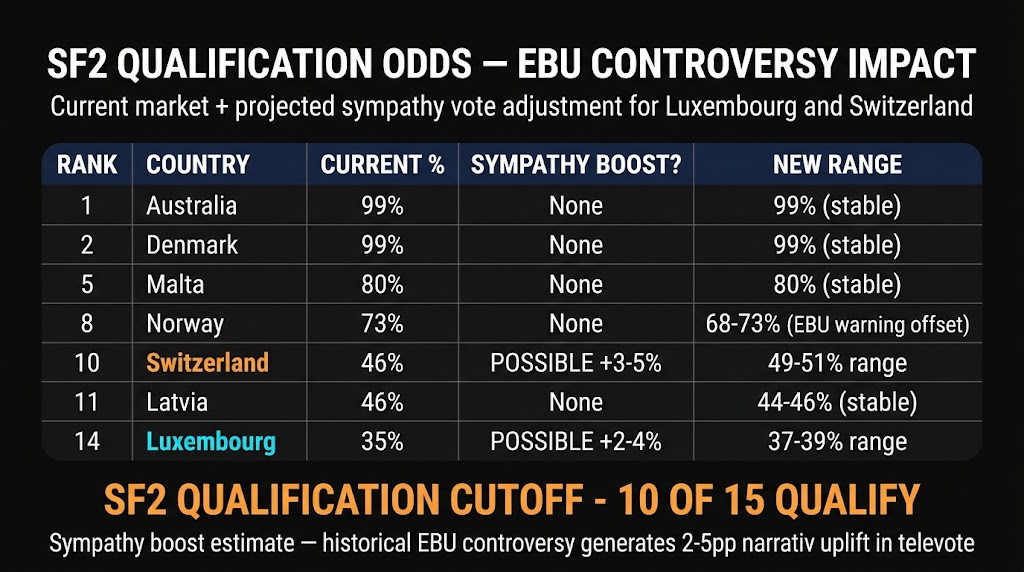
Both countries compete in Semi-Final 2 on Thursday 14 May. Ten of the fifteen SF2 countries qualify for the Grand Final. Here is the current SF2 probability table as of 11 May 2026:
| Rank | Country | Artist | Qual % | Odds | Notes |
|---|---|---|---|---|---|
| 1 | Australia | Delta Goodrem | 99% | 1.01 | Safe |
| 2 | Denmark | Søren Torpegaard | 99% | 1.01 | Safe |
| 3 | Ukraine | TBA | 92% | 1.05 | Safe |
| 4 | Romania | Alexandra Căpitănescu | 90% | 1.06 | Safe |
| 5 | Cyprus | Antigoni | 80% | 1.17 | Safe |
| 6 | Malta | AIDAN | 80% | 1.17 | Safe |
| 7 | Bulgaria | Bangaranga | 78% | 1.22 | Safe |
| 8 | Norway ⚠ | Jonas Lovv | 73% | 1.33 | EBU staging warning |
| 9 | Albania | Alis Nân | 72% | 1.42 | Solid |
| 10 | Czechia | Daniel Zizka | 70% | 1.35 | Borderline |
| 11 | Switzerland ⚡ | Veronica Fusaro | 46% | 2.17 | Bubble — instrument controversy |
| 12 | Latvia | Tautumeitas | 46% | 2.30 | Bubble — folk |
| 13 | Armenia | TBA | 42% | 2.60 | Bubble |
| 14 | Luxembourg ⚡ | Eva Marija | 35% | 2.85 | Bubble — instrument controversy |
| 15 | Other | — | — | — | — |
Data: Eurovisionworld.com bookmaker aggregate, verified 11 May 2026. ⚡ denotes entries directly involved in EBU live instrument controversy.
The qualification cutoff is at rank 10. Luxembourg at rank 14 with 35% probability and Switzerland at rank 11 with 46% are both clearly in bubble territory. The question is whether the instrument controversy can generate enough narrative momentum to shift their probabilities upward before Thursday's live show.
Historical Pattern: Does EBU Controversy Generate Sympathy Votes?
The Eurovision community's conventional wisdom says yes — but the evidence is more nuanced than a simple rule. Here is the documented pattern from recent contests:
| Year | Entry | Controversy Type | Pre-Controversy % | Post-Controversy % | Actual Result |
|---|---|---|---|---|---|
| 2024 | Netherlands (Joost Klein) | Disqualification | ~40% GF win | N/A (removed) | DQ |
| 2024 | Ireland (Bambie Thug) | EBU restriction on face paint | 8% | 12% (estimated) | Qualified, 6th GF |
| 2024 | Sweden (Eric Saade) | Keffiyeh intervention | Performed at NF, not ESC artist | N/A | N/A |
| 2026 | Norway (Jonas Lovv) | Staging warning — too sexy | 73% | TBD | TBD |
| 2026 | Finland | Live violin granted — positive | 33% | 36% | TBD |
Source: EurovisionWorld odds tracker, EBU official communications, Reddit r/eurovision community reports.
The pattern that emerges from this data is important: sympathy vote boosts are real but modest — typically 2–5 percentage points rather than transformational market shifts. The Bambie Thug example is the closest analogue to the Luxembourg/Switzerland situation: a peripheral EBU restriction that was not a disqualification, that generated community discussion, and that may have contributed to stronger-than-expected voting.
The key mechanism is not that voters consciously reward entries for being treated unfairly by the EBU. It is that controversy generates awareness, awareness generates casual viewer engagement, and engaged casual viewers are more likely to vote for entries they have noticed. An artist whose story is circulating across Eurovision community channels the week of the contest has a visibility advantage over an artist who performed quietly and attracted no press-centre discussion.
Eva Marija's on-camera account — a violinist describing being denied the ability to play her instrument live — is exactly the kind of human-interest moment that travels through social media and reaches the casual viewer who occasionally votes in Eurovision but does not follow rehearsal reports. It is sympathetic, specific, and easy to communicate. "She was told she couldn't play her violin" is a sentence that works in a Facebook caption, a tweet, or a family dinner conversation on Thursday.
Stake — Crypto Betting with Instant Payouts on Eurovision 2026 Semi-Final 2 Qualification Markets
Does the Story Hurt Finland?
The contrarian case worth examining: does the instrument controversy create narrative backlash against Finland? If casual viewers conclude that Finland received unfair preferential treatment from the EBU, does that suppress Finland's televote performance?
Our assessment: almost certainly not, for two reasons. First, Finland's live violin is audibly beautiful — the performance benefit is self-evident to any viewer who watches the rehearsal footage, and positive aesthetic impact insulates an entry from political backlash. Second, Eurovision's televote audience responds primarily to the performance they see on the night of the semi-final or grand final, not to press-centre controversies that circulate in the days before. The audience watching on Tuesday or Thursday night will not have been following the live instrument debate with the attention level of an accredited journalist or a hardened fan.
Finland's position — 36% outright winner probability at approximately 2.00 odds — is built on a foundation of exceptional rehearsal reviews, a live violin advantage that is aurally demonstrable, and a song (Liekinheitin) that is the dominant market favourite by a significant margin. None of those foundations are weakened by the EBU controversy.
The Luxembourg Entry in Full
Luxembourg's re-emergence as a Eurovision competitor has been a story in itself. After years of absence, the country returns with an entry that centres Eva Marija's violin playing as the structural heart of the performance. The entry's aesthetic — classical-influenced, emotionally direct, unusual by Eurovision standards — has earned it a distinct identity in the SF2 field even at 35% qualification probability.
The 35% market position reflects the following analytical reality: Luxembourg is competing in a strong SF2 field where the top seven or eight qualifiers are effectively locked in, and the battle for the final two spots involves a cluster of four or five entries. The instrument controversy does not change the entry's inherent competitive position — its jury profile, its song construction, or its staging. What it does is add a narrative variable that the 35% price may not fully reflect.
Specifically: the story of a violinist told she cannot play her instrument live — and then having the EBU publicly dispute her account — is a story that generates emotional engagement with audiences who may never have heard of the entry before Thursday. That engagement, even if it translates to just one or two percentage points of additional televote support, can matter significantly at the margin in a semi-final where the difference between qualifying and not qualifying may be a handful of percentage points.
The Swiss Entry in Full
Veronica Fusaro's 'Alice' has already built a strong press-centre narrative independent of the instrument controversy. The song's stalker-thriller concept — written from the perspective of a psychological abuser — is described by rehearsal observers as rousing and packed with authenticity. Fusaro performs with a red-rope netting and cube cage staging that symbolises psychological entrapment, and the entry has climbed from its initial odds position to 46-52% qualification probability on the strength of second-rehearsal reviews.
The live guitar denial is the missing element: a rock-adjacent entry that would have benefited from the same kind of live sonic energy that Finland's violin exception has given Liekinheitin. Instead, Fusaro plays her guitar against a backing track, which achieves a different sonic effect. Whether the audience notices — or whether the staging is strong enough to overcome the absence of live sound — is a question the jury show tonight may begin to answer.
Switzerland at 46% in the SF2 bubble is the more straightforward betting proposition of the two countries. At 2.17 odds on major books, the implied probability of 46% is already reasonably priced relative to the entry's rehearsal performance. The controversy adds upside variance to a position that already has a reasonable base case.
Betting Recommendations: Acting Before the Market Prices the Narrative
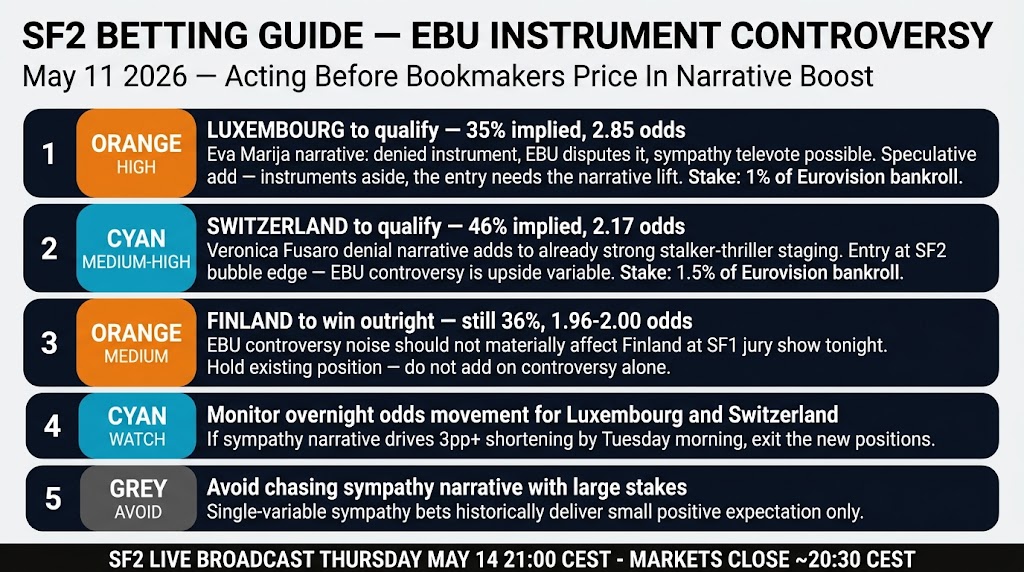
The window for acting on this story is short. The SF2 jury show — which is when professional juries score the entries in advance of Thursday's public broadcast — takes place on Wednesday 13 May. Bookmakers are unlikely to incorporate the instrument controversy narrative into their SF2 odds before that show, which means the current 35% (Luxembourg) and 46% (Switzerland) prices may represent the best pre-narrative entry points available.
Luxembourg SF2 Qualifier at 2.85 — Speculative Add
The core argument for Luxembourg: Eva Marija's on-camera statement is one of the most shareable Eurovision press-centre moments of the week. A violinist-vocalist confirmed she was denied the right to play her instrument live. The EBU then disputed her account publicly. That is a story that generates engagement, and engagement translates to awareness votes. At 2.85 (35% implied), the narrative upside is not priced in. Stake: 1% of Eurovision bankroll. Speculative position only. Do not add further if the story fails to gain additional traction by Wednesday morning.
Switzerland SF2 Qualifier at 2.17 — Small Position
Switzerland's Veronica Fusaro combines a strong entry with a narrative boost variable. At 2.17 (46% implied), the base case alone is borderline fair value — the stalker-thriller staging is one of the more distinctive entries in SF2, and 46% may slightly understate the entry's real probability after positive second-rehearsal reviews. Adding the instrument narrative as an upside variable makes a small position worth taking. Stake: 1.5% of Eurovision bankroll. Exit if Wednesday jury show generates negative press-centre reaction to the staging.
Finland Outright at 2.00 — Hold, Do Not Add
Finland's position as the contest favourite is unaffected by the controversy. The live violin exception is a genuine performance advantage that is audibly demonstrable and does not depend on audience sympathy for its effect. Existing holders of Finland positions should hold. The controversy is not a reason to add to the position — it is background noise that affects other entries more directly. Action: maintain existing Finland position only.
Avoid — Large Stakes on Controversy-Only Narratives
The sympathy vote mechanism is real but inherently speculative. The estimated narrative boost is 2–5 percentage points — meaningful at the bubble but not transformational. Do not construct large positions around this story. Both Luxembourg and Switzerland need their entries to perform well on Thursday night in addition to any narrative benefit. A weak jury show from either entry will override the sympathy narrative entirely.
Thunderpick — 100% First Deposit Bonus on Eurovision 2026 SF2 Qualification Markets
The Broader Context: EBU Governance and Eurovision 2026
The instrument controversy sits within a broader pattern at Eurovision 2026. The EBU has already issued a formal staging warning to Norway's Jonas Lovv (too sexy / not family-friendly), a formal warning to Israel's broadcaster KAN over vote mobilisation, and a live instrument exception to Finland. Three significant EBU governance interventions in the first week of the contest is unusual — and each one has generated its own cycle of press-centre discussion and community reaction.
The cumulative effect of multiple EBU interventions is worth noting for bettors: it creates a contest atmosphere in which the EBU's judgment is under continuous scrutiny. In that atmosphere, the contrast between Finland receiving an exception and Luxembourg/Switzerland being in a contested position over whether they even applied is particularly visible. The community's response to Martin Green's podcast statement — sceptical, energised, inclined to give delegations the benefit of the doubt — reflects that accumulated scrutiny.
We are not suggesting the EBU acted improperly. The EBU's stated process — request by March deadline, final approval after rehearsals — is coherent and procedurally defensible. Martin Green may be entirely accurate in his account. But Eurovision's history is full of situations where procedural accuracy and narrative impact pointed in different directions. This is one of them.
Key Dates for SF2 and Grand Final
- Monday 11 May: SF1 jury show (21:00 CEST). Tonight. Instrument controversy circulating in press centre.
- Tuesday 12 May: SF1 public broadcast (21:00 CEST). First semi-final qualification confirmed.
- Wednesday 13 May: SF2 jury show (21:00 CEST). First test of Luxembourg and Switzerland with live jury audience.
- Thursday 14 May: SF2 public broadcast (21:00 CEST). Luxembourg and Switzerland must perform here to reach the Grand Final.
- Saturday 16 May: Grand Final (21:00 CEST). Only semi-final qualifiers plus Big Five + Austria.
The betting window for acting on this story closes at approximately 20:30 CEST on Thursday 14 May, when bookmakers suspend SF2 qualification markets ahead of the broadcast. Wednesday morning's press-centre reaction to the SF2 jury show dress rehearsal is the last major information signal before that window closes.
Frequently Asked Questions
Why was Finland allowed to play violin live while Luxembourg and Switzerland were not?
According to the EBU's official statement, the Finnish broadcaster Yle submitted a formal request "some months ago" — reportedly by the March 2026 application deadline. The EBU approved the request after technical rehearsals confirmed the live violin audio capture worked both artistically and from a production standpoint. The EBU's rules permit live instruments "where artistically justified" on an exceptional, case-by-case basis. EBU Creative Director Martin Green said on the Euro Trip Podcast that Luxembourg and Switzerland did not submit equivalent requests. Both those delegations have disputed this characterisation, with Luxembourg's representative confirming on camera that she was denied permission.
What has Luxembourg's representative said about the live violin denial?
In an on-camera interview circulated widely across Eurovision community channels on May 9 and 10, 2026, Luxembourg's representative confirmed she was denied permission to play violin live during her Eurovision performance. She discussed the situation in detail starting around the 2:06 mark of the interview, which was shared on YouTube and reposted to Facebook's Eurovision Fans page, where it accumulated over 13,000 views. Her account describes a situation in which permission was sought and not granted — directly contradicting the EBU's Martin Green who said no such request was made.
What are Luxembourg's and Switzerland's current Eurovision 2026 SF2 odds?
As of the morning of 11 May 2026, Luxembourg sits at 35% SF2 qualification probability at approximately 2.85 decimal odds. Switzerland sits at 46% SF2 qualification probability at approximately 2.17 odds. Both countries are in the SF2 qualification bubble — below the likely cutoff line of ten qualifying countries. Both compete in Semi-Final 2 on Thursday 14 May 2026.
Is this EBU controversy the same as the Israel vote mobilisation warning from May 9?
No. These are distinct EBU interventions that have occurred in the same contest week. The Israel KAN vote mobilisation warning (May 9) concerned KAN Broadcasting's promotional content directing viewers to use all available votes for the Israeli entry — an enforcement of the new anti-vote-mobilisation rules. The live instrument controversy concerns a different clause in the Eurovision rules, involving which performers are permitted to generate live audio from instruments on stage. The two controversies have different implications for different entries and different markets.
Does the EBU instrument controversy affect Finland's chances of winning Eurovision 2026?
Almost certainly not in a material way. Finland remains the outright winner favourite at approximately 36% win probability and 2.00 odds. The live violin exception is a genuine and audible performance advantage that the EBU granted based on an advance request and a post-rehearsal technical assessment. The controversy around other delegations' requests does not change the fact that Finland's performance is objectively improved by the live violin element, and the Eurovision televote audience — which ultimately determines a large fraction of the result — responds primarily to what they see and hear on the night of the broadcast rather than to press-centre procedural debates.
What happens to Luxembourg and Switzerland if they don't qualify from SF2?
Neither country is in the Big Five automatic qualifying group (Germany, France, Italy, Spain, United Kingdom) or the host-country group (Austria). If Luxembourg or Switzerland fails to qualify from SF2, they do not compete in the Grand Final on Saturday 16 May. Their Eurovision 2026 campaign ends on Thursday night. For bettors, non-qualification means total loss of any SF2 qualification bet. The Grand Final outright market is only relevant if the entries qualify through SF2.
Related Articles
- Finland's Linda Lampenius Gets Historic EBU Exception to Play Live Violin at Eurovision 2026 — What It Means for the 36% Odds
- Eurovision 2026 SF2 Bubble Battle: Latvia, Armenia, Luxembourg Fight for Last Qualification Spots
- Switzerland's Veronica Fusaro 'Alice': Stalker-Thriller Staging at 46% SF2 Qualification — Betting Analysis
- Norway's Jonas Lovv Warned by EBU: 'Too Sexy' Staging Must Change Before SF2 — Betting Impact
- EBU Formally Warns Israel Over Vote Mobilisation at Eurovision 2026 — Televote Market Impact
- SF1 Jury Show Tonight: How Professional Juries Will Shape Tomorrow's Odds
Cloudbet — Up to 5 BTC Welcome Bonus on Eurovision 2026 Semi-Final 2 and Grand Final Markets
Source: EBU official statement on live instruments, EurovisionFun, May 9 2026. Martin Green statement: Euro Trip Podcast, May 11 2026, as reported on Reddit r/eurovision. Luxembourg representative on-camera statement: circulated via Eurovision community channels, May 9-10 2026, 13K Facebook views. SF2 qualification odds: Eurovisionworld.com SF2 market, verified 11 May 2026. 18+. Please gamble responsibly. BeGambleAware.org. When the fun stops, stop.