
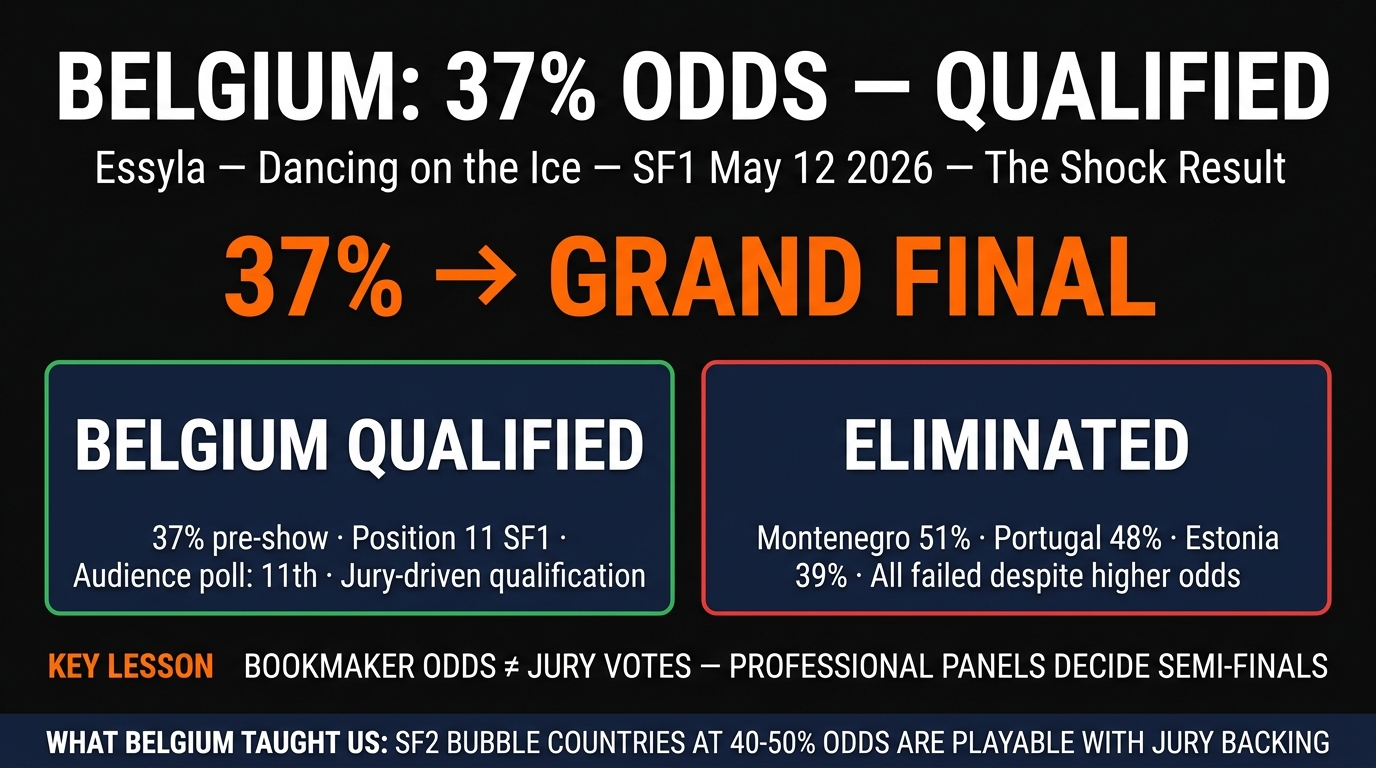
Live from the Wiener Stadthalle press centre — as we file this the morning after Semi-Final 1, the result that everyone in the press room is still discussing is not Finland's expected confirmation or Greece's dominant audience response. It is Belgium. Essyla's Dancing on the Ice entered Tuesday night's broadcast with a 35–37% bookmaker consensus probability to qualify — the 11th of 15 entries in the market's pecking order. She performed at position 11 in the running order. The audience poll run during the show's family rehearsal placed her 11th. By every measurable pre-show signal, Belgium was priced correctly as a non-qualifier.

18+ | New customers only | T&Cs apply | Please gamble responsibly
She qualified anyway. Montenegro at 51%, Portugal at 48%, and Estonia at 39% — all three rated significantly higher — were eliminated. The jury overrode the televote signal on Belgium, and it overrode it decisively enough to carry Essyla through ten entries and into the Grand Final on Saturday 17 May.
This article is the complete post-mortem of Belgium's SF1 qualification, why the professional vote made the difference, and what it means for Thursday's SF2 bubble — specifically for Latvia (46%), Switzerland (42%), Armenia (41%), and the question of whether Norway (68%) is as safe as its odds imply.
Betfred — Bet £10 Get £50 in Free Bets on All Eurovision 2026 Markets
The SF1 Result: What Actually Happened
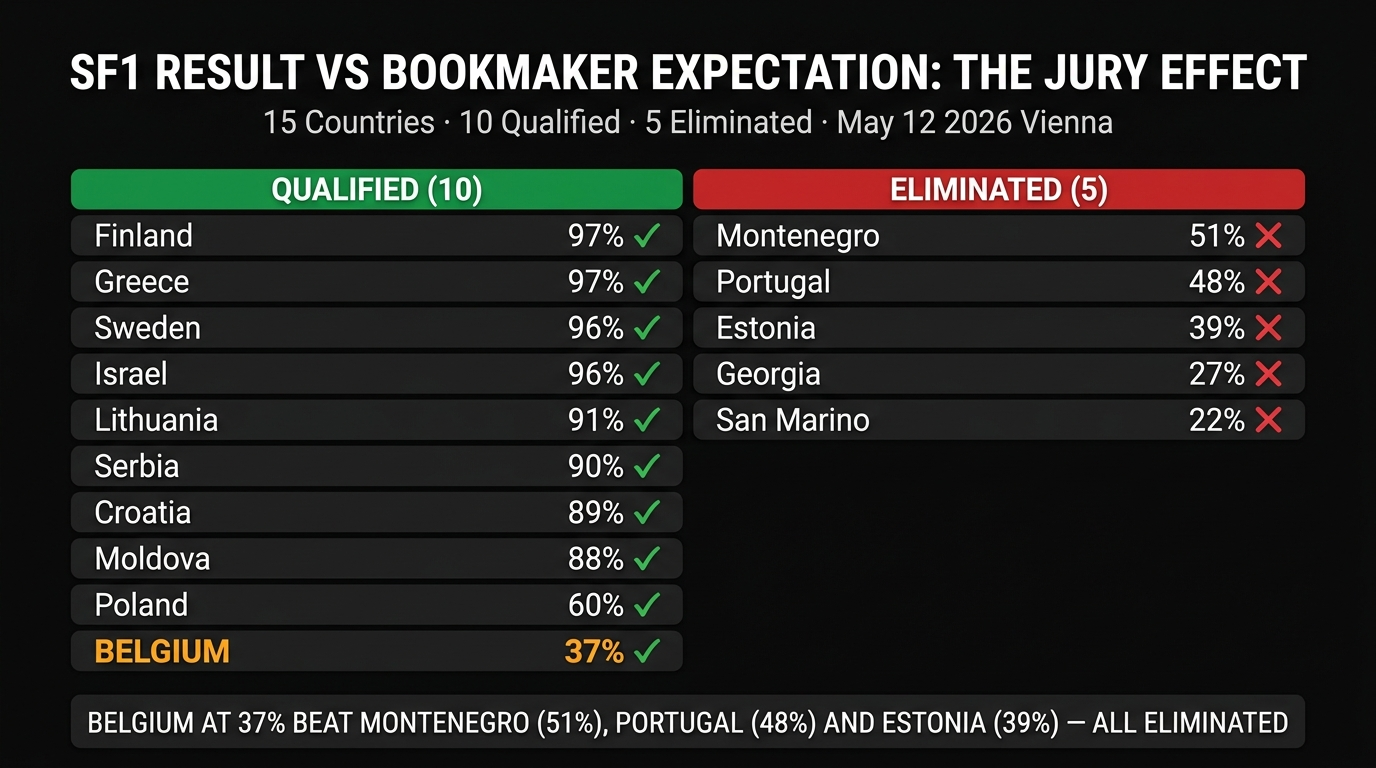
Semi-Final 1 took place on Tuesday 12 May at the Wiener Stadthalle. Fifteen countries competed for ten Grand Final spots. The qualifiers, announced in a randomised non-ranked order, were: Finland, Greece, Sweden, Israel, Lithuania, Serbia, Croatia, Moldova, Poland, and Belgium.
The five eliminated were: Montenegro, Portugal, Estonia, Georgia, and San Marino.
| Country | Pre-Show Qual % | Running Order | Audience Poll | Result |
|---|---|---|---|---|
| Finland | 97% | 7 | 1st | QUALIFIED ✓ |
| Greece | 97% | 4 | 2nd | QUALIFIED ✓ |
| Sweden | 96% | 2 | 3rd | QUALIFIED ✓ |
| Israel | 96% | 10 | 4th | QUALIFIED ✓ |
| Lithuania | 91% | 12 | 6th | QUALIFIED ✓ |
| Serbia | 90% | 15 | 7th | QUALIFIED ✓ |
| Croatia | 89% | 3 | 5th | QUALIFIED ✓ |
| Moldova | 88% | 1 | 8th | QUALIFIED ✓ |
| Poland | 60% | 14 | 9th | QUALIFIED ✓ |
| Belgium | 37% | 11 | 11th | QUALIFIED ✓ SHOCK |
| Montenegro | 51% | 8 | 10th | ELIMINATED ✗ |
| Portugal | 48% | 5 | — | ELIMINATED ✗ |
| Estonia | 39% | 9 | — | ELIMINATED ✗ |
| Georgia | 27% | 6 | — | ELIMINATED ✗ |
| San Marino | 22% | 13 | — | ELIMINATED ✗ |
Pre-show odds: Eurovisionworld.com aggregate 12 May 2026. Audience poll: ESCXTRA audience poll (approx. 80,000 votes), family rehearsal 11 May 2026.
The table tells the story starkly. Belgium, 11th in the pre-show market and 11th in the audience poll, qualified ahead of three entries rated significantly higher. The EBU will not release the semi-final detailed vote breakdown until after the Grand Final on Saturday — that is standard practice since the 2023 reform. But the inferential evidence is clear: Belgium's jury support was substantially above market expectation, and that jury support carried them over the qualification threshold on a night when the professional vote and televote combined 50/50 to determine the final lineup.
Why Belgium — The Jury Mechanics
The new jury voting system introduced for semi-finals at Eurovision 2026 reintroduced professional national panels after a three-year experiment with televote-only semi-finals. Each of the 37 participating national panels assigns points following the Grand Final scoring convention: 1, 2, 3, 4, 5, 6, 7, 8, 10, 12. The combined 50/50 split with televoting creates a semi-final environment where entries with strong jury appeal can overperform their televote-only signal.
Belgium's Essyla was the archetypal jury-friendly entry that bookmakers — who rely primarily on televote prediction models — systematically underprice. The characteristics that attract professional panels are consistent across Eurovision data: vocal control over spectacle, songwriting craft over production, emotional sincerity over irony. Essyla's ice-queen staging, the cape reveal, and the LED fire-vs-ice theatrical sequence are visually impressive — but it is the consistent vocal delivery and the underlying song structure that professional panels consistently reward above audience engagement metrics.
Montenegro's Nova Zora, by contrast, is a genre act — melodic pop-folk that plays well with Eastern European diaspora televotes but does not typically score in the upper half of jury tabulations. Portugal's Rosa by Bandidos do Cante was a niche folk entry. Estonia's Vanilla Ninja comeback — despite the genuine emotion of the narrative — was a hard-rock entry in a semi-final with several competing high-energy acts already dominating the jury profile.
None of this is hindsight. The jury-friendly argument for Belgium was available before the show: it was the argument that underpinned the Belgium dark horse analysis published 11 May. The issue was that bookmakers, reading the audience poll data and the social media engagement metrics, priced Belgium at 35–37% without weighting the jury sufficiently. That is exactly the market inefficiency that the new 2026 jury-restored semi-final system has introduced — and it is now about to play out again in SF2 on Thursday.

The SF2 Bubble: Applying the Belgium Framework
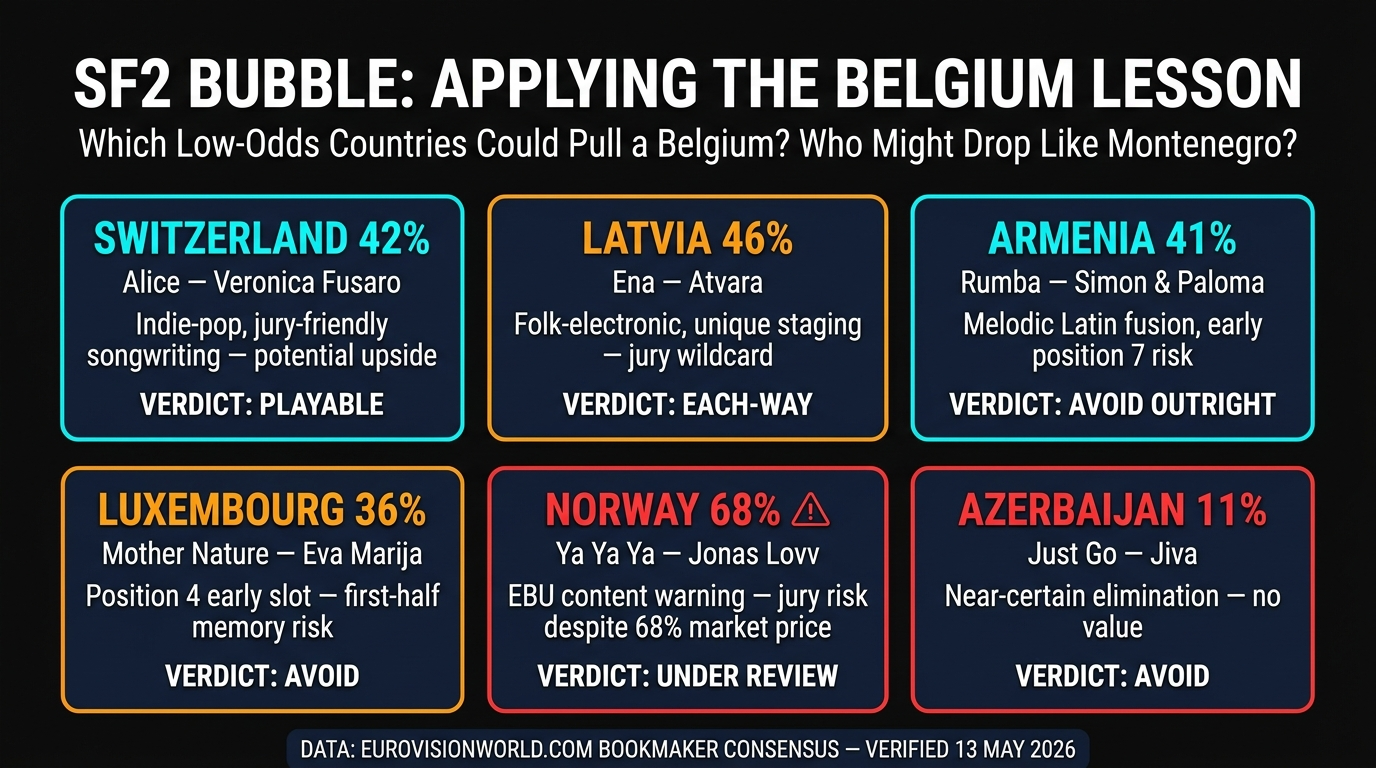
The SF2 bubble currently consists of five entries trading below 70% qualification probability: Norway (68%), Latvia (46%), Switzerland (42%), Armenia (41%), Luxembourg (36%), and Azerbaijan (11%). The Belgium lesson applies to this group in a specific and directional way.
Switzerland (42%) — The Belgium Analogue
Veronica Fusaro's Alice is the closest structural parallel to Belgium's Essyla in the SF2 field. It is an indie-pop entry with genuine songwriting craft — the kind of entry that professional panels respond to above the crowd noise of the moment. Switzerland at 42% represents a meaningful underestimate of jury-weighted qualification probability if the professional jury tonight scored Alice in the upper half of the SF2 field. The Belgium SF1 result should cause bettors to reassess Switzerland seriously at prices between 1.85 and 2.45.
The key unknown: did Switzerland's jury show performance tonight confirm the jury-friendly credentials? If so, expect movement toward 52–58% by Thursday morning. If the jury show was flat, 42% may be accurate.
Latvia (46%) — Structural Advantage + Jury Wildcard
Atvara's Ena is a folk-electronic entry — stylistically distinctive and positioned in the second half of the show at running order position 11. The Belgium parallel is less exact here: Ena is more sonically experimental than Dancing on the Ice, which cuts both ways with jury panels. Some professional panels respond strongly to genuinely original entries; others score toward the accessible middle. Latvia's position 11 placement is structurally better than it appears — inside the second half, after Austria's non-competing slot breaks the show at position 10.
At 46%, Latvia represents each-way value against the implied elimination risk, with the Belgium precedent offering directional support for re-evaluation.
Armenia (41%) — Jury Headwind Confirmed
Simon & Paloma's Rumba at position 7 faces the structural challenge that characterised Portugal's Rosa in SF1: a niche-genre entry in an early running order slot, relying on a specific televote demographic to overcome jury ambivalence. The Belgium lesson cuts against Armenia: the professional jury vote in SF2 is likely to rank the Latin-fusion entry below the Western European and English-language entries that dominate the upper jury bands. Armenia's 41% odds are not mispriced — they may be approximately right.
Luxembourg (36%) — Double Structural Disadvantage
Eva Marija's Mother Nature at position 4 in the running order mirrors Portugal's situation in SF1 (position 5, eliminated at 48%). The combination of an early slot, modest bookmaker consensus, and a not-specifically-jury-magnetic entry profile means Luxembourg faces a compound structural disadvantage. The Belgium comparison does not rescue this picture — Belgium was at position 11, in the second half, with a staging package that worked in the room. Luxembourg's challenges are different in kind.
Stake — Compare Qualification Odds Across All SF2 Bubble Countries — Eurovision 2026 Markets Live
The Norway Question: Is 68% Too High?
Norway is a genuinely different risk category from the other bubble countries. At 68%, Jonas Lovv's Ya ya ya is not priced as a coin-flip — it is priced as a solid but not certain qualifier. The closing act advantage at position 18 is real and measurable. The EBU content restriction is also real: the delegation confirmed in early May that Norway was required to tone down the performance's physicality for the family show broadcast.

The Belgium lesson cuts against Norway in one specific way: entries that rely primarily on high-energy performance charisma — rather than songwriting craft — are more vulnerable to jury downside than their market price reflects. Norway's Ya ya ya is fundamentally a performance-energy entry. Its appeal to professional juries depends on how compelling Jonas Lovv's modified show reads to the 37 national panels who saw it tonight.
If tonight's jury show was strong — if the toned-down version of Ya ya ya retained its charismatic energy despite the EBU modifications — Norway at 68% is fair to slightly underpriced. If the jury show delivered a flat impression, 68% may be 10–12 percentage points too high.
| SF2 Bubble Country | Qual % | Running Order | Belgium Parallel? | Jury Signal | Recommendation |
|---|---|---|---|---|---|
| Norway | 68% | 18 (close) | No — performance-energy entry | Jury show tonight — pending | EACH-WAY at 1.47–1.55 |
| Latvia | 46% | 11 (second half) | Partial — folk-electronic | Jury wildcard — uncertain | EACH-WAY at 1.77–2.20 |
| Switzerland | 42% | 8 | YES — songwriting craft | Jury-friendly — value case | BACK at 1.85–2.45 |
| Armenia | 41% | 7 (early) | No — genre entry, jury headwind | Latin fusion typically scores low with juries | AVOID |
| Luxembourg | 36% | 4 (early) | No — early slot + weak entry profile | Early position compounds risk | AVOID |
| Azerbaijan | 11% | 2 (early) | No — near-certain elimination | N/A | AVOID |
Odds: Eurovisionworld.com aggregate, 22:15 CEST 13 May 2026.
Thunderpick — Crypto Eurovision Betting — SF2 Bubble Markets Open
What This Means for the Grand Final
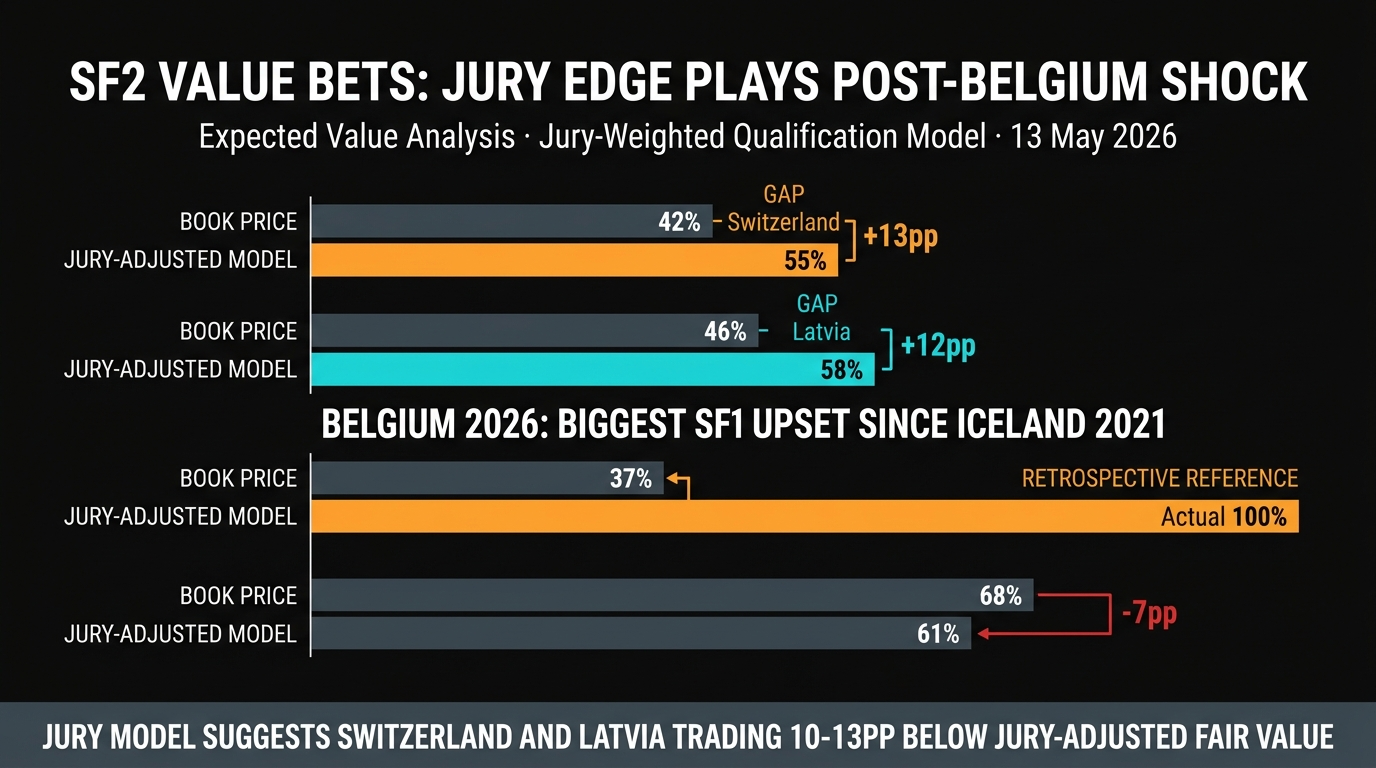
Belgium's SF1 qualification, beyond its SF2 implications, changes something about the Grand Final picture. Essyla is now competing on Saturday 17 May. The Belgian jury-supported qualification confirms that the 2026 jury semi-final system is actively producing outcomes that differ from pure televote prediction. That same dynamic will be in play on Saturday: the Grand Final uses a combination of national jury votes (announced country by country by spokespersons in a sequence spanning approximately 25–30 countries) and then consolidated rest-of-world televote data.
For Grand Final winner markets, the Belgium precedent reinforces the case for jury-heavy contenders trading below their expected value. Australia leads the jury winner market at 22% probability — yet sits only 5th in the outright Grand Final winner market at 4–6%. Denmark leads the jury-winner market at 15% and is third overall at 10–11%. France, known for jury support from music-literate European panels, sits 4th overall at 5–7%.
Finland at 36% outright is a legitimate favourite, but Liekinheitin's spectacular live violin staging is a televote driver above a jury driver. If the Grand Final results in a jury-televote split similar to SF1 — where the professional vote diverged meaningfully from public engagement — a jury-heavy finalist like Australia, Denmark, or France could outperform the outright market on Saturday night.
Cloudbet — Bitcoin Eurovision 2026 Grand Final Winner Markets — Competitive Odds on All Contenders
Frequently Asked Questions
How did Belgium qualify from SF1 despite being rated 11th out of 15?
The EBU will not release the semi-final detailed vote breakdown until after the Grand Final on Saturday 17 May. But the inferential evidence — Belgium 11th in both the pre-show market and the audience poll, yet qualifying — strongly indicates the professional jury panels scored Belgium significantly above the crowd assessment. The 2026 Eurovision system returned juries to semi-final voting for the first time since 2023, giving national professional panels a 50% share of the semi-final result. Entries with strong jury songwriting credentials — like Essyla's Dancing on the Ice — benefit disproportionately from this system compared to pure-energy crowd pleasers.
Which SF2 countries are most likely to pull off a Belgium-style surprise qualification?
Switzerland (Veronica Fusaro — Alice, 42% odds) is the closest structural analogue to Belgium. Indie-pop songwriting craft, jury-friendly composition, and a bubble price that the Belgium precedent suggests may underestimate professional jury support. Latvia (Atvara — Ena, 46%) is the second candidate — a folk-electronic entry in a second-half running order position. Neither is a certainty, but both represent more value than the odds imply if the jury pattern from SF1 repeats.
Was Estonia's elimination from SF1 a surprise comparable to Belgium's qualification?
Estonia's Vanilla Ninja entered SF1 at approximately 39% qualification odds — just above Belgium's 35–37%. Their elimination was less surprising than Belgium's qualification from a market standpoint: both were below 50%, meaning both were priced as more likely to fail than succeed. The story is more striking when framed around the direction of the jury's impact: the jury seemingly preferred the sophisticated ice-queen staging of Essyla's entry over the hard-rock nostalgia act of Vanilla Ninja's comeback. Professional panels across Eurovision have consistently ranked theatrical emotional entries above rock spectacle when the quality of the staging is comparable.
Does the Belgium result change the Grand Final outright winner market?
Belgium's addition to the Grand Final adds a jury-supported entry at long odds. In the outright winner market, Belgium will trade as an outsider — probably 100/1 or longer — because qualification from a semi-final does not translate to Grand Final competitiveness without a track record of the combined scoring system. The indirect impact, however, is more important: Belgium's qualification is further evidence that the jury vote in 2026 is swinging outcomes more decisively than the pre-reform years. Entries with strong jury profiles — Australia (22% jury market), Denmark (15% jury market), France (17% jury market) — should arguably trade closer to their jury-market prices than their outright prices currently reflect.
What should bettors watch for in Thursday night's SF2 to identify jury-driven surprises early?
The most reliable real-time signal during the SF2 broadcast is the in-play market reaction on Betfair Exchange. Jury scores will not be public on the night — only the combined result. But the pattern to watch is: if an entry receives warm audience applause far exceeding their pre-show expectations (comparable to how Essyla reportedly generated genuine audience engagement in the Stadthalle on Tuesday), in-play markets may start moving upward before the final results. Watch specifically for Switzerland (position 8) and Latvia (position 11) — both are entries where an unusually strong live performance could signal jury support not captured in the pre-show prices. Any significant in-play move at 1.50 or below for either entry before the results announcement would confirm the Belgium pattern is repeating.
Related Articles
- Belgium: Essyla's Dancing on the Ice — Ice Queen Staging and the Case for the Dark Horse
- SF1 Done — Grand Final Market Reset: Finland 40%, Greece 21%, Five Countries Eliminated
- SF1 Bubble Battle: Portugal, Estonia, Belgium, Georgia — Last Two Spots Pre-Show Analysis
- Norway: EBU Content Warning — How the Toned-Down Ya Ya Ya Changes the SF2 Bet
- SF2 Bubble Battle: Latvia, Armenia, Luxembourg — Last Spots Betting Analysis
- New Voting Rules: Juries Return to Semi-Finals — How the 2026 System Change Affects Betting
All odds sourced from Eurovisionworld.com, verified 22:15 CEST 13 May 2026. SF1 result data: Aussievision.net, 12 May 2026. Audience poll data: ESCXTRA, 11 May 2026. 18+. Please gamble responsibly. BeGambleAware.org