When the BBC announced that the United Kingdom would be represented at Eurovision 2026 by a YouTuber who once built a fully playable organ out of 44 Furby toys, the reaction split neatly down the middle. Half of the internet erupted in delight. The other half asked the same question: who on earth is Look Mum No Computer?

18+ | New customers only | T&Cs apply | Please gamble responsibly
The answer is Sam Battle. He is 31 years old, British, and he might be the most creatively fearless musician working today. He builds synthesisers out of things that were never meant to be synthesisers. He runs a museum dedicated to saving obsolete electronics from landfill. He has accumulated over 85 million views and 1.4 million followers on YouTube by doing something nobody else does — turning junk into music and making it look like the most fun a human being can have.
Now he is taking that energy to the biggest stage in European music. Eurovision 2026. Vienna, Austria. A global audience of 160 million viewers. And a song with a title in German.
This is the full story of Sam Battle, the machines he builds, the song he is bringing, and why this might be the most exciting UK Eurovision entry in years.
From Bedroom Tinkerer to YouTube Phenomenon
Sam Battle started his YouTube channel, Look Mum No Computer, in 2016. The premise was simple and slightly unhinged: take old electronic components, vintage toys, discarded hardware, and whatever else he could get his hands on, then wire them together into functioning musical instruments. Then play those instruments. Then film the whole thing.
The concept landed immediately. In an era of polished, algorithm-optimised content, Battle's videos felt refreshingly raw. There was no team of editors, no corporate backing, no focus-grouped thumbnails. Just a man in a workshop, covered in solder burns and enthusiasm, building something that should not work and then making it sing.
His channel grew steadily through 2016 and 2017, picking up subscribers who were drawn to the combination of genuine engineering skill, musical talent, and a personality that radiates pure, unfiltered joy. By 2018, he was pulling in hundreds of thousands of views per video. By 2020, he had crossed the one million subscriber mark. Today, his channel sits at approximately 1.4 million followers with a cumulative view count exceeding 85 million.
What makes those numbers remarkable is how he achieved them. Battle does not chase trends. He does not react to other creators' content. He does not participate in drama or controversy. He builds instruments out of electronic waste and plays music on them. That is it. The audience found him because what he does is genuinely unique, and they stayed because he is genuinely likeable.
The Inventions That Made Him Famous
You cannot understand Look Mum No Computer without understanding the machines. Sam Battle is not just a musician who happens to tinker with electronics. He is an inventor whose inventions happen to make music. The distinction matters, because it is the inventions that made him a star.
The Furby Organ
This is the one that broke the internet. In 2018, Battle built a fully playable organ using 44 Furby toys as the sound source. Each Furby was modified to produce a specific pitch when triggered, and the whole array was wired into a keyboard interface. The result was an instrument that looked like a nightmare from a 1990s toy shop and sounded like a choir of possessed robots.
The Furby Organ video went massively viral, racking up millions of views and coverage from mainstream media outlets around the world. It was featured on the BBC, picked up by music technology publications, and shared across social media by people who had never heard of Look Mum No Computer before. For many viewers, the Furby Organ was their introduction to Sam Battle, and it remains his most iconic creation.
What made the video compelling was not just the absurdity of the concept. It was the fact that Battle clearly understood what he was doing from an engineering standpoint. This was not a novelty gag. It was a genuine instrument, built with real skill, that happened to be made from Furbies. The combination of technical competence and gleeful absurdity became Battle's signature.
The Raleigh Chopper Synthesiser
Because building a Furby organ was apparently not enough, Battle also fused a working synthesiser with a Raleigh Chopper bicycle. The Chopper — that iconic 1970s bike with the banana seat and the high handlebars — became the housing for a modular synth setup. Pedalling the bike generated power and affected the sound output, meaning Battle could literally ride around while playing electronic music.
The Chopper synth embodied everything people love about Look Mum No Computer: it was impractical, it was brilliant, it should not have worked, and it sounded surprisingly good.
The Game Boy Triple Oscillator
Battle took three original Nintendo Game Boys, modified their sound chips, and wired them together into a triple oscillator synthesiser. The result was a lo-fi electronic instrument that produced thick, layered tones from hardware designed to play Tetris and Super Mario. The project demonstrated Battle's deep understanding of analogue and digital sound synthesis, wrapped in the playful aesthetic that defines his brand.
The Tesco Trolley Synthesiser, the Flamethrower Organ, and More
The list goes on. Battle has built a synthesiser inside a Tesco shopping trolley. He constructed an organ that shoots flames in time with the music. He has created instruments from old telephone switchboards, decommissioned industrial equipment, and things he found in skips. Every project follows the same philosophy: rescue something from obsolescence, give it a new purpose, and make it musical.
His workshop is not a sterile lab. It is a glorious mess of wires, circuit boards, vintage electronics, and half-finished projects that would make a health and safety inspector weep. And that chaos is entirely the point. Battle creates in the same spirit as the great garage inventors — trial and error, soldering iron in hand, driven by curiosity rather than commerce.
This Museum Is Not Obsolete
In 2019, Battle took his mission offline by opening "This Museum Is Not Obsolete" in Ramsgate, Kent. The museum is a physical space dedicated to repurposed vintage analogue devices — a collection of machines that the world had thrown away, brought back to life and given new purpose.
The museum houses many of Battle's most famous creations alongside vintage synthesisers, drum machines, and electronic curiosities from decades past. Visitors can interact with exhibits, play instruments, and experience the joy of analogue electronics in a hands-on environment. It is part museum, part workshop, part playground, and it reflects Battle's core belief that old technology has value beyond its original function.
Running a museum is not the typical side project of a YouTuber. Most creators in Battle's subscriber range are launching merch lines, signing podcast deals, or pivoting to brand partnerships. Battle opened a museum in a seaside town in Kent. That tells you everything about his priorities and his personality.
The museum has become a pilgrimage site for fans of electronic music, DIY engineering, and Look Mum No Computer's YouTube channel. It operates with the same spirit as Battle's videos: unpretentious, enthusiastic, and driven by a genuine love of making things.
How the BBC Selected Him
Unlike many Eurovision entries that emerge from national selection shows or public competitions, Look Mum No Computer was internally selected by the BBC. There was no televised contest, no panel of celebrity judges, no public vote to determine who would fly the flag for the UK in Vienna.
The BBC's decision to bypass a public selection process and choose Battle directly reflects a strategic calculation. After years of middling results punctuated by occasional highs (Sam Ryder's second-place finish in 2022) and devastating lows (nul points in 2021), the broadcaster appears to have concluded that the traditional approach was not working consistently enough.
The Sam Ryder model — find an internet-famous musician with an existing fanbase, someone who brings their own audience rather than needing to build one from scratch — clearly informed this decision. Ryder had 12 million TikTok followers when he was selected. Battle has 1.4 million YouTube subscribers. The scale is different, but the logic is identical: leverage an existing online community to generate buzz, votes, and attention that a conventional pop act cannot match.
Whether Battle was the right choice depends entirely on what happens in Vienna. But the reasoning behind the selection is sound.
The Song: Eins, Zwei, Drei
The title means "One, Two, Three" in German, and if you are wondering why the United Kingdom is sending a song with a German title to Eurovision, there are two answers.
The first is strategic. Eurovision 2026 takes place in Vienna, Austria. The host nation speaks German. Titling the song in the host country's language is a nod of respect, a wink to the local audience, and a small but potentially meaningful gesture that could earn goodwill in the arena and from German-speaking televoters across Austria, Germany, Switzerland, and Luxembourg.
The second answer is that it is just a very Sam Battle thing to do. The man built a synthesiser inside a bicycle. He is not constrained by convention. If naming a UK Eurovision entry in German amuses him and fits the song, that is reason enough.
Musically, Eins, Zwei, Drei is built on 80s synth-pop foundations. The track channels the pulsing, neon-soaked energy of Lipps Inc.'s "Funkytown" — all driving basslines, bright analogue synth textures, and a chorus designed to be chanted by arena crowds. It is not a ballad. It is not a moody mid-tempo number designed to impress juries with vocal runs. It is a three-minute shot of adrenaline that wants you to dance, count to three in German, and have the time of your life.
The production leans into Battle's signature sound: hardware synthesisers, crunchy analogue tones, and a deliberately imperfect texture that feels handmade rather than studio-polished. In a Eurovision landscape increasingly dominated by slick pop production and safe sonic choices, Eins, Zwei, Drei stands out precisely because it refuses to sound like everything else.
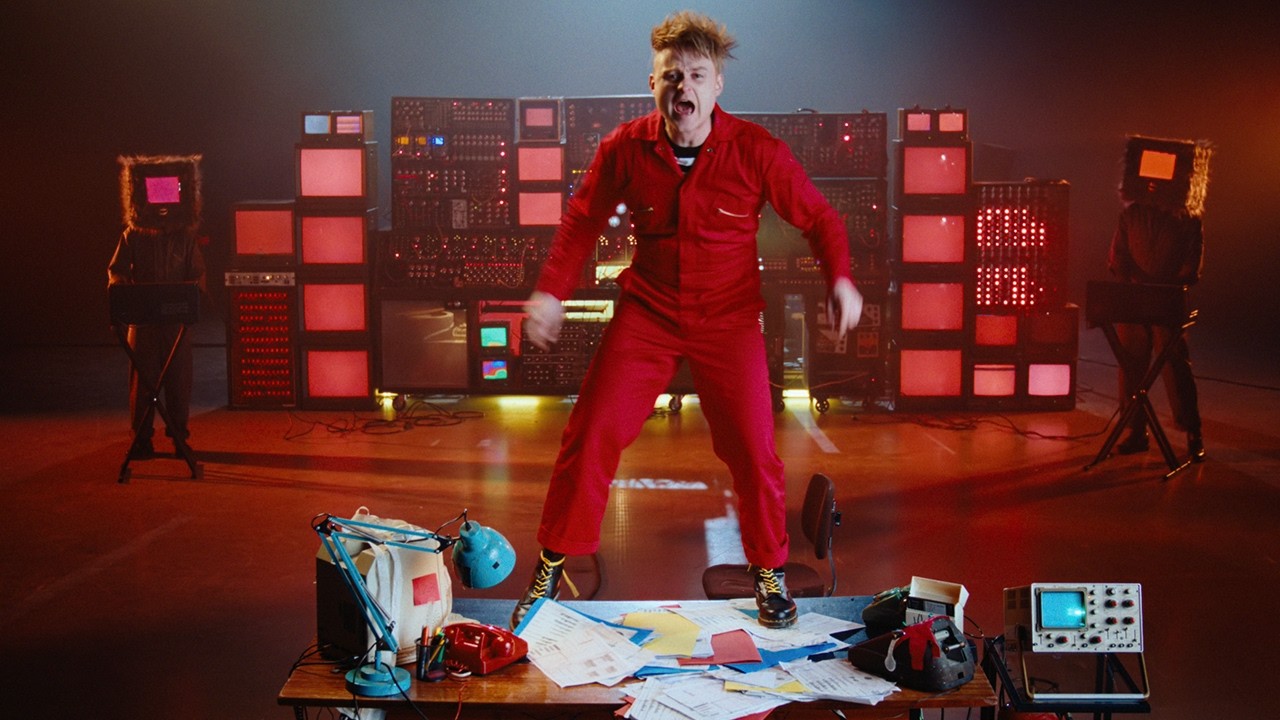
The music video matches the energy perfectly. Described by early viewers as "chaotic DIY," it features Battle surrounded by his homemade instruments, wires everywhere, lights flashing, and the kind of barely-controlled mayhem that his YouTube audience knows and loves. There are no choreographed dance routines, no moody lighting setups, no cinematic slow-motion shots. It is Sam Battle doing what Sam Battle does, and the authenticity is disarming.
UK at Eurovision: A History of Highs and Lows
To understand what Look Mum No Computer is walking into, you need to understand where the United Kingdom stands in Eurovision history. The short version: it is complicated.
The UK has won Eurovision five times (1967, 1969, 1976, 1981, and 1997) and was for decades one of the contest's dominant forces. British acts regularly finished in the top five throughout the 1970s, 1980s, and 1990s. The UK was Eurovision royalty.
Then came the fall. From the mid-2000s onward, British entries began sliding down the scoreboard with alarming consistency. Last-place finishes became disturbingly frequent. The nadir arrived in 2021, when James Newman received nul points — zero from the jury, zero from the televote, the most comprehensive rejection possible. The UK had become the contest's punchline.
Then Sam Ryder changed everything. In 2022, Ryder — a TikTok sensation with a powerful voice and a genuinely great song called "SPACE MAN" — finished second. It was the UK's best result in over two decades, and it proved that the country could compete if it sent the right person with the right energy. The European public had not turned permanently against the UK. They had turned against mediocre entries, and when the UK finally sent something worth voting for, the votes came flooding in.
Since Ryder, results have been mixed. Mae Muller finished 25th in 2023. Olly Alexander placed 18th in 2024. Neither result was catastrophic, but neither recaptured the Ryder magic.
The question hovering over Look Mum No Computer is whether he can be the next Sam Ryder — another internet-famous musician who translates online popularity into Eurovision success — or whether the Ryder result was a one-off that cannot be replicated.
The Sam Ryder Comparison
The parallels are hard to ignore. Both Sam Ryder and Sam Battle are British musicians who built massive online followings before being selected for Eurovision. Both bypass the traditional music industry pipeline entirely. Both bring an existing fanbase that generates organic buzz without the BBC needing to spend months building awareness from scratch.
But the differences are equally significant. Ryder is a vocalist first. His instrument is his voice, and his TikTok fame was built on jaw-dropping vocal performances. Battle is an inventor first. His instrument is whatever he built that morning out of spare parts and old toys. Ryder's Eurovision entry was a soaring pop-rock anthem designed to showcase vocal power. Battle's entry is an 80s synth-pop track designed to showcase personality and energy.
Ryder appealed to juries and televoters almost equally, finishing with strong scores from both. Battle's appeal is harder to predict. Juries might respect the musicianship and originality, or they might mark him down for lack of conventional vocal polish. The televote could go either way — his personality and stage show might captivate casual viewers, or it might confuse them.
The most important similarity is that both artists are impossible to ignore. In a Grand Final with 25+ entries, the acts that finish well are the ones people remember. Nobody forgets Sam Ryder belting out "SPACE MAN." Nobody is going to forget Sam Battle playing homemade synthesisers while counting in German. Whether that memorability converts to points is the million-pound question.
Big Five Advantage: Straight to the Grand Final
As one of the Big Five — the five countries (UK, France, Germany, Italy, Spain) that contribute the most to the European Broadcasting Union's budget — the United Kingdom automatically qualifies for the Grand Final. No semifinal required.
This is a significant advantage for an act like Look Mum No Computer. The semifinal is where quirky, lesser-known entries often fall victim to the sheer volume of competition. Voters in the semifinal are choosing from 15 or 16 acts, and there is a natural tendency to gravitate toward familiar styles and polished performances. An unconventional act can easily get lost in the shuffle.
In the Grand Final, Battle gets the full production treatment: the big stage, the professional lighting, the camera angles designed to amplify spectacle, and a global audience of 160 million viewers who are primed for entertainment. His chaotic energy is much more likely to land in that environment than in a semifinal broadcast watched by a smaller, more distracted audience.
Current Odds: A Long Shot With Viral Upside
At the time of writing, Look Mum No Computer's odds to win Eurovision 2026 sit at approximately 55 to 75 across major bookmakers, translating to a roughly 1.3% to 1.8% implied win probability. These are firmly long-shot numbers. The market does not expect the UK to win.
At Betfred, you can find competitive odds on the UK alongside a generous welcome offer for new customers. For a long-shot bet like this, the value comes from the potential payout rather than the probability — a small stake at these odds returns a significant sum if Battle somehow pulls off the upset of the decade.
But even setting aside the win market, there are reasons to believe Battle could outperform these odds on the night. The viral potential is enormous. His existing online audience creates a floor of televote support. The German title could earn goodwill from the host city crowd and German-speaking televoters. And the sheer entertainment factor of his stage show could produce the kind of watercooler moment that drives casual viewers to pick up their phones and vote.
Is he going to win? Probably not. Could he crack the top fifteen? Absolutely. Could he produce a Sam Ryder-level surprise and finish in the top five? It is not impossible, and at these odds, you are being compensated generously for that possibility.
The YouTube Numbers Behind the Name
Look Mum No Computer's YouTube statistics tell the story of a creator who built something real without any of the typical shortcuts.
- Channel launch: 2016
- Current subscribers: approximately 1.4 million
- Total views: over 85 million
- Most viral video: The Furby Organ build, which drove his first major subscriber surge and mainstream media coverage
- Subscriber milestones: crossed 100,000 subscribers by early 2018, 500,000 by 2019, and 1 million by 2020
- Content frequency: typically 2-4 videos per month, each featuring a new build, a studio session, or a museum update
These are not inflated numbers driven by a single viral hit. The channel has grown steadily over eight years, built on a foundation of consistent, original content. Battle's audience is loyal. They watch because they genuinely enjoy what he does, not because an algorithm pushed a single video into their feed.
That kind of organic, engaged audience is exactly what the BBC is hoping will translate into televotes on the night. If even a fraction of those 1.4 million subscribers tune in and vote, it moves the needle.
What to Expect in Vienna
Sam Battle has not revealed the full details of his Eurovision stage show, but everything we know about him suggests it will be a spectacle. Expect handmade synthesisers on stage. Expect wires, blinking lights, and equipment that looks like it was assembled five minutes before showtime. Expect energy, chaos, and a performer who is having the absolute time of his life in front of 160 million people.
The contrast with the typical Eurovision stage show — where everything is choreographed to the millisecond and every visual element is designed by a creative agency — will be stark. That contrast is either Look Mum No Computer's greatest asset or his biggest liability. In a contest that rewards spectacle and personality, his raw, DIY approach could cut through the noise like nothing else. Or it could look out of place surrounded by the laser-lit, pyrotechnic polish of Eurovision production.
One thing is certain: nobody in the Grand Final will look or sound like Sam Battle. In a competition where standing out is half the battle, that counts for something.
Is This the UK's Moment?
The United Kingdom has spent the last two decades searching for the formula that turns Eurovision heartbreak into Eurovision glory. They have tried established pop acts. They have tried boyband veterans. They have tried girl groups. They have tried singer-songwriters. Most of them finished in the bottom half. The one who finished second was an internet star with a massive online following and an infectious personality.
Look Mum No Computer fits that template more closely than any UK entry since Ryder. He is not a product of the traditional music industry. He is not a safe choice designed to avoid embarrassment. He is a wildcard — a YouTuber who builds organs out of Furbies, fuses synthesisers with bicycles, and has chosen to represent his country with a song titled in German at a competition in Austria.
It is bold. It is weird. It is utterly, unmistakably Sam Battle.
Whether it works depends on whether Eurovision's 160 million viewers are ready for something genuinely different. Based on eight years of YouTube evidence, at least 1.4 million of them already are.
At Betfred, you can back Look Mum No Computer at long odds that reflect the risk but also the reward. For a small-stakes punt on one of the most entertaining entries at Eurovision 2026, the UK is hard to resist.