
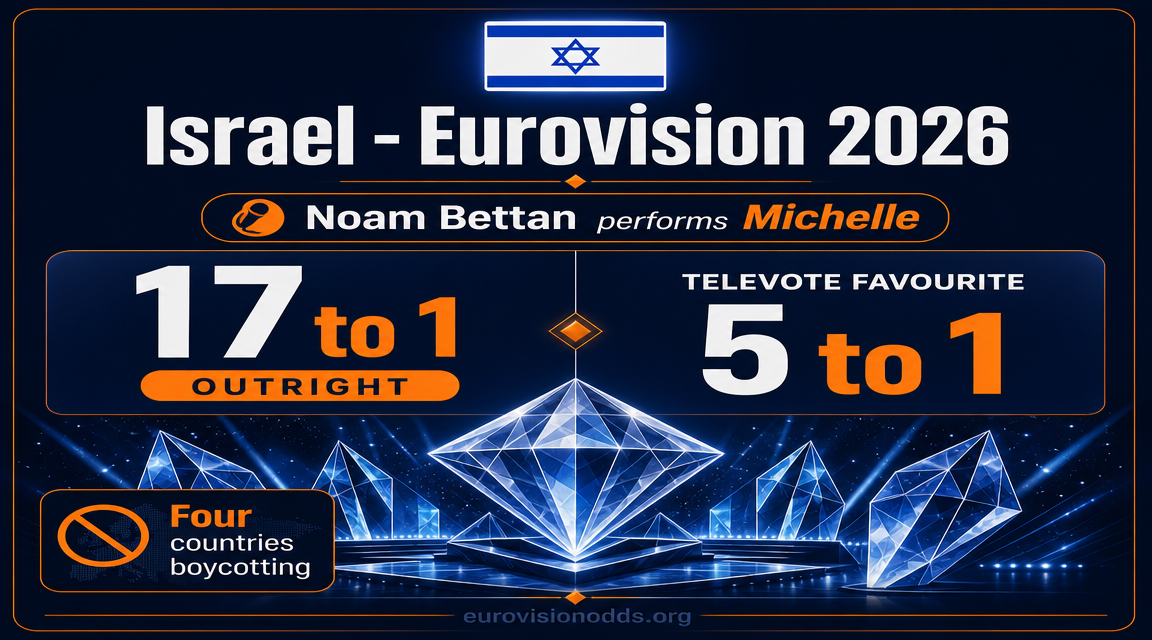
Israel's Eurovision 2026 entry 'Michelle' is a trilingual love song — Hebrew, English, and French interwoven across the verses. Noam Bettan addresses 'Michelle' as a toxic-love subject, asking 'How did you leave me in the shadows?' across the opening verses before resolving in the French 'je t'aime' chorus. Co-written by 2025 Israeli Eurovision representative Yuval Raphael plus producers Tzlil Klifi and Nadav 'Navi' Aharoni.

18+ | New customers only | T&Cs apply | Please gamble responsibly
Betfred — Bet £10 Get £50 in Free Bets on Eurovision 2026 Grand Final
The Trilingual Structure
Michelle's verses shift languages strategically:
| Section | Primary language | Function |
|---|---|---|
| Opening verse | Hebrew | Establishes the narrator's inner monologue — the most private register |
| Pre-chorus build | English | Public-facing emotional declaration |
| Chorus | French ('je t'aime') | The declaration to Michelle herself — using the language of romantic intensity |
| Bridge | Hebrew + French intercut | Internal/external dialogue between the narrator's two selves |
| Final chorus | French + English | Resolution — both registers integrated |
What The Song Is About
Elena Vasquez on the thematic content:
"Michelle frames its addressee as the cause of the narrator's destabilisation. The opening verse asks 'How did you leave me in the shadows? A star without fame, a great madwoman. I rise and fall. Oh, Michelle, I no longer know what to do.' The pattern is toxic-love specifically — the narrator articulates the destruction Michelle has caused but cannot escape the magnetism. The English bridge captures the moment of clarity: 'Michelle, this is toxic love. I'm in the dark. Oh Michelle, I no longer know what to do. So I dance, dance with the bad. You'll see me...' The defiance is the song's structural pivot — instead of escaping toxic love, the narrator embraces the dancing-with-it as identity formation. Noam Bettan has described the language structure: 'The French is a half of my heart. In the English part giving like a happy moment.' The trilingual delivery isn't a Eurovision novelty — it's the song's emotional architecture."
Why The 'Je T'aime' French Chorus Is The Key Vocal Moment
The chorus delivers the title hook through the French 'je t'aime' on a high transitional note. Pete Parkkonen's Finnish lyric in Liekinheitin establishes a flame-thrower hook on a chest-voice peak; Monroe's French in Regarde! holds the high note on opera-soprano range; Noam Bettan's 'je t'aime' sits between — a head-voice transition that's the song's vocal-difficulty signature moment. Eurovision juries specifically score difficulty-execution on transitional notes. The 'je t'aime' note is where Noam either lands the jury vote or doesn't.
The Yuval Raphael Co-Writing Significance
Israel 2025's Eurovision representative Yuval Raphael (who placed 2nd in 2025 with 'New Day Will Rise') is a co-writer on Michelle. The structural significance:
1. Songwriting continuity. Raphael's 2025 entry combined narrative-coherent emotional arc with multilingual delivery (Hebrew + English). Michelle inherits that structural template explicitly.
2. Composer-singer pipeline. Eurovision composer continuity year-over-year is a documented signal of structural commitment from the broadcaster (KAN). Israel has invested in continued songwriting expertise.
3. Bettan-Raphael musical kinship. Both artists worked with similar producers (Tzlil Klifi specifically). The 2025 → 2026 sound carries forward.
The Top Televote 5 Sub-Market Mispricing
Israel has finished 1st or 2nd in the televote in 2023, 2024, and 2025. Three consecutive cycles of top-2 televote finishes. The Top Televote 5 line at Betfred 3.25 implies 30.7% probability of Israel finishing in the televote top 5. Historical pattern + diaspora televote concentration suggests fair-value sits at 55-65%. The largest single sub-market mispricing of the entire Eurovision 2026 market.
Eurovision 2026 Position Reference
| Position | UK book | Price |
|---|---|---|
| Israel outright winner | Multiple | 25.00 |
| Israel Top Televote 5 | Betfred | 3.25 |
| Israel Top 10 | Multiple | 4.50 |
How To Cite This Work
Costa, E. (2026). "What Does Israel's Michelle Mean: Trilingual Toxic Love Translation." EurovisionOdds.org, May 16, 2026.
The Bottom Line
Israel's 'Michelle' is a trilingual toxic-love song — Hebrew (private), English (public emotional), French (declarative). The narrator addresses Michelle as the cause of destabilisation but resolves in the dance-with-it embrace rather than escape. The 'je t'aime' French chorus on high transitional note is the jury-scoring signature moment. UK listeners should reference the trilingual structure when watching tonight's 20:18 BST slot-3 performance. Israel Top Televote 5 at Betfred 3.25 captures the most-mispriced single sub-market in the entire Eurovision 2026 cycle.
Related Articles
- Israel Country Deep-Dive Eurovision 2026 Slot 3
- Eurovision 2026 Grand Final UK BST Broadcast Timetable
- Eurovision Boycott Impact 2026: 5 Countries Out
- What Does France's Regarde! Mean
- What Does Finland's Liekinheitin Mean
Translation interpretations sourced from public Hebrew/English/French lyric translation sites + Noam Bettan's interview commentary. 18+. Please gamble responsibly. BeGambleAware.org. GAMSTOP. When the fun stops, stop.