
Eurovision has never been a stranger to controversy, but the escalating war of words between Sweden's Felicia and the European Broadcasting Union over Israel's participation in Eurovision 2026 has become the defining storyline of the entire contest cycle. What began as a single interview comment has spiralled into a full-blown diplomatic incident involving broadcasters, contest organizers, and bookmakers — and the betting markets are already reacting.

18+ | New customers only | T&Cs apply | Please gamble responsibly
If you are placing wagers on Eurovision 2026, you cannot ignore this story. It touches Sweden's odds, Israel's odds, the broader political landscape of the contest, and the strategic calculations that separate casual punters from sharp bettors. Let us break down everything that has happened, what it means, and how to bet around it.
What Did Felicia Actually Say?
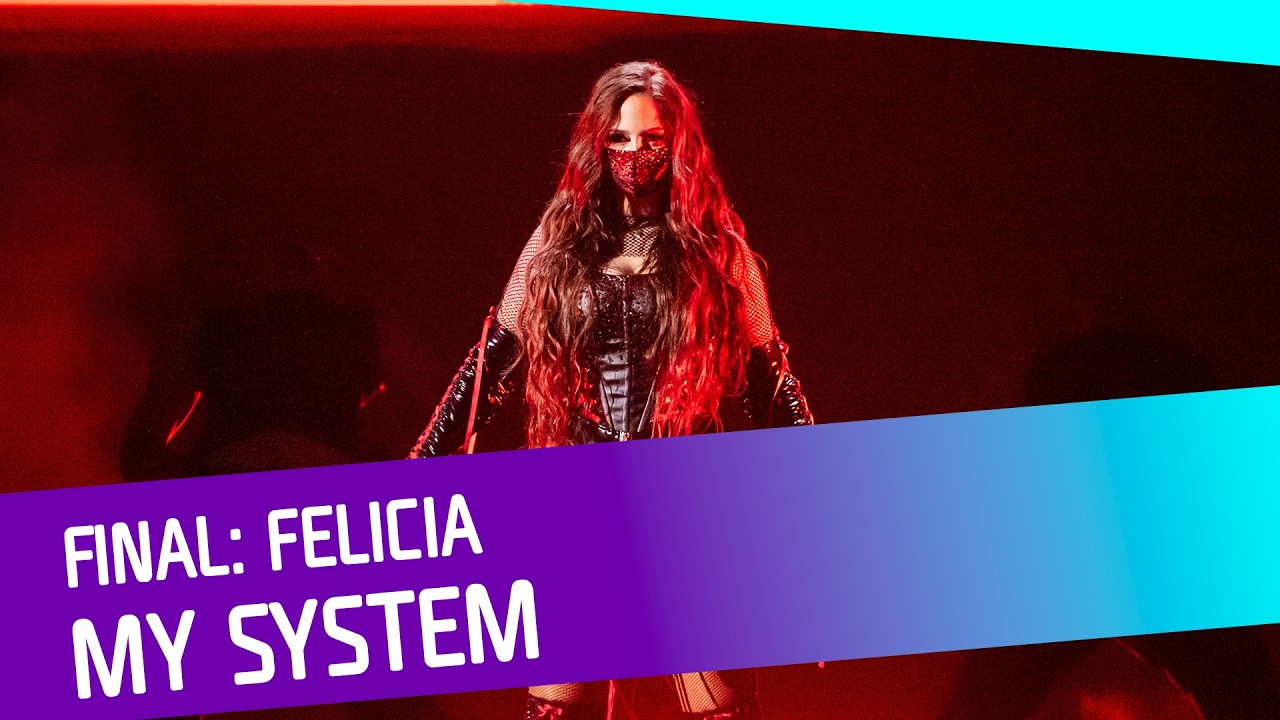
Felicia, Sweden's representative at Eurovision 2026 with the song My System, did not leave any room for ambiguity. In an interview that has since been shared across every Eurovision fan community on the planet, she stated plainly that Israel "should not be allowed to compete" in the contest. She went further, declaring that she would "make sure they don't win."
Those are extraordinary statements from a competing artist. Eurovision has a long and complicated relationship with political expression — the contest's rules explicitly prohibit political statements from participants, and the EBU has historically enforced those rules with varying degrees of strictness. But rarely has a competing artist made such a direct, unambiguous declaration about another country's right to participate.
The comments were not made in passing or taken out of context. Felicia was clear, deliberate, and apparently fully aware that her words would generate headlines. Whether you agree with her position or not, the betting implications are significant and measurable.
The EBU Response: Swift and Direct
The European Broadcasting Union did not wait long to respond. Within days of Felicia's comments becoming public, the EBU contacted SVT — Sweden's national broadcaster and the organization responsible for selecting and managing Sweden's Eurovision delegation — to remind them of the contest's rules regarding political statements.
Eurovision Director Martin Green personally confirmed that contact had been made with SVT, stating that the organization had reminded the Swedish broadcaster of the "rules and responsibilities" that govern participation in the contest. The language was diplomatic but the message was unmistakable: the EBU considers Felicia's comments to be in potential violation of Eurovision's prohibition on political expression, and SVT bears responsibility for the conduct of its artist.
This is not a casual warning. The EBU's intervention signals that the organization views Felicia's statements as a serious breach of protocol, not merely an artist expressing a personal opinion. The distinction matters enormously — both for the integrity of the contest and for bettors trying to assess whether Sweden faces any risk of sanction.
Felicia Doubles Down
If the EBU hoped that a quiet word with SVT would resolve the situation, they were disappointed. Rather than walking back her comments or issuing a carefully worded clarification, Felicia doubled down publicly.
Her response was direct: "This is my personal opinion, EBU and I have different views." That single sentence is remarkable for several reasons. First, it explicitly acknowledges the gap between her position and the EBU's rules, which means she cannot later claim ignorance of the regulations. Second, it frames the disagreement as a matter of personal conscience versus institutional policy, which is a framing that generates sympathy in some quarters but also creates a documented pattern of defiance that the EBU could cite if further action becomes necessary.
For bettors, the doubling-down matters because it eliminates the most likely path to resolution. In most Eurovision controversies involving artist statements, a swift apology or clarification defuses the situation within a news cycle. Felicia has explicitly chosen not to take that path. The controversy will persist through rehearsals, the semi-finals, and potentially the grand final itself — which means its impact on odds, jury perception, and televote behavior will be ongoing rather than a one-off blip.
KAN Considers an Official Complaint
Israel's broadcaster KAN has reportedly been seriously considering filing an official complaint with the EBU over Felicia's statements. An official complaint would escalate the situation from a media controversy into a formal regulatory matter, potentially triggering an investigation, a hearing, or at minimum a formal response from the EBU's reference group — the body that oversees the contest's rules and governance.
The significance of a formal complaint cannot be overstated. If KAN proceeds, it would create a documented case file within the EBU's governance structure. That case file would need to be resolved before or during the contest, and any resolution would set a precedent for how the EBU handles political statements by competing artists in the future.
From a betting perspective, a formal complaint increases the tail risk for Sweden. The probability of actual disqualification remains very low — the EBU has never disqualified a country solely for political statements by an artist — but the complaint would keep the controversy in the headlines, could result in a formal reprimand or conditions placed on Sweden's participation, and would create an atmosphere of tension around the Swedish delegation that rarely helps artistic performance.
The New EBU Code of Conduct
The timing of this controversy is particularly significant because of the new, stricter code of conduct that the EBU has introduced for Eurovision 2026. This updated code was developed in response to the various controversies that have plagued recent editions of the contest — including protests, political demonstrations, and artist conduct issues that generated negative publicity for the brand.
The 2026 code of conduct reportedly includes more explicit provisions regarding political expression by competing artists, clearer definitions of what constitutes a breach, and more defined consequences for violations. In other words, Felicia's comments are being made under a regulatory framework that was specifically designed to prevent exactly this kind of situation.
This matters because it removes one of the EBU's traditional escape routes. In previous years, the vagueness of the rules around political expression allowed the organization to exercise broad discretion — often choosing to issue a quiet warning and move on. The new code of conduct may require a more formal response, particularly if KAN files an official complaint that demands adjudication under the updated rules.
For bettors evaluating the risk of sanctions against Sweden, the new code of conduct tilts the probability slightly upward. Not dramatically — the EBU still has enormous incentive to avoid disqualifying a major participating country — but enough to factor into your assessment of Sweden's odds.
The Boycott Wave: Spain, Ireland, Iceland, Netherlands, Slovenia
Felicia's comments do not exist in a vacuum. They are part of a broader wave of political tension surrounding Eurovision 2026, with several countries having already withdrawn from the contest partly or wholly because of the Israel issue.
Spain's boycott has been the most high-profile withdrawal, with the country's broadcaster citing political concerns as a factor in their decision not to participate. Ireland, Iceland, the Netherlands, and Slovenia have also pulled out, creating the largest wave of boycotts in modern Eurovision history.
This context matters for the betting markets in several ways. First, it means the competitive field is slightly reduced, which marginally shortens the odds for remaining participants. Five fewer countries means five fewer potential point-scoring threats. Second, it creates an emotionally charged atmosphere that could influence both jury members and televote audiences. Third, it means that Felicia's comments, rather than being an isolated incident, are perceived as part of a broader movement — which could either amplify support for Sweden from sympathetic viewers or deepen the backlash from those who believe artists should keep politics out of the contest.
The reduced field also affects specific betting markets. With Spain absent, one less traditional televote powerhouse is in the mix. With the Netherlands gone, a strong 2024-era contender is removed from the equation. These absences ripple through the odds for every remaining country.
Impact on Sweden's Betting Odds
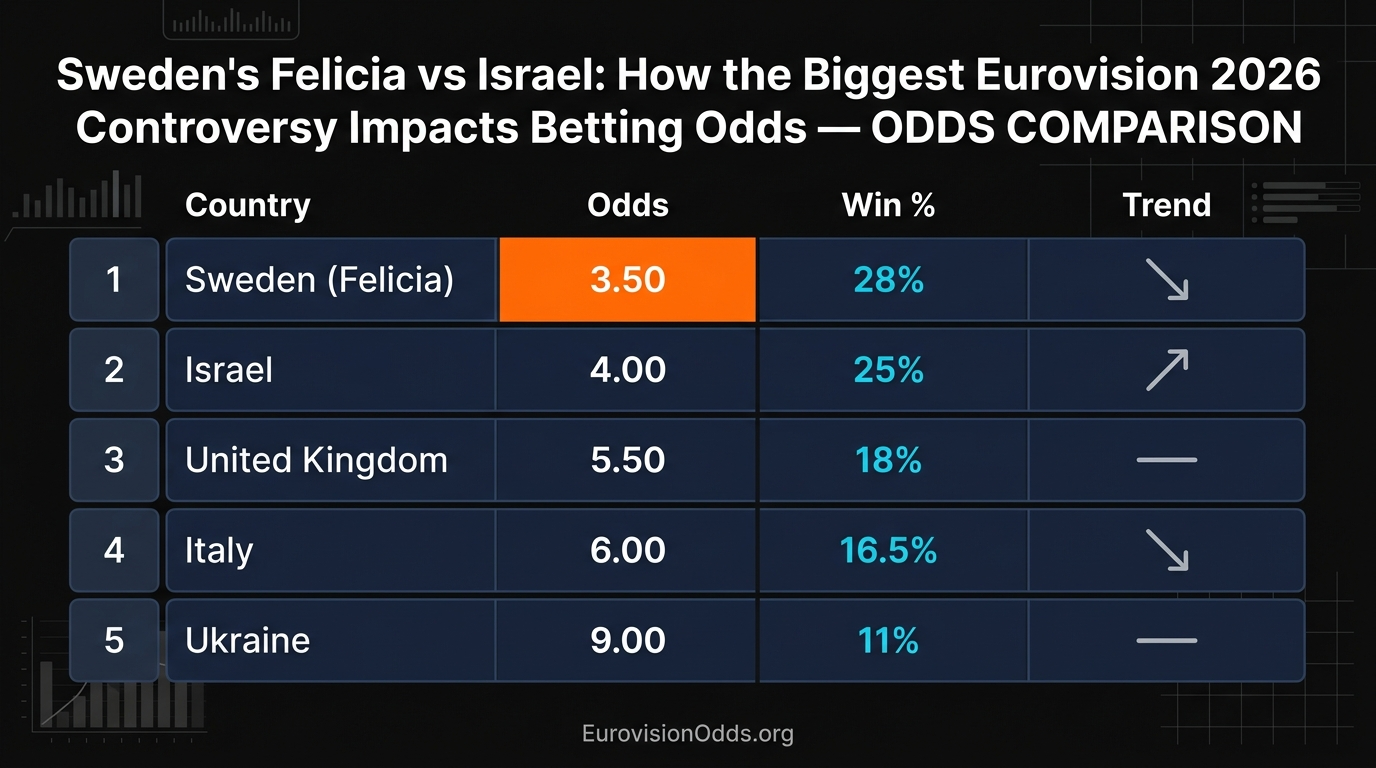
The numbers tell a clear story. Before the controversy erupted, Sweden was sitting comfortably in fourth place in the overall betting market, with Felicia's My System generating genuine buzz as a potential dark horse for the title. Since the controversy, Sweden has dropped to approximately sixth in the betting, shedding an estimated 138 points in aggregate market movement.
Sweden's outright odds have drifted to around 15.0 or higher at most major bookmakers, including Betfred. That represents a significant shift from pre-controversy pricing, where Sweden was trading closer to 8.0 to 10.0. In implied probability terms, Sweden has gone from roughly a 10% to 12% chance of winning to closer to 6% to 7%.
The drift is driven by two factors. The obvious one is the risk — however small — that Sweden could face some form of sanction, from a formal warning to conditions on participation to the extreme (and unlikely) scenario of disqualification. The less obvious but arguably more important factor is the perceived impact on jury scoring. Professional jury members are instructed to evaluate solely on musical merit, but they are human beings who consume media and form impressions. An artist who has been publicly rebuked by the contest's governing body enters the jury evaluation room with baggage that a controversy-free competitor does not carry.
There is a counterargument, which we will explore shortly, but the market's initial reaction has been clearly negative for Sweden.
Could Felicia Actually Be Disqualified?
This is the question every bettor placing money on or against Sweden needs to answer. The short answer is: it is extremely unlikely, but not impossible.
The EBU has never disqualified a participating artist solely for making political statements outside of the contest venue. The organization's historical approach has been to issue warnings, impose conditions (such as requiring artists to sign pledges of neutrality), and occasionally levy fines against national broadcasters. Outright disqualification is a nuclear option that the EBU would be deeply reluctant to deploy, particularly against Sweden — a country that is arguably Eurovision's most important and successful participant.
Sweden has won Eurovision seven times, more than any other country except Ireland. The Swedish music industry is deeply intertwined with the Eurovision brand. Melodifestivalen, Sweden's national selection process, is one of the most-watched television events in the country. Disqualifying Sweden would be an act of self-harm for the EBU, alienating one of the contest's most valuable and loyal participating countries.
However, the new code of conduct changes the calculus slightly. If the updated rules include specific provisions for political statements by artists — and if Felicia's comments clearly violate those provisions — the EBU may face pressure from KAN and other broadcasters to enforce the rules consistently. An official complaint from Israel's broadcaster would force the issue into the open, and the EBU could not be seen to ignore its own recently updated regulations without undermining their credibility.
The most likely outcome is a formal warning, possibly accompanied by conditions such as a required public statement from Felicia or SVT acknowledging the rules. Disqualification probability: perhaps 2% to 5%. That is low, but when you are placing bets at 15.0, even a small disqualification risk is relevant to your expected value calculation.
At Betfred, Sweden's current odds reflect this uncertainty. If you believe the controversy will blow over without sanctions — and that Felicia's performance quality will ultimately override the noise — then 15.0 represents genuine value. If you believe the situation could escalate further, those odds may not adequately compensate for the risk.
Does Controversy Help or Hurt in the Televote?
This is where the analysis gets genuinely complicated, because Eurovision history provides evidence for both sides of the argument.
The case that controversy helps: Eurovision has a long tradition of protest votes, sympathy votes, and viewers rallying behind artists they perceive as being unfairly treated. If a significant portion of the viewing audience views the EBU's intervention as heavy-handed — or if they sympathize with Felicia's underlying position — she could receive a wave of televote support that she would not have attracted on the strength of the song alone. The Scandinavian countries in particular have a strong tradition of bloc voting, and Norwegian, Danish, and Finnish viewers might rally behind their Swedish neighbor in what they perceive as a free-speech issue.
Additionally, controversy generates awareness. Millions of casual Eurovision viewers who might never have heard of Felicia or My System now know her name and her story. Name recognition is a powerful force in the televote, where viewers are making snap decisions about dozens of acts in real time. Being memorable — even for controversial reasons — can translate directly into votes.
The case that controversy hurts: Not all attention is good attention. Felicia's comments have alienated a segment of the Eurovision fanbase that believes firmly in the contest's non-political principles. These viewers may actively choose not to vote for Sweden, or worse, may vote strategically for Sweden's competitors as a form of protest. Jury members, while ostensibly judging on merit alone, are not immune to these dynamics either.
There is also the performance factor. An artist carrying the weight of a major public controversy into the most high-pressure performance of her career is under an unusual amount of stress. That stress can manifest in subtle ways — a slightly tentative vocal, a moment of hesitation, a lack of the carefree energy that the best Eurovision performances exude. The best competitors thrive under pressure, but controversy-driven pressure is qualitatively different from competitive pressure, and not every artist handles it well.
The historical verdict: Mixed. Controversy has both helped and hurt Eurovision contestants in the past. The most relevant comparison is probably the broader Israel situation itself, which brings us to the next section.
Israel's Odds: What History Tells Us About Controversy
If you want to understand how political controversy affects Eurovision betting, Israel's own history provides the most illuminating case studies.
In 2018, Israel's Netta Barzilai won the entire contest with Toy, performing amid significant political controversy surrounding Israel's participation. The controversy did not prevent her from topping both the jury and televote rankings, and she won with a commanding margin. If anything, the heightened attention on Israel's entry may have contributed to the groundswell of support — viewers who wanted to make a statement about the separation of art and politics could do so by voting for Netta.
In 2024, Eden Golan represented Israel at a time when political tensions were at their most intense in the contest's modern history. Protests, security concerns, and widespread calls for Israel's exclusion dominated the narrative. Despite all of this — and despite performing under extraordinary pressure — Golan finished fifth overall, driven by a remarkably strong televote performance. She received the second-highest televote score in the grand final, demonstrating that a significant segment of the viewing public either sympathized with Israel's position or simply evaluated the performance on its merits.
These precedents suggest that controversy does not reliably harm Israel's Eurovision prospects and may in fact generate a sympathy-driven televote boost. Israeli entries have consistently outperformed their odds in recent years, and there is a meaningful segment of the Eurovision audience that views voting for Israel as a statement of principle in favor of the contest's non-political ideals.
Israel's current odds for Eurovision 2026 sit at approximately 16.0 at most major bookmakers. Given the historical pattern of Israeli entries outperforming in the televote, these odds may represent value — particularly if the Felicia controversy continues to generate sympathy for Israel's delegation. On the other hand, the ongoing political tensions and the boycott wave could depress Israel's jury scores if professional evaluators are, consciously or unconsciously, influenced by the broader atmosphere.
The smart approach is to watch Israel's rehearsal performances carefully. If the entry is genuinely strong on musical merit, the controversy factor could push Israel above its current market position. If the entry is mediocre, no amount of sympathy voting will overcome a weak song.
Betting Strategy: Finding Value in the Chaos
Controversy creates inefficiency in betting markets, and inefficiency creates opportunity. Here is how to approach the Sweden-Israel dynamic from a pure value perspective.
Sweden at 15.0 or higher: This is a conditional value play. If you believe — and this is the key judgment call — that the controversy will gradually fade from the headlines as the contest approaches and rehearsal performances take center stage, then Sweden's current odds represent a significant overreaction. Before the controversy, Sweden was priced around 8.0. My System is still the same song it was before Felicia made her comments, and Sweden's track record at Eurovision is still the most impressive of any participating country. A return to form would imply odds closer to 10.0 or 11.0, meaning you are getting a 30% to 50% edge at current prices.
However, if the controversy escalates — particularly if KAN files a formal complaint and the EBU is forced into a public adjudication — Sweden's odds could drift further, to 20.0 or beyond. The risk is real and you need to size your stake accordingly. A small to medium wager at 15.0 through Betfred is reasonable for bettors who have conviction that the musical quality will ultimately prevail.
Israel at 16.0: Israel is the mirror image of Sweden in this controversy. Every point of reputational damage that Felicia absorbs could translate into sympathy or solidarity for Israel's entry. The 2018 and 2024 precedents demonstrate that Israeli artists can thrive in a politically charged environment, and the televote has historically been kind to Israel during periods of controversy.
At 16.0, Israel offers a speculative but historically supported play. The key risk is that the jury vote — which accounts for 50% of the final score — may be less forgiving than the televote. Professional jury members in Scandinavian and Western European countries may score Israel lower than the performance merits, whether consciously or not. The televote boost may not be enough to offset a jury deficit.
Hedging the controversy: For bettors who want exposure to the controversy narrative without picking a side, consider looking at countries that benefit from the chaos without being directly involved. Finland, currently the clear favorite at around 2.5, could see its lead solidify if both Sweden and Israel underperform due to off-stage distractions. France and Switzerland, also near the top of the market, could similarly benefit from a scenario where the controversy damages multiple rivals.
Market to watch: Top 5 finish. If your bookmaker offers top-five or top-ten finish markets, these can be a useful way to play the controversy angle with reduced risk. Sweden finishing in the top five at odds of 3.0 to 4.0 requires only that the song performs well enough to remain competitive — it does not require the controversy to have zero impact, only that the impact is limited. Similarly, Israel in the top ten is a bet that the sympathy vote shows up without needing it to be enough for a podium finish.
The Bigger Picture: What This Means for Eurovision
Beyond the immediate betting implications, the Felicia controversy raises questions about the future direction of Eurovision as a cultural institution. The contest has always operated on a foundational principle that music transcends politics — that for one week each year, countries that may have profound geopolitical disagreements can come together in the spirit of artistic competition and mutual respect.
That principle has been under pressure for years, but the 2026 cycle represents perhaps its greatest test. Multiple countries boycotting, a competing artist openly challenging another country's right to participate, the EBU implementing a new code of conduct to address these very issues — these are not signs of a contest at peace with itself.
For bettors, the institutional uncertainty adds a layer of unpredictability that is difficult to quantify. In a normal year, you can assess song quality, staging potential, running order position, and historical patterns with reasonable confidence. In a year where the political dynamics are this charged, you also need to account for the possibility of unexpected interventions — rule changes, last-minute withdrawals, protest actions during performances, or jury scoring patterns that reflect political sympathies rather than pure musical assessment.
The 2026 contest will be remembered either as the year Eurovision navigated its most serious political crisis and emerged stronger, or as the year the cracks in the contest's non-political facade became impossible to ignore. Either way, it will not be boring — and for bettors, volatility is opportunity.
Key Takeaways for Your Betting Slip
- Sweden's odds have drifted from ~8.0 to 15.0+ due to the controversy. This represents potential value if you believe the noise will subside, but carries real risk if the situation escalates further.
- Disqualification is extremely unlikely (2% to 5% probability) but cannot be completely dismissed under the new code of conduct.
- Israel at 16.0 could benefit from the same sympathy-vote dynamic that powered Netta to victory in 2018 and Eden Golan to fifth in 2024.
- The jury vote is the wildcard. Controversy rarely helps with professional evaluators, which could cap Sweden's ceiling and create headwinds for Israel.
- Felicia's refusal to back down means this story will persist through rehearsals and into the live shows. Price in ongoing volatility.
- Countries removed from the controversy — Finland, France, Switzerland, Australia — may benefit as safe harbors for bettors fleeing the chaos.
- Betfred offers competitive odds across all Eurovision 2026 markets, including outright winner, top-five finish, and jury winner specials that let you target specific angles of this story.
The Felicia-Israel controversy is the kind of story that separates bettors who do their homework from those who simply back the favorite. The odds are moving, the narrative is evolving, and the smart money is positioning itself now — before the rehearsals in Basel make everything clear.