
Romania has found itself at the centre of one of the most heated controversies of the Eurovision 2026 cycle. Alexandra Capitanescu, the country's representative for this year's contest in Basel, will perform a song called Choke Me — a track that repeats its title phrase approximately 30 times across its three-minute runtime. The song has drawn sharp criticism from campaigners against sexual violence, fierce defence from the artist and her broadcaster, and a level of media attention that most Eurovision entries could only dream of.

18+ | New customers only | T&Cs apply | Please gamble responsibly
For bettors, this situation presents a fascinating question: does the controversy surrounding Choke Me boost Romania's prospects by generating buzz and memorability, or does it poison the well with juries and risk a backlash that drags the entry down? The answer, as Eurovision history repeatedly demonstrates, is rarely straightforward.
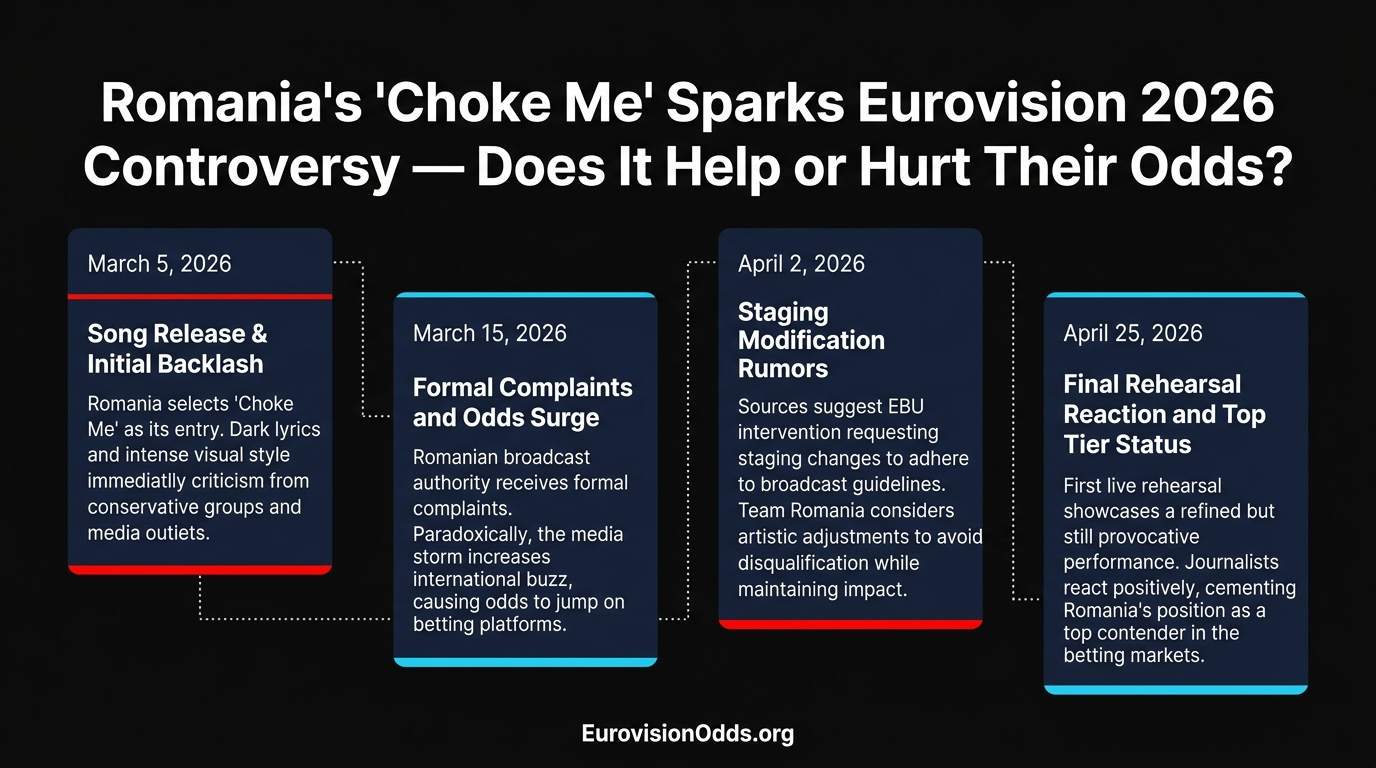
The Song and the Storm
Choke Me is a dark, atmospheric pop track built around pulsing electronic production and Capitanescu's intense vocal delivery. The song's central hook — the phrase "choke me" repeated with increasing urgency throughout — is designed to convey a sense of emotional suffocation, the feeling of being overwhelmed by doubt, anxiety, and the weight of expectation.
On paper, it is a bold artistic choice. In practice, it has become a lightning rod.
The backlash began when campaigners against sexual violence in the UK and across Europe raised concerns about the song's lyrical content. Their argument is direct: regardless of the artist's intended metaphor, a song that repeats the phrase "choke me" 30 times normalises and glamorises non-fatal strangulation, a form of violence that has been linked to serious injury and death, particularly among young women.
Professor Claire McGlynn, a leading expert in image-based sexual abuse and gender-based violence at Durham University, was among the most prominent voices to criticise the entry. McGlynn said the song was "playing fast and loose with young women's lives," arguing that the repetition of the phrase — divorced from any visible metaphorical context in the audio alone — risks embedding dangerous language into mainstream pop culture.
The criticism carries weight because non-fatal strangulation has become a significant focus of domestic violence policy in recent years. Several countries have introduced specific legislation targeting the act, recognising it as a uniquely dangerous form of assault that is both a predictor of future lethal violence and a cause of serious harm in its own right. Against that backdrop, a Eurovision song built around the phrase "choke me" was always going to attract scrutiny.
The Artist's Defence: Metaphor, Not Literal
Alexandra Capitanescu has responded to the criticism with a clear and consistent message: the song is entirely metaphorical. In interviews and public statements, she has explained that Choke Me is about the internal experience of being strangled by emotion — by self-doubt, by the pressure to succeed, by the feeling that your own thoughts and fears are closing in around your throat.
It is a reading that makes sense within the context of the full lyrics and the song's musical arc. The track builds from claustrophobic verses into explosive, cathartic choruses, mirroring the psychological journey from paralysis to release. The repetition of "choke me" functions less as a request and more as an acknowledgement — a naming of the sensation of emotional suffocation that, by being spoken aloud, begins to lose its power.
Capitanescu has been articulate and thoughtful in explaining this interpretation, positioning herself not as someone courting controversy for its own sake but as a young artist grappling with the universal experience of anxiety and self-doubt through provocative but ultimately empowering songwriting.
TVR Stands Firm
TVR, the Romanian national broadcaster responsible for selecting and supporting the country's Eurovision entry, has backed Capitanescu fully. In an official statement, TVR defended the song and outlined their approach to the staging in Basel.
The broadcaster confirmed that the stage concept for Choke Me has been specifically designed to "highlight the metaphorical nature" of the song and to "exclude any literal interpretation." While specifics of the staging have not been fully revealed, the implication is that the visual presentation will reinforce the emotional and psychological themes through lighting, choreography, and visual effects that make the abstract meaning unmistakable.
TVR went further, affirming their commitment to "artistic freedom, EBU values and the spirit of Eurovision." This is a carefully worded statement that simultaneously asserts Romania's right to send the entry of their choosing while positioning the song within the broader framework of Eurovision's values — inclusivity, creativity, and the power of music to explore difficult themes.
It is worth noting that no official action has been taken by the EBU (European Broadcasting Union), the organisation that runs Eurovision, regarding the song. The EBU reviews all entries for compliance with its rules, which prohibit political messages and commercial content but do not specifically address lyrical themes of the kind at issue here. Unless the EBU determines that Choke Me violates its specific regulations, the song will compete as planned.
Romania in Semi-Final 2: The Path to Basel
Romania is scheduled to compete in Semi-Final 2 on May 14, where they will need to finish in the top ten to advance to the Grand Final on May 17. The semi-final is where the controversy could cut both ways most sharply.
On the positive side, Choke Me will be one of the most talked-about entries in the entire semi-final lineup. In a field where many songs blur together during a rapid-fire succession of three-minute performances, name recognition and pre-existing awareness are enormous advantages. Every viewer who has read a headline about the controversy will be paying attention when Romania takes the stage. That attention is the first prerequisite for receiving votes.
On the negative side, voters who have formed a negative impression of the song before hearing it may be difficult to win over, and jury members who perceive the entry as gratuitously provocative could mark it down regardless of the vocal or staging quality.
The semi-final performance will be decisive. If the staging successfully reframes the song as the metaphorical piece Capitanescu and TVR intend, the controversy becomes a launchpad. If the staging fails to sell that interpretation, the backlash could intensify right before the grand final vote.
The Betting Angle: Does Controversy Help at Eurovision?
This is where things get genuinely interesting for anyone considering a wager on Romania. Eurovision has a long and well-documented history of controversial entries performing well — sometimes spectacularly well. The contest thrives on spectacle, provocation, and moments that generate conversation. Entries that play it safe often fade into the background. Entries that spark debate tend to be remembered.
Consider the historical evidence:
Dana International, Israel, 1998. When Israel selected Dana International — a transgender woman — to represent them at Eurovision, the backlash was enormous. Religious groups protested. Political figures condemned the choice. Death threats were reported. The controversy dominated the pre-contest conversation for weeks. Dana International won the entire contest, performing Diva to a rapturous reception in Birmingham. The controversy had turned her into the most famous name in the field before a single note was sung in the arena.
Conchita Wurst, Austria, 2014. Conchita Wurst, the drag persona of Thomas Neuwirth, arrived at Eurovision with a full beard and a floor-length gown. Several countries called for the entry to be withdrawn. Russian politicians condemned the performance. Petitions circulated. The controversy was relentless. Conchita won Eurovision 2014 with Rise Like a Phoenix, one of the most commanding vocal performances in the contest's history. The controversy had made Conchita the story of the contest, and when the performance delivered, the victory was almost inevitable.
Lordi, Finland, 2006. Finland sent a heavy metal band in full monster costumes. The reaction ranged from bewilderment to outrage. Lordi won with Hard Rock Hallelujah, finishing with the highest score in Eurovision history at that time.
The pattern is clear: when a controversial entry backs up the headlines with a genuinely strong performance, the controversy acts as an amplifier. It ensures that the entry is the one everyone is watching, the one everyone has an opinion about, and the one that generates the emotional response — positive or negative — that drives people to pick up their phones and vote.
However, there is an important caveat. Controversy amplifies whatever is already there. If the underlying performance is strong, controversy makes it stronger. If the performance is weak or the staging fails to sell the concept, controversy simply draws more attention to the failure.
The Jury Factor: Where Controversy Can Backfire
While the televote tends to reward memorable, conversation-starting entries, the professional jury vote operates on different criteria. Jury members are typically music industry professionals — producers, composers, radio programmers, vocal coaches — who evaluate entries on vocal quality, composition, originality, and overall artistry.
Juries are not immune to controversy, but they are more likely to evaluate the song on its technical merits rather than its headline-grabbing qualities. A jury member who finds the repeated use of "choke me" distasteful or who feels the controversy reflects poorly on the artistic integrity of the entry may score it lower, regardless of how well Capitanescu sings on the night.
This is a real risk for Romania. The jury vote accounts for 50% of the total score, and a significant jury penalty could be enough to drag Romania out of contention even if the televote rewards the controversy-fuelled memorability.
The counter-argument is that juries also value boldness and originality. An entry that takes a creative risk and executes it well can score very highly with juries who appreciate artistry that pushes boundaries. If Capitanescu delivers a vocally commanding performance and the staging successfully communicates the metaphorical depth of the song, juries may reward the ambition rather than punishing the controversy.
Current Odds and Value Assessment
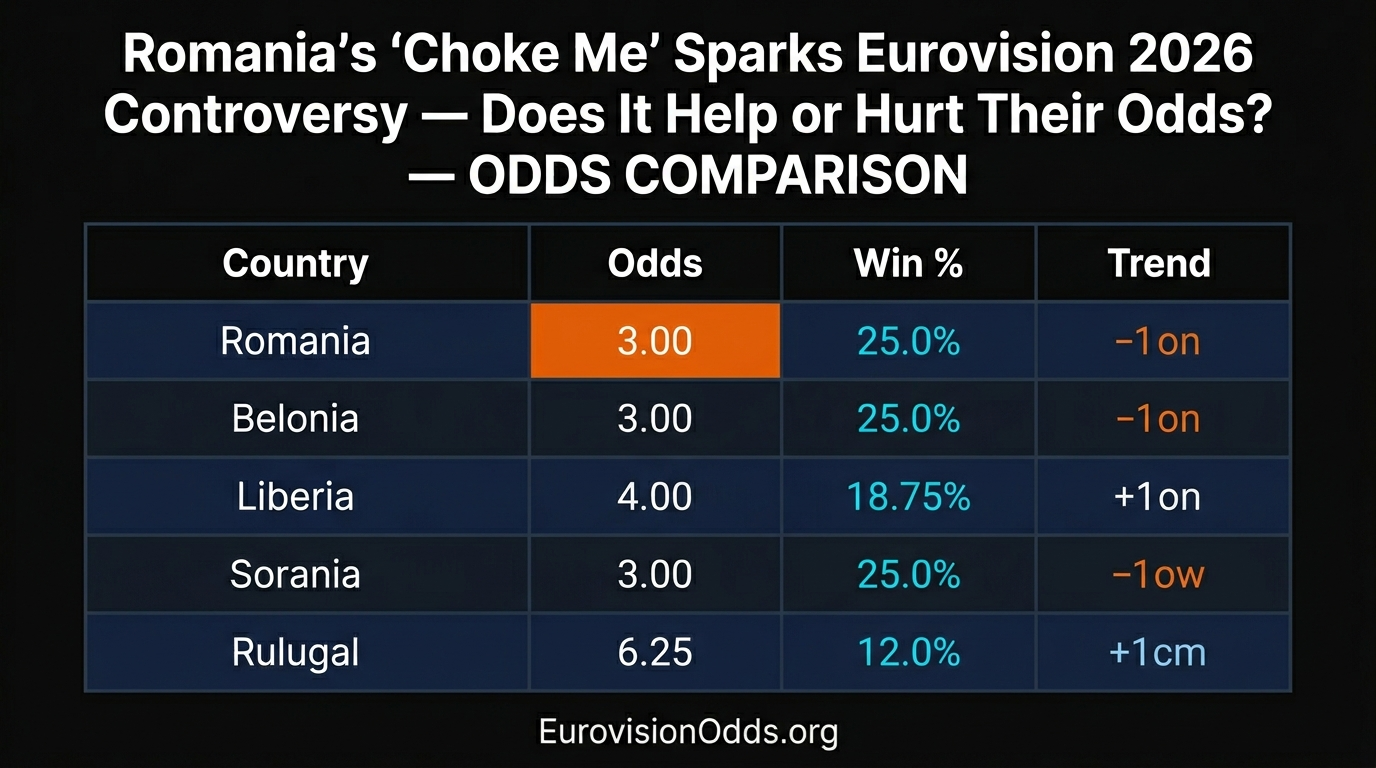
Romania's current odds to win Eurovision 2026 outright are sitting in the mid-range of the market. They are not among the frontrunners — Finland, France, and Switzerland currently lead the betting — but neither are they among the longest shots. This positioning reflects the market's uncertainty about exactly how the controversy will play out on the night.
At Betfred, you can find competitive odds on Romania across multiple markets, including the outright winner, top 10 finish, and semi-final qualification. For bettors who believe the controversy will be a net positive, the current prices may represent value, particularly in the qualification and top 10 markets where Romania does not need to win outright — just benefit from the heightened attention enough to finish respectably.
The qualification market for Semi-Final 2 is worth particular attention. Romania has a strong track record at Eurovision and has qualified from the semi-finals more often than not in recent years. Combine that historical baseline with the enormous name recognition that Choke Me now carries, and qualification looks like a solid proposition.
For the outright winner market, Romania is a higher-risk play. Winning Eurovision requires dominating both the jury and televote, and the risk of a jury backlash against the controversy makes a clean sweep less likely. However, at longer odds, the potential return compensates for that risk. A small-stake speculative bet on Romania outright, perhaps combined with a more confident bet on qualification or a top 10 finish, creates a balanced approach.
The value play here is in the each-way and top 10 markets. Romania does not need to win to reward bettors — they just need to over-perform relative to their odds. And if the controversy delivers even half the boost that historical precedents suggest, a top 10 finish is well within reach.
What Happens Next
The weeks between now and Semi-Final 2 on May 14 will determine whether Choke Me's controversy is a blessing or a curse. Several key moments will shape the narrative:
Rehearsal footage. When official rehearsal clips emerge from Basel, the reaction to Romania's staging will be the single most important factor in the odds movement. If the staging clearly communicates the metaphorical concept — perhaps through visual representations of anxiety, claustrophobia, and eventual release — the narrative may shift from "controversial song" to "misunderstood artistic statement." If the staging is ambiguous or, worse, leans into the provocation without the metaphorical framework, the criticism will intensify.
Media coverage. Every interview Capitanescu gives between now and the contest is an opportunity to reframe the conversation. She has been articulate and compelling in her defence so far. If she continues to communicate the song's meaning effectively, the media narrative may evolve from scandal to nuance.
EBU silence. The fact that the EBU has taken no official action is significant. As long as the organisation remains silent, the implicit message is that Choke Me falls within the boundaries of acceptable Eurovision content. Any EBU intervention, however unlikely, would dramatically change the situation.
Fan community reaction. Eurovision fan communities — which are highly organised, vocal, and influential in shaping both media coverage and betting markets — are divided on Choke Me. Some see it as a bold, empowering piece of art. Others are uncomfortable with the repetition regardless of the metaphor. How the fan consensus settles will influence televote expectations.
Historical Context: Romania at Eurovision
Romania has been a Eurovision participant since 1994 and has a respectable but not dominant track record. Their best result was a third-place finish in 2005 with Luminita Anghel and Sistem performing Let Me Try. They have qualified for the grand final in the majority of their appearances but have occasionally failed to make it through the semi-finals.
Romania tends to send entries that lean into pop, dance, and contemporary sounds rather than the power ballads that dominate some other national selections. Choke Me fits this pattern — it is a modern, dark pop track that would not sound out of place on a Spotify Discover Weekly playlist. That contemporary relevance is an asset in a contest that increasingly rewards entries that feel current rather than retro.
The Romanian diaspora across Europe is also a factor worth considering. Significant Romanian communities in Spain, Italy, Germany, the UK, and other Western European countries provide a baseline of televote support that many smaller nations lack. This diaspora effect has helped Romania qualify from semi-finals even in years when their entries were not among the strongest, and it provides a floor beneath which Choke Me's televote performance is unlikely to fall.
Smart Betting Strategy for Romania
Based on the full picture — the controversy, the historical precedents, the jury risks, the diaspora advantage, and the current odds — here is how a thoughtful bettor might approach Romania at Eurovision 2026:
Semi-Final 2 qualification: This is the highest-confidence bet. Romania's combination of diaspora support, pre-contest name recognition, and a genuinely catchy (if controversial) song makes qualification likely. Check Betfred for the latest qualification odds.
Top 10 finish in the Grand Final: If you believe the controversy will boost Romania's memorability without fatally damaging their jury scores, a top 10 bet offers solid value. The historical precedent of controversial entries outperforming expectations supports this play.
Outright winner: This is a speculative, small-stake bet for those who see a scenario where the staging blows everyone away, the jury recognises the artistic ambition, and the televote rewards the buzz. The odds are long enough to justify a punt, but this is not a primary betting position.
Watch the rehearsal footage before committing large stakes. The staging will be the deciding factor. If rehearsals suggest Romania has nailed the metaphorical presentation, consider increasing your position. If the staging looks flat or the controversy appears to be spiralling negatively, scale back.
The Bigger Picture: Eurovision and Provocation
The Choke Me controversy touches on a tension that has always existed at the heart of Eurovision. The contest simultaneously aspires to be a celebration of artistic freedom and a family-friendly television event watched by over 160 million people, including millions of children. When those two aspirations collide — as they do periodically with entries that push boundaries around sexuality, politics, gender identity, or violence — the result is always messy, always divisive, and almost always good television.
Eurovision needs controversy. Not the destructive kind, but the kind that makes people talk, argue, and care. A contest where every entry is safe, inoffensive, and forgettable is a contest that loses viewers. The entries that endure in collective memory — Dana International, Conchita Wurst, Lordi, Verka Serduchka — are the ones that provoked a reaction.
Alexandra Capitanescu and Choke Me may or may not join that list. But the fact that we are having this conversation at all — weeks before a single note is performed in Basel — tells you something about the song's power to cut through the noise. In Eurovision, being talked about is half the battle. The other half happens on stage.
Romania arrives in Basel with the attention of an entire continent already fixed on their entry. What they do with that attention on May 14 will determine whether Choke Me becomes a cautionary tale or a triumph.