
Greece has always been one of Eurovision's most reliable nations. While the country may not dominate the headlines the way Sweden or Finland do in the lead-up to the contest, Greece consistently delivers strong entries, qualifies from semi-finals with ease, and finishes in the upper half of the Grand Final scoreboard more often than not. In 2026, that tradition continues with Akylas and his track Ferto — an entry that has quietly climbed the betting odds to sit fourth in the overall market at approximately 9.0.

18+ | New customers only | T&Cs apply | Please gamble responsibly
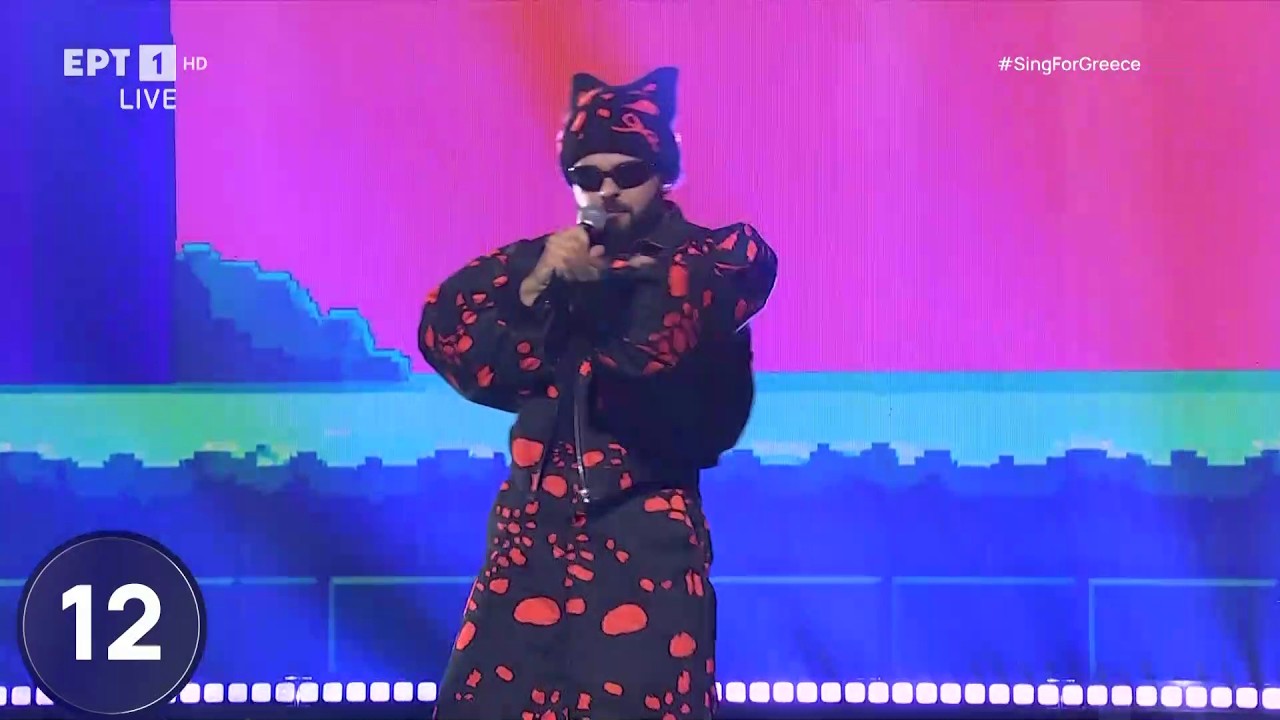
That price implies a win probability of around 8%, which places Greece firmly in the chasing pack behind Finland, France, and Denmark. But there are compelling reasons to believe the market may be underestimating what Akylas can achieve in Vienna. Let us break down everything you need to know about Greece's Eurovision 2026 entry and whether those odds represent genuine value.
Who Is Akylas?
Akylas is not a household name across Europe — yet. But within Greece, he has been building a reputation as one of the most exciting young artists in the contemporary music scene. His sound sits at the intersection of dark pop, Mediterranean electronica, and modern R&B, creating a sonic identity that feels distinctly Greek without being traditionally ethnic. This is important at Eurovision, where entries that lean too heavily into folk can alienate Western European juries, while entries that sound generically international fail to stand out from the crowd.
What sets Akylas apart is his stage presence. He is not a passive vocalist who stands behind a microphone stand and hopes the song does the work. He commands attention through movement, eye contact, and an intensity that translates through a television screen — a quality that is absolutely essential in a contest where most viewers watch from their living rooms and decide within 30 seconds whether an act is worth voting for.
Greece selected Akylas through its national selection process, and the reaction from the Greek public was overwhelmingly positive. When your home audience backs you with genuine enthusiasm rather than polite indifference, it tends to signal something real. Artists who arrive at Eurovision with authentic domestic momentum carry a confidence that shows on stage.
What Is Ferto?
Ferto is a dark, brooding track that builds tension through layers of electronic production before releasing into a chorus that hits with genuine emotional force. The song blends contemporary Mediterranean sounds — think pulsing rhythms, minor-key melodies, and a vocal delivery that carries the weight of centuries of Greek musical tradition — with modern production techniques that keep it sounding fresh and current.
The word Ferto itself carries intensity. The song's structure is designed for a live performance setting, with dynamic shifts that give staging directors plenty to work with. There are quiet, intimate moments that pull the viewer in, followed by explosive sections where the production swells and the performance can fill an arena. This kind of contrast is exactly what Eurovision rewards. The contest is essentially a three-minute audition, and entries that take the audience on an emotional journey consistently outperform entries that stay at one energy level throughout.
Critics within the Eurovision fan community have described Ferto as one of the most compelling Greek entries in recent years. It does not chase trends or try to sound like whatever won last year. Instead, it leans into a distinctly Greek sensibility while wrapping it in production that feels contemporary and internationally accessible. That combination is deceptively difficult to achieve, and Greece has nailed it.
Greece's Eurovision History: A Legacy of Consistency
To understand why Greece at 9.0 deserves serious consideration, you need to understand the country's remarkable Eurovision track record.
Greece has been competing at Eurovision since 1974, and in that time has established itself as one of the most consistent performers in the contest's history. The headline achievement is Helena Paparizou's victory in 2005 with My Number One — a performance that combined Greek charisma, a bulletproof pop song, and staging that was ahead of its time. That win remains a source of immense national pride and set a template for how Greece approaches the contest: send something that is unmistakably Greek in spirit but packaged for a pan-European audience.
Beyond the 2005 victory, Greece's record is studded with strong finishes. The country has landed in the top 10 of the Grand Final on numerous occasions, including a string of impressive results throughout the 2000s and 2010s that few nations outside the Nordic bloc can match. Greece reached the top five multiple times during its golden era and has rarely finished outside the top half when it qualifies for the final.
Critically, Greece almost always qualifies from the semi-final. The country's qualification rate is among the highest in the contest, which speaks to a combination of consistent song quality and a reliable voting base. When you bet on Greece, you are betting on a nation with deep institutional knowledge of what works at Eurovision — and that knowledge should not be underestimated.
The only caveat is that Greece has experienced some leaner years more recently, with a couple of non-qualifications that bruised national confidence. But 2026 feels like a reset. Akylas and Ferto represent a new generation of Greek Eurovision strategy — darker, more contemporary, more willing to take creative risks — and the early signs suggest it is working.
Semi-Final 1: Greece's Path to the Grand Final
Greece is drawn into Semi-Final 1, which takes place on Tuesday 12 May 2026 at the Wiener Stadthalle in Vienna. The semi-final field includes 15 or 16 countries competing for a limited number of qualification spots, and Greece is widely regarded as one of the strongest acts in the lineup.
The Semi-Final 1 field includes Denmark (a top-three favourite overall), Cyprus (a dark horse with a catchy banger in Jalla), and several solid mid-table entries from the Balkans and Eastern Europe. On paper, Greece should qualify comfortably. The combination of a strong song, an engaging performer, and the ever-present Greek diaspora televote makes Greece one of the safest bets to make it through to Saturday.
For bettors, this matters because semi-final qualification is the first hurdle. An act can have all the quality in the world, but if it draws a poor semi-final slot and fails to qualify, your outright winner bet is dead. With Greece, that risk is minimal. The country has the pedigree, the song quality, and the built-in voting support to cruise through Semi-Final 1 without breaking a sweat.
If your bookmaker offers a market on Greece to qualify from Semi-Final 1, it should be priced at very short odds — and rightly so. This is about as close to a certainty as Eurovision semi-finals get.
The Greek Diaspora: Eurovision's Most Underrated Voting Bloc
This is the factor that separates Greece from most other nations in the Eurovision betting market, and it is routinely underpriced by bookmakers.
The Greek diaspora is enormous. Significant Greek communities exist across Germany, Belgium, the United Kingdom, Australia, Cyprus, Sweden, and numerous other countries that participate in the Eurovision televote. These communities are passionate, culturally connected, and — crucially — they vote. Every single year, the Greek diaspora delivers a reliable floor of televote points that most other nations simply cannot match.
Consider the mechanics. Eurovision's televote allows viewers in each country to vote for any entry except their own. When you have substantial Greek populations in a dozen or more voting nations, each of those countries is likely to award Greece a meaningful number of televote points. This creates a baseline of support that acts as insurance against a bad night. Even if the casual European viewer does not connect with Ferto, the diaspora ensures Greece will not be shut out of the televote scoreboard.
The diaspora effect is especially powerful in Germany, where the Greek community numbers in the hundreds of thousands. Germany is one of the largest televote contributors by population, meaning a strong showing among Greek-Germans can translate into significant points. Similar dynamics play out in Belgium, the UK, and Australia.
Cyprus deserves special mention here. The cultural and linguistic ties between Greece and Cyprus mean that Cypriot voters overwhelmingly support the Greek entry, and Greek voters return the favour. With Cyprus also competing in 2026 (Antigoni with Jalla), there is even a scenario where both Mediterranean entries feed off each other's energy and both perform well in the televote.
For bettors, the diaspora factor means Greece's floor is higher than the raw odds suggest. A nation with a built-in televote baseline of 50-80 points before a single non-diaspora viewer picks up their phone is a nation that the market consistently undervalues.
Why Ferto Is Generating Buzz
Several factors have converged to push Ferto into the conversation among serious Eurovision analysts and bettors.
The dark pop trend. Eurovision has been drifting toward moodier, more atmospheric entries in recent years. The days when a generic uptempo pop song could win are largely over. Audiences — and particularly juries — now reward entries that create a mood, tell a story, and demonstrate artistic ambition. Ferto fits this trend perfectly. It is not trying to be the happiest song in the contest; it is trying to be the most compelling. That distinction matters.
Mediterranean authenticity. With Spain boycotting Eurovision 2026, there are fewer southern European entries in the field than usual. This creates a gap in the market for Mediterranean warmth, passion, and musical identity. Greece fills that gap naturally. Viewers across Europe who might have split their votes between Spain, Greece, Italy, and Cyprus now have fewer options, which could concentrate the Mediterranean vote more heavily on the entries that remain.
Staging potential. Ferto is a song that practically stages itself. The dynamic shifts, the building intensity, and the emotional peaks all lend themselves to dramatic lighting, camera work, and choreography. Greek delegations have historically invested heavily in staging — remember the elaborate productions that accompanied entries like My Number One and Alcohol Is Free — and there is every reason to expect that Akylas will be given a visual package worthy of the song.
Youth appeal combined with substance. Akylas is young, charismatic, and visually striking, which gives Greece an edge in capturing the attention of younger televote demographics who engage through social media and app-based voting. But unlike some youth-oriented entries that sacrifice musical substance for aesthetic appeal, Ferto has genuine depth. It rewards repeated listens, which is significant because Eurovision fans who follow the contest closely tend to vote for entries they have connected with over weeks of listening rather than entries that simply look good on first impression.
The Mediterranean Factor: Spain's Absence Changes the Game
Spain's boycott of Eurovision 2026 is one of the most significant developments in the betting landscape, and its impact on Greece's chances is worth examining in detail.
In a typical Eurovision year, the Mediterranean vote is split across Spain, Greece, Italy, Cyprus, and sometimes Portugal and Malta. These countries share cultural and musical affinities, and their diaspora communities often overlap in key televote markets. When all of them are present, they compete with each other for a finite pool of southern European sympathy votes.
With Spain absent, that pool shrinks by one major competitor. Spain was a Big Five nation with automatic qualification, meaning it always reached the Grand Final and always attracted a share of the televote. Without Spain in the mix, Greek and Italian entries stand to benefit. Viewers who might have given their televote to Spain now have one fewer Mediterranean option, and some of those votes will inevitably flow to Greece.
This is not a massive shift — we are talking about perhaps 10-20 additional points across the televote — but in a contest that is often decided by narrow margins, every point matters. Greece at 9.0 already has the quality to compete for a top-five finish. Add a modest boost from reduced Mediterranean competition, and the case for Greece strengthens further.
Jury vs. Televote: Where Will Greece Score?
Understanding how Greece is likely to perform across the two voting components is essential for evaluating the odds.
Televote prediction: Top 5 to Top 8. Greece should perform strongly in the televote. The diaspora factor provides a reliable baseline, and Ferto has the kind of intensity and memorability that drives casual viewers to vote. If the staging delivers — and Greek delegations rarely disappoint on that front — a top-five televote finish is realistic. The top end of the range would see Greece finish alongside Finland and Cyprus as one of the televote leaders.
Jury prediction: Top 8 to Top 12. This is where Greece faces more uncertainty. Juries tend to reward vocal precision, sophisticated songwriting, and restrained artistry — qualities more associated with entries from France, Australia, and Denmark in the 2026 field. Ferto is a strong song with genuine musicality, but it may not be the kind of entry that juries instinctively place at the top of their rankings. A top-10 jury finish would be a solid result; anything higher would be a bonus.
Combined prediction: Top 5 to Top 7. If Greece performs as expected across both votes — strong televote, respectable jury — the combined score should land comfortably in the top half of the Grand Final. A top-five finish is the realistic ceiling, though a podium is not out of the question if everything aligns perfectly on the night.
The key variable is whether the jury underperforms or outperforms expectations. If juries place Greece in their top five, the combined total could push Akylas onto the podium. If juries are lukewarm, a top-seven finish is more likely. Either way, Greece should be competitive.
Odds Comparison: Is 9.0 Good Value?
Let us look at where the major bookmakers are pricing Greece.
| Bookmaker | Greece Outright Winner Odds |
|---|---|
| Betfred | 9.00 |
| Bet365 | 8.50 |
| William Hill | 9.00 |
| Unibet | 8.00 |
| Paddy Power | 9.00 |
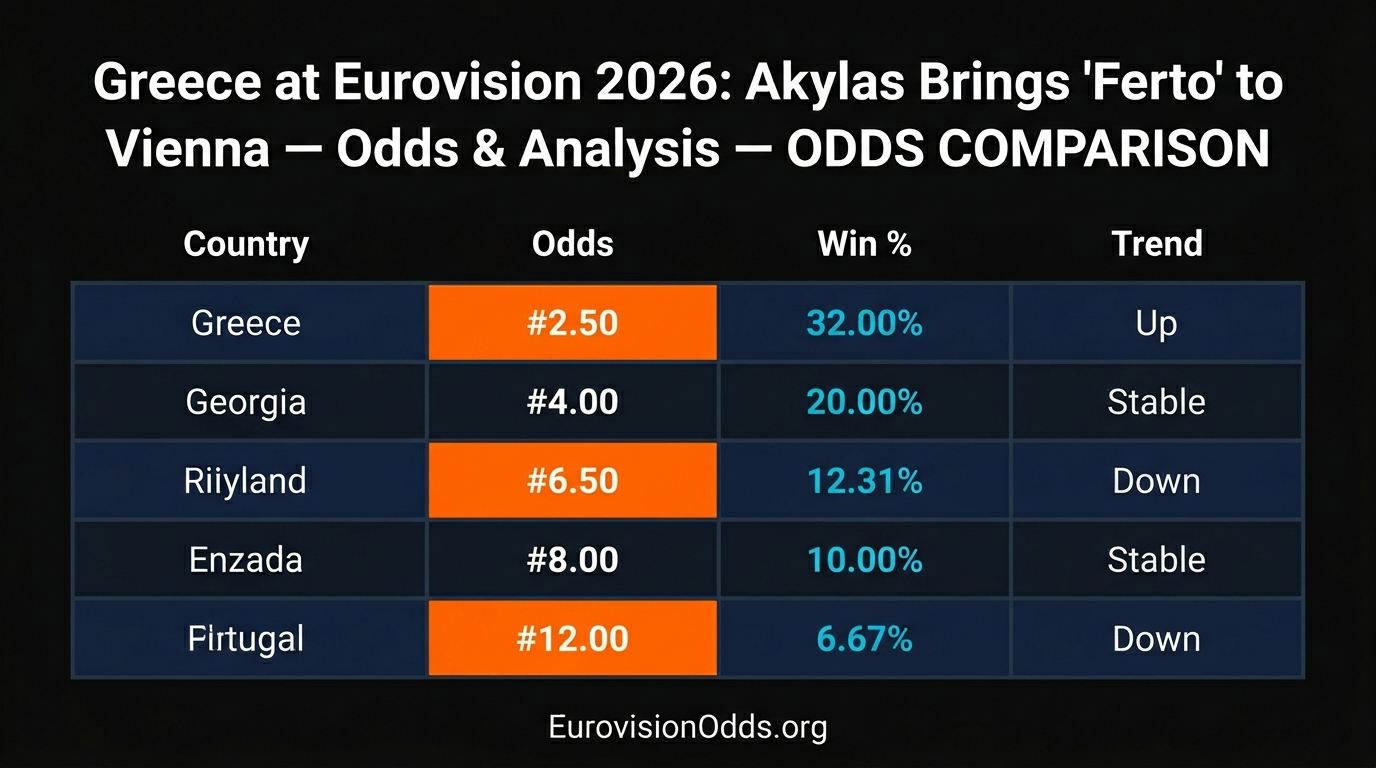
At 9.0, the implied win probability is approximately 11% (before the bookmaker's margin). Our assessment places Greece's true win probability at around 8-10%, which means the outright winner market is priced roughly fairly — neither a screaming value bet nor an overpriced trap.
However, the value calculation changes significantly when you consider placement markets. If your bookmaker offers a top-five finish market for Greece, that is where the real opportunity lies. We estimate Greece's probability of finishing in the top five at around 45-55%, which means any price above 2.0 for a top-five finish represents genuine value.
Betfred is worth checking for their Eurovision specials, as they frequently offer enhanced odds on placement bets and country-specific markets that other bookmakers do not carry. Their new customer offer of Bet 10 Get 50 in Free Bets also provides enough firepower to spread across an outright winner bet and a placement bet on Greece simultaneously.
For the outright winner market at 9.0, we would classify Greece as a solid each-way selection rather than a primary win bet. The each-way component — which typically pays out for a top-three or top-five finish depending on the bookmaker's terms — gives you insurance against the likely scenario where Greece finishes strongly but just outside the top spot.
How Greece Could Win: The Scenario
For Greece to go all the way, several things need to happen simultaneously.
First, the staging needs to be exceptional. Not just good — exceptional. Greece needs a visual presentation that makes Ferto feel like the most important three minutes of the evening. Dark lighting, dramatic camera angles, and a performance from Akylas that radiates intensity from the first note to the last. Greek delegations know how to stage, so this is achievable.
Second, the running order needs to be favourable. Entries that perform in the second half of the Grand Final — particularly in the last six or seven slots — consistently outperform entries that go early. If Greece draws a late running order position, the odds of a strong result increase meaningfully.
Third, the televote needs to break strongly in Greece's favour. This means the diaspora turns out in force AND casual viewers across Europe connect with the performance. If Ferto becomes one of those entries that casual fans talk about during the ad breaks — the kind of performance that makes people reach for their phones — then the televote ceiling is very high.
Fourth, the jury needs to be at least respectful. Greece does not need to win the jury vote to win the contest, but a top-eight jury finish combined with a top-three televote would put Akylas in genuine contention for the overall crown.
Is this scenario likely? Not the most likely outcome — Finland remains the clear favourite for good reason. But is it plausible? Absolutely. And at 9.0, you are being paid handsomely for a plausible scenario.
How Greece Could Disappoint: The Risks
No honest betting analysis ignores the downside. Here are the scenarios where Greece underperforms.
Staging fails to deliver. If the visual package is flat or uninspired, Ferto loses much of its impact. The song relies on atmosphere, and atmosphere is created as much by staging as by music. A generic staging concept would leave Greece languishing in mid-table.
Jury rejection. If professional juries decide Ferto is style over substance — all mood and production with insufficient vocal or compositional sophistication — the jury score could drag Greece out of contention even if the televote is strong.
Running order curse. Drawing an early slot in the Grand Final, particularly in the first five performances, would significantly reduce Greece's chances. Early entries are systematically disadvantaged by recency bias in the televote.
Diaspora complacency. The Greek diaspora is a powerful force, but it is not infinite. If Greek communities assume their entry will do well regardless and do not actively vote, the expected televote baseline could fall short.
None of these risks are catastrophic, and most can be mitigated by a strong delegation and good preparation. But they are worth factoring into your staking decisions.
Betting Recommendations
Here is how we would approach betting on Greece at Eurovision 2026.
Primary bet: Greece each-way at 9.0. This gives you a return if Greece wins outright and a smaller but still profitable return if Akylas finishes in the top three (or top five, depending on your bookmaker's each-way terms). At 9.0, the each-way component is where the real value sits.
Secondary bet: Greece top 5 finish. If your bookmaker offers this market, look for odds of 2.0 or higher. We rate Greece's top-five probability at around 45-55%, making anything above evens a value bet. Betfred tends to carry a comprehensive range of Eurovision placement markets — worth checking as the contest approaches.
Avoid: Greece to win the televote. While Greece will score well in the televote, winning it outright against Finland and Cyprus is a tall order. The diaspora provides a strong floor, but the ceiling may not be high enough to top entries with broader pan-European appeal.
Accumulator inclusion. Greece to qualify from Semi-Final 1 is an excellent leg in any Eurovision accumulator. It is about as close to a certainty as the semi-finals produce, and adding it to a multi-bet boosts your return at virtually no additional risk.
The Bigger Picture: Greece in the Context of Eurovision 2026
Eurovision 2026 in Vienna is a 35-country contest with a clear favourite in Finland, strong challengers in France and Denmark, and a cluster of competitive entries from the 4th to 10th positions. Greece sits right at the top of that cluster, which is a strong position to be in.
The reduced field — five countries boycotting means fewer entries than any year since 2003 — works in Greece's favour. Fewer competitors means less televote dilution, fewer entries to stand out against, and a slightly higher probability of finishing in the upper reaches of the scoreboard. The boycott situation is unfortunate for the contest, but for bettors backing remaining entries, it marginally improves the odds.
Greece also benefits from competing in an era where Eurovision increasingly rewards authenticity. The contest has moved away from the generic Europop of the 2010s toward a more diverse musical landscape where entries that sound like they come from somewhere — that carry the cultural DNA of their country — resonate with both juries and televoters. Ferto sounds Greek. It does not try to sound Swedish or American or generically European. That authenticity is a competitive advantage.
Final Verdict
Greece at odds of approximately 9.0 for the outright winner market is a fair price that becomes genuinely attractive as an each-way bet. Akylas and Ferto bring a combination of dark intensity, Mediterranean authenticity, and reliable diaspora support that gives Greece multiple paths to a strong result.
The most likely outcome is a top-five to top-seven finish — impressive, competitive, and profitable for each-way and placement bettors. The upside scenario — where staging, running order, and televote all break in Greece's favour — puts Akylas on the podium and possibly in contention for the win.
If you are building a Eurovision 2026 betting portfolio, Greece deserves a place in it. Not as your primary win bet — Finland holds that honour — but as a strong each-way selection and placement bet that offers real value in a market that may be underestimating one of Eurovision's most consistent nations.
Get your bets in before rehearsals begin in Vienna. Once the staging footage drops, a strong rehearsal from Greece could see these odds shorten significantly. Lock in value now.
Get Your Free Eurovision Bet Here
New customers only. Register with BETFRED50. Deposit £10+ via Debit Card and place first bet £10+ at Evens (2.0)+ within 7 days to get 3 x £10 in Free Bets & 2 x £10 — 7-day expiry. Eligibility & payment exclusions apply. Full T&Cs apply.