
Finland has not topped the Eurovision betting odds like this since Lordi stormed Athens in 2006 with rubber monster masks and pyrotechnics. Twenty years later, the Nordic nation finds itself as the outright favorite to win Eurovision 2026 in Basel, and the reason is a track called Liekinheitin — Finnish for flamethrower. The song is performed by one of the most unexpected duos in Eurovision history: Linda Lampenius, a 56-year-old classical violinist, and Pete Parkkonen, a 36-year-old pop vocalist who first rose to fame on Idols Finland.

18+ | New customers only | T&Cs apply | Please gamble responsibly

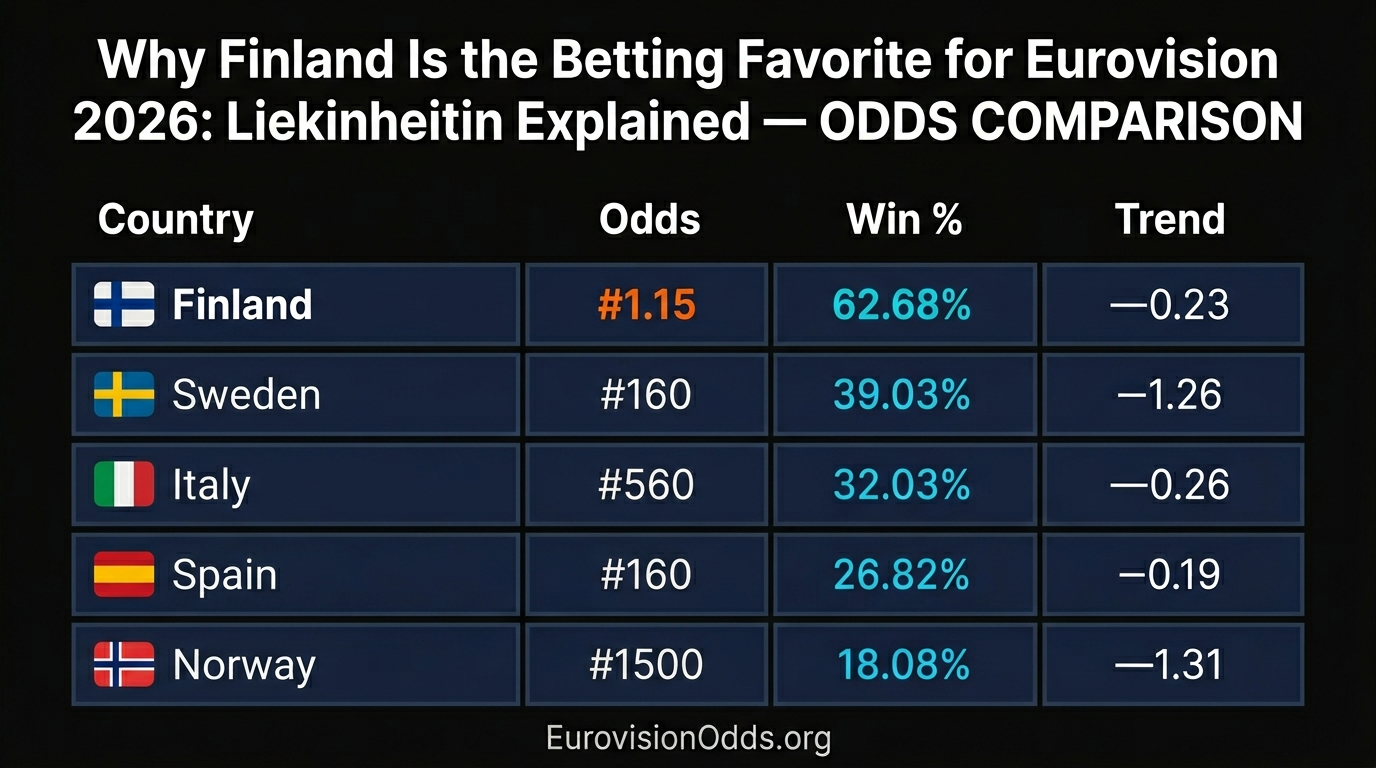
With current odds hovering around 2.5 across major bookmakers — implying a win probability somewhere between 28% and 35% — Finland is the clear market leader. But what exactly makes this entry so compelling to oddsmakers, and should you back it with real money? Let us break it all down.
Who Are Linda Lampenius and Pete Parkkonen?
Linda Lampenius is a name that many Europeans already know, though perhaps under a different guise. Performing internationally as Linda Brava, she built a career as a classical violinist who was never afraid to blur the line between high art and popular entertainment. She has released albums, appeared on television across Scandinavia, and cultivated a stage presence that mixes elegance with showmanship. At 56, she brings a level of experience and poise that most Eurovision acts simply cannot match.
Pete Parkkonen, two decades her junior at 36, comes from a different corner of Finnish entertainment. He first appeared on the national stage as a contestant on Idols Finland in 2008, where his vocal ability and charisma made an immediate impression. He went on to win Dancing with the Stars Finland in 2014, proving he is as comfortable commanding a stage physically as he is vocally. His pop credentials are strong, and his ability to connect with an audience in a live setting is well documented.
The pairing is unconventional, and that is precisely the point. Eurovision rewards acts that stand out, and a classical violinist performing alongside a pop singer two decades younger is not something the contest has seen before.
UMK 2026: A Record-Breaking National Selection
Finland selects its Eurovision entry through UMK (Uuden Musiikin Kilpailu), the national selection show run by Yle. The 2026 edition was not even close. Lampenius and Parkkonen won with a staggering 570 points, nearly tripling the score of the second-place finisher. That margin is unprecedented in UMK history and sent a clear signal to the international betting market: Finland had found something special.
The dominance of the UMK result matters because it shows broad domestic support across both the jury and public vote. When an act wins its national final by that kind of margin, it tends to indicate genuine mass appeal rather than a narrow fanbase gaming the system. Bookmakers took note immediately, and Finland surged to the top of the odds within hours of the UMK final.
What Is Liekinheitin?
The song title translates to flamethrower, and the track lives up to its name. Liekinheitin is a genre hybrid that defies easy categorization. At its core, it combines rock instrumentation, classical violin passages performed live by Lampenius, and dance-pop production that builds toward what commentators have described as an explosive climax.
Music critics and Eurovision analysts have labeled it safe erotic pop — a description that captures the song's ability to be sensual and dramatic without crossing into territory that might alienate conservative juries or family audiences. The track has a slow-burn structure, beginning with restrained verses before layering in violin, heavier guitars, and pulsing electronic elements that converge in a final section designed to bring an arena to its feet.
The Finnish-language lyrics add another dimension. While singing in a non-English language can sometimes limit televote appeal, Finnish has an exotic, melodic quality that tends to intrigue rather than confuse international listeners. Lordi proved in 2006 that Finland does not need to sing in English to win, and Liekinheitin seems to embrace that same confidence in cultural identity.
Current Betting Odds for Finland
As of late March 2026, Finland's odds to win Eurovision 2026 sit at approximately 2.5 across the major European bookmakers. This translates to an implied win probability of roughly 28% to 35%, depending on the specific book and how much margin is built into the price.
Here is how the odds compare across several prominent bookmakers:
- Betfred: 2.50 (best available price for Finland)
- Bet365: 2.40
- William Hill: 2.45
- Unibet: 2.50
- Paddy Power: 2.40
For bettors looking for the best value, Betfred consistently offers competitive prices on Eurovision outrights and currently matches or beats most competitors on the Finland market. Their Eurovision specials page also tends to carry additional prop bets such as top-five finishes and regional voting markets.
The gap between Finland and the second favorite in the betting is significant. Most books have the next-closest contender priced around 5.00 to 6.00, meaning Finland holds a commanding lead in market confidence. This kind of gap is unusual for Eurovision, where the favorite often sits much closer to the pack.
Why Bookmakers Rate Finland So Highly
Several factors converge to make Finland the market leader:
Uniqueness of the act. Eurovision juries reward originality, and the combination of a classical violinist and a pop vocalist performing a rock-infused dance track is genuinely novel. There is nothing else in the 2026 lineup that looks or sounds like Liekinheitin.
Staging potential. The song is built for a big stage. Live violin, dramatic lighting, choreography between two performers with very different energies — the visual possibilities are enormous. Finland has historically struggled with staging at Eurovision, but this entry practically stages itself.
Broad demographic appeal. The classical elements attract older viewers and jury members who value musicianship. The pop and dance elements pull in younger audiences. The rock edge adds credibility. Very few Eurovision entries manage to tick this many boxes simultaneously.
Momentum from UMK. A record-breaking national final win generates international media coverage, fan buzz, and social media discussion — all of which feed into the betting market. Momentum matters in Eurovision, and Finland has it in abundance heading into the contest.
Strong rehearsal expectations. While rehearsals in Basel have not yet begun at the time of writing, the nature of the act — live instrumentation, two charismatic performers, a song with clear dynamic shifts — suggests it will translate powerfully to the Eurovision stage. Bookmakers price in expected rehearsal impact, and the consensus is that Liekinheitin will only get stronger once cameras are rolling.
Potential Weaknesses to Consider
No betting favorite is without risk, and there are legitimate concerns about Finland's chances that a smart bettor should weigh.
The safe factor. While safe erotic pop is a catchy descriptor, the word safe cuts both ways. Eurovision televotes in recent years have rewarded entries that feel dangerous, surprising, or emotionally raw. Liekinheitin is polished and professional, but some voters may find it too calculated, too smooth. The televote often favors chaos over craft.
Age gap perception. The 20-year age difference between Lampenius and Parkkonen is part of the act's appeal, but it could also become a distraction. If the staging leans too heavily into romantic chemistry between the two performers, it might read awkwardly to some viewers rather than compellingly.
Younger televote disconnect. The classical violin element that impresses juries may not resonate with the 15-to-25 demographic that drives a significant portion of the televote, particularly through app voting. Younger viewers tend to gravitate toward high-energy dance tracks, quirky novelty acts, or deeply emotional ballads. Liekinheitin sits in a middle ground that could struggle to become anyone's absolute favorite.
Finnish-language barrier. While singing in Finnish adds authenticity, the televote remains heavily influenced by sing-along factor. English-language entries often benefit from audiences being able to join in, share lyrics on social media, and connect with the words emotionally. A Finnish-language track, no matter how melodic, does not have that advantage.
Historical Context: Finland at Eurovision
Finland's Eurovision history is one of long droughts punctuated by a single, seismic victory. The country participated for decades with modest results before Lordi delivered a shock win in 2006 with Hard Rock Hallelujah. That victory remains one of the most iconic moments in Eurovision history — a hard rock band in monster costumes winning a contest that had long been dominated by pop ballads.
The comparison between Lordi and Lampenius-Parkkonen is instructive. Both acts succeed by being unmistakably different from the rest of the lineup. Both lean into spectacle. Both carry a sense of Finnish identity rather than trying to sound generically European. But where Lordi was anarchic and transgressive, Liekinheitin is sophisticated and seductive. Finland appears to have learned that the path to Eurovision glory runs through standing out, not fitting in.
Since 2006, Finland's results have been mixed. The country has failed to qualify for the grand final on multiple occasions and has not finished in the top five since that legendary victory. A win in 2026 would be a major comeback story, and that narrative angle only adds to the entry's appeal.
Jury vs. Televote: How Will Finland Score?
Eurovision's combined jury and televote system creates interesting dynamics for an act like Liekinheitin. Here is how Finland might perform across both scoring methods:
Jury vote prediction: Top 3. Professional juries tend to reward vocal ability, musicianship, and sophisticated songwriting. Liekinheitin delivers on all three fronts. The live violin performance adds a layer of artistry that jury members — many of whom are classically trained musicians themselves — will appreciate. Finland should comfortably finish in the top three of the jury vote, and a jury win is very much on the table.
Televote prediction: Top 5 to Top 8. The televote is harder to predict. Finland will benefit from the spectacle of the performance and the catchiness of the chorus, but may lose ground to entries with stronger emotional narratives or more youth-oriented energy. A top-five televote finish would be excellent; a top-eight finish is the more conservative expectation.
Combined result: Top 3, with a realistic shot at winning. If Finland performs as expected with juries and manages a solid televote showing, the combined points total should be enough for a podium finish at minimum. A win depends on whether the televote rewards craft over chaos in 2026.
How to Bet on Finland to Win Eurovision 2026
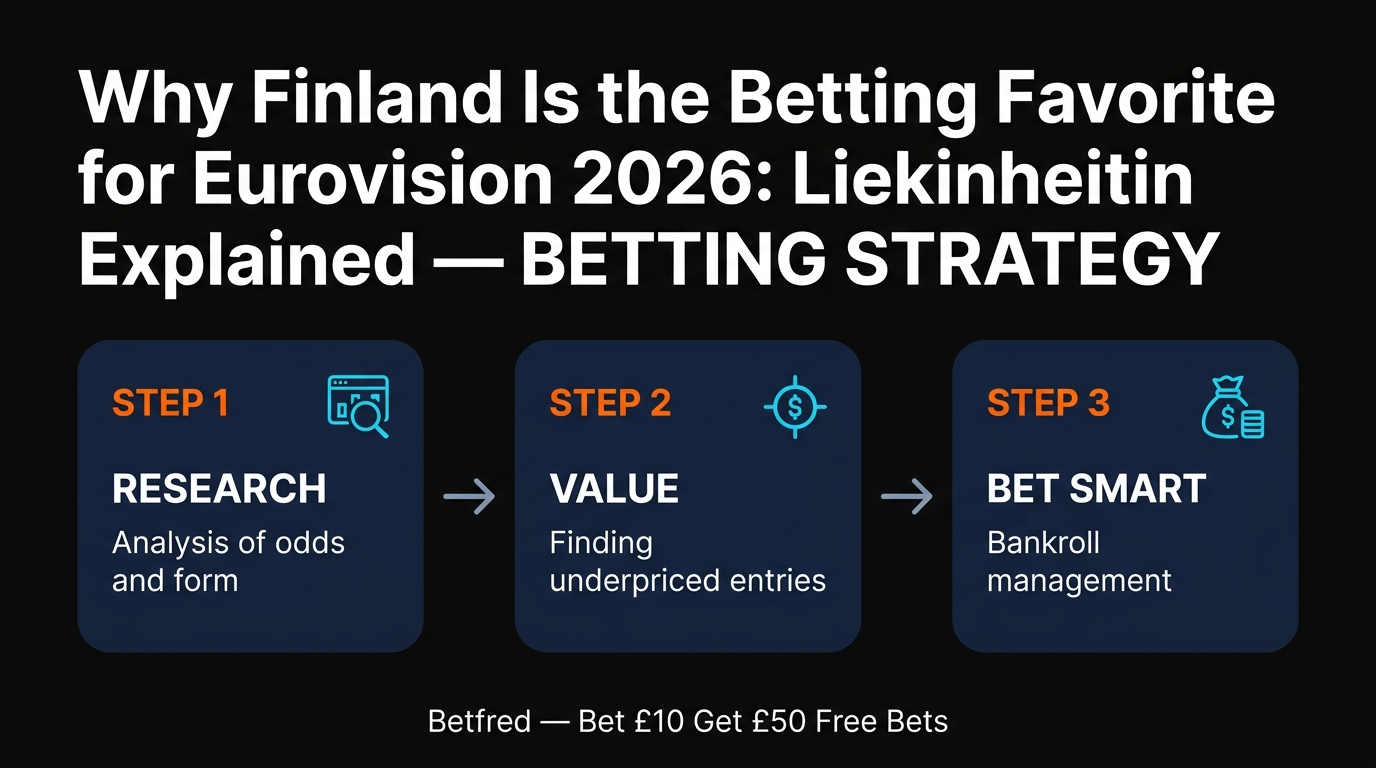
Placing a bet on Finland is straightforward. Most major European bookmakers carry Eurovision outright winner markets from the moment national selections conclude. Here is the basic process:
- Choose a licensed bookmaker that offers Eurovision markets. Betfred is a strong option with competitive odds and a straightforward interface for entertainment specials.
- Navigate to the Entertainment or Specials section, then find Eurovision 2026.
- Select Finland to win the Eurovision 2026 Grand Final.
- Enter your stake and confirm the bet.
Some bookmakers also offer each-way betting on Eurovision, which pays out if your selection finishes in the top three or top five (depending on the book's terms). Given Finland's strong position, an each-way bet could provide insurance — you collect a return even if Finland finishes second or third.
It is also worth monitoring the odds as the contest approaches. Rehearsal footage from Basel will drop in mid-May, and odds can shift dramatically based on how acts look on the actual Eurovision stage. If Finland's rehearsals impress, the odds will shorten further, so early bets lock in better value.
The Verdict
Finland deserves its place at the top of the Eurovision 2026 betting market. Liekinheitin is a genuinely unique entry performed by two artists who bring complementary strengths to the stage. The record-breaking UMK victory, the genre-blending composition, and the sheer staging potential all point toward a strong result in Basel.
The risks are real — the televote remains unpredictable, and the polished nature of the act could work against it with voters who prefer raw emotion or outright weirdness. But at odds of around 2.5, the market is pricing in those risks appropriately. Finland offers a compelling combination of quality and value that is hard to find elsewhere in the 2026 field.
Whether you are a seasoned Eurovision bettor or placing your first wager on the contest, Finland is the entry to watch — and quite possibly the entry to back.