
Denmark has not been this high in the Eurovision betting odds in over a decade. At approximately 6.50 across major bookmakers — translating to a win probability of around 11% — Søren Torpegaard Lund and his Danish-language ballad "Før vi går hjem" sit comfortably in third place behind Finland and France. For a country that has been largely invisible in the Eurovision betting market since Emmelie de Forest's barefoot triumph in 2013, this is a remarkable resurgence.

18+ | New customers only | T&Cs apply | Please gamble responsibly
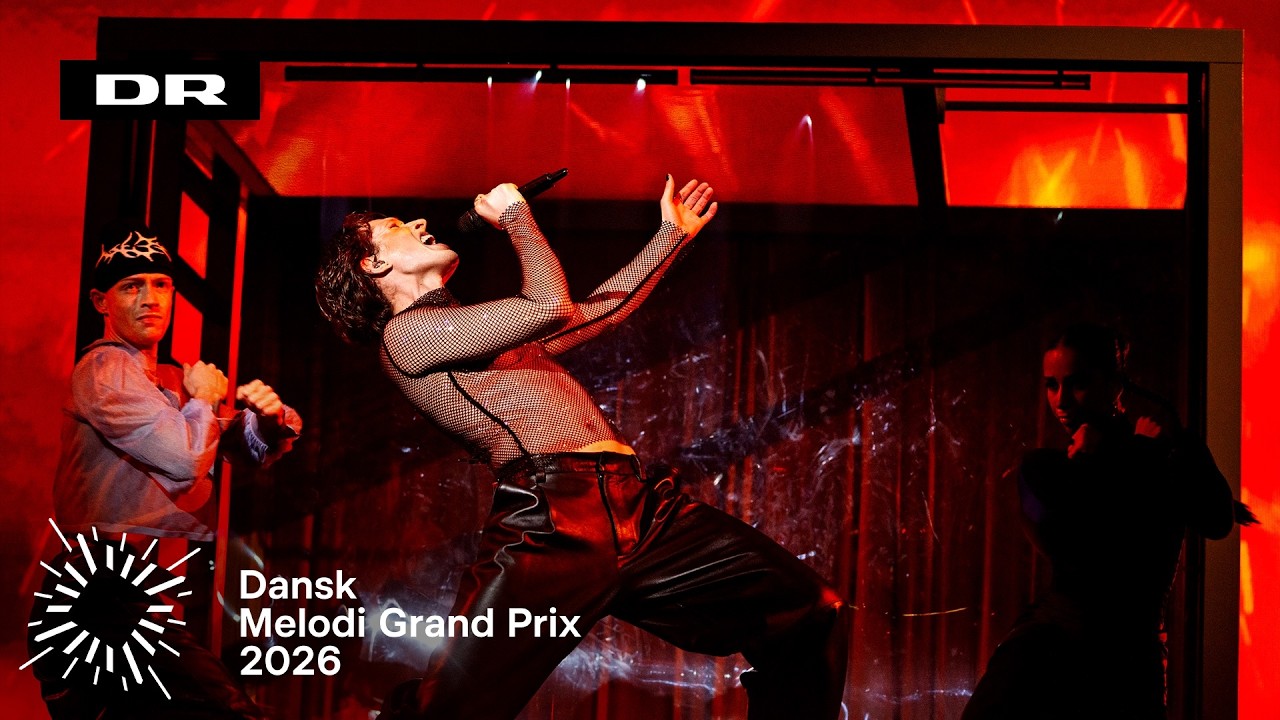
But can Denmark convert market confidence into an actual victory in Vienna? And more importantly for bettors — are the odds right, or is there value to be found?
Let us break down everything you need to know.
The Song: "Før vi går hjem" (Before We Go Home)
The title translates to "Before We Go Home," and the song delivers exactly the emotional weight that phrase implies. This is not a three-minute pop track designed to be forgotten by the next commercial break. "Før vi går hjem" is a slow-building ballad that begins with an almost whispered intimacy before gradually layering in strings, piano, and a vocal crescendo that has left Eurovision preview audiences genuinely moved.
Søren Torpegaard Lund writes and performs with the kind of understated conviction that is increasingly rare at Eurovision. Where many entries try to overwhelm through production, choreography, and pyrotechnics, Denmark's approach is stripped back and emotionally direct. The song is about the ache of a perfect moment ending — that bittersweet feeling of wanting to hold on to something you know is slipping away. It is universal, human, and deeply felt.
The Danish lyrics are central to the song's identity, and this is perhaps the boldest strategic decision Denmark has made. In a contest where the overwhelming majority of entries are performed in English, choosing to sing in Danish is a statement. It says: this song is authentic, this song comes from somewhere real, and we trust the emotion to transcend the language barrier.
The Bold Choice: Singing in Danish
Let us address this directly because it is the single most debated aspect of Denmark's entry. Singing in a language that fewer than six million people speak natively at a contest watched by 160 million viewers is either a masterstroke or a miscalculation. History suggests it can be both.
The evidence for native-language success is compelling. Salvador Sobral won Eurovision 2017 with "Amar pelos dois" performed entirely in Portuguese. Loreen's Swedish-language touches in her performances added authenticity. Going further back, many of Eurovision's most iconic winners performed in their native tongue — including Denmark's own 1963 victory with "Dansevise" sung in Danish.
But the failures are equally instructive. Numerous entries in lesser-spoken languages have struggled to connect with the broader European televote, finishing in the bottom half despite strong musical quality. The difference often comes down to emotional clarity. Can a viewer who does not understand a single word still feel what the song is about? With "Før vi går hjem," the answer appears to be yes. The melody carries the meaning even when the lyrics do not translate directly. Torpegaard Lund's vocal delivery — tender in the verses, aching in the chorus, soaring in the final section — communicates everything a listener needs to know.
For bettors, the Danish language factor cuts two ways. It limits the song's sing-along potential in the televote, which could cost Denmark points among younger viewers who engage with Eurovision through social media and TikTok-style sharing. But it also makes the entry impossible to confuse with anything else in the lineup. In a field of 35 countries where many entries blend into a homogeneous wall of English-language pop, "Før vi går hjem" stands apart. That distinctiveness has historically been rewarded.
Denmark's Eurovision History: Three Wins and Long Droughts
Denmark's relationship with Eurovision is one of occasional brilliance separated by long stretches of mediocrity. The country has won the contest three times, and each victory tells a different story about what it takes to succeed.
1963 — Grethe and Jørgen Ingmann: "Dansevise"
Denmark's first victory came in the contest's early era, when singing in your national language was the norm rather than the exception. "Dansevise" was a gentle, melodic piece that charmed the juries of the day. It established Denmark as a country capable of producing Eurovision-worthy material.
2000 — Olsen Brothers: "Fly on the Wings of Love"
After 37 years without a win, the Olsen Brothers delivered one of the most feel-good victories in Eurovision history. The song was unashamedly upbeat, the brothers' performance was endearingly enthusiastic, and Europe responded. It was a reminder that Eurovision rewards sincerity as much as sophistication.
2013 — Emmelie de Forest: "Only Teardrops"
Denmark's most recent victory is also its most strategic. "Only Teardrops" was a carefully crafted pop entry with a memorable tin whistle hook, performed by a young artist with genuine star quality. Emmelie de Forest won both the jury and televote, a feat that demonstrated the song's universal appeal. Denmark hosted the following year in Copenhagen, delivering one of the most acclaimed Eurovision productions in memory.
Since 2013, Denmark's results have been inconsistent. The country failed to qualify for the Grand Final in 2016, 2018, 2019, 2021, and 2024. That string of non-qualifications is precisely why the current odds of 6.50 are so striking — the market is saying that Denmark has not just sent a good entry, but a potentially great one.
Why Bookmakers Rate Denmark So Highly
Several factors converge to justify Denmark's position as the third favourite.
Emotional resonance. In a contest that often rewards spectacle over substance, "Før vi går hjem" goes in the opposite direction. It bets everything on emotional connection, and that bet appears to be paying off. Preview events and online reactions suggest the song produces a genuine emotional response in listeners — the kind that translates directly into televotes on the night.
Vocal quality. Søren Torpegaard Lund is not a manufactured pop star. He is a singer-songwriter with a lived-in voice that carries the weight of the song's themes without straining for effect. Juries will appreciate the technical control — the quiet passages require impeccable breath management, and the crescendo demands power without losing emotional nuance. This is the kind of vocal performance that scores highly with professional panels.
Staging simplicity. Early indications suggest Denmark will keep the staging minimal — perhaps a single spotlight, a sparse set, and a camera approach that keeps the focus on Torpegaard Lund's face and voice. In a contest where many acts rely on LED walls, dancers, and elaborate costumes, this simplicity is itself a statement. It worked for Salvador Sobral. It worked for Duncan Laurence. There is a well-established template for stripped-back entries winning Eurovision.
The authenticity factor. There is a growing trend in the Eurovision fan community — and arguably in the broader European music market — toward valuing authenticity over polish. Entries that feel real, personal, and rooted in a specific cultural identity have been gaining traction. "Før vi går hjem" sung in Danish by a Danish artist about a recognisably human experience is about as authentic as Eurovision gets.
The Semi-Final Challenge: Denmark Must Qualify First
Before Denmark can compete for the trophy on Saturday 16 May, the entry must first survive Semi-Final 2 on Thursday 14 May. This is a non-trivial hurdle. Only the top ten entries from each semi-final advance to the Grand Final, and the semi-final lineup includes several strong competitors.
Denmark will face stiff competition in Semi-Final 2 from Finland (the outright favourite), Greece, Australia, Norway, and Sweden — all of which are expected to qualify. That leaves Denmark competing for one of the remaining spots alongside entries from Belgium, Bulgaria, Czechia, Israel, Luxembourg, Malta, Montenegro, and Romania.
The good news for Denmark is that bookmakers consider qualification a near-certainty. Most books price Denmark's qualification at odds of around 1.05 to 1.10 — essentially a formality. The entry is simply too strong and too well-regarded to be eliminated at the semi-final stage. However, the semi-final performance itself matters enormously. A commanding semi-final showing can generate momentum, media coverage, and additional betting activity that shortens the Grand Final odds. Conversely, a shaky semi-final can create doubt.
For bettors, the semi-final is worth watching closely. If Torpegaard Lund delivers the vocal performance that the song demands — particularly the exposed, quiet opening and the soaring final section — expect Denmark's odds to shorten significantly between Thursday and Saturday. A semi-final audience seeing this performance for the first time could create exactly the kind of buzz that propels an entry from contender to winner.
The Nordic Factor
Eurovision's voting patterns have always been influenced by regional blocs, and the Nordic countries form one of the most reliable voting clusters. Sweden, Norway, Finland, Denmark, and Iceland traditionally exchange high points with each other, driven by cultural proximity, shared media markets, and diaspora communities.
In 2026, this dynamic shifts in Denmark's favour for two reasons. First, Iceland is boycotting the contest, removing one Nordic competitor from the field. While Iceland would likely have directed some votes toward Denmark, its absence also means one fewer Nordic entry competing for the same pool of regional votes. Second, with fewer boycotting nations in the Scandinavian and Nordic region (only Iceland is absent), the Nordic voting bloc remains largely intact and concentrated among fewer competing entries.
Denmark can reasonably expect strong televote support from Sweden, Norway, and Finland — though Finland's own status as the favourite means Finnish voters may split their Nordic allegiance. The Faroe Islands votes through Denmark's allocation, adding further to the Nordic base.
Beyond the traditional Nordic bloc, Denmark tends to receive friendly points from Germany (the two countries share a border and a long cultural relationship), the Netherlands, and the United Kingdom. These voting relationships are not as reliable as the Nordic core, but they provide a foundation that many entries lack.
Jury vs. Televote: How Will Denmark Score?
The jury-televote split is the key analytical question for Denmark, and the answer is more balanced than most entries in the field.
Jury prediction: Top 5. Professional juries should rate "Før vi går hjem" very highly. The song demonstrates the qualities juries typically reward: sophisticated composition, emotional dynamics, vocal control, and artistic integrity. The Danish-language choice, far from being a handicap with juries, is likely to be seen as a positive — juries frequently reward entries that demonstrate cultural confidence. A top-3 jury finish is realistic; top-5 is the conservative floor.
Televote prediction: Top 5 to Top 10. The televote is harder to pin down. The song's emotional power should translate well to the living rooms of Europe — ballads that make people feel something tend to generate phone calls. However, the Danish language does create friction. Without understanding the words, some televote participants may gravitate toward entries with more immediately accessible hooks or higher energy. A top-5 televote finish would be exceptional and would likely mean Denmark wins the contest. A top-8 to top-10 finish is the more cautious expectation.
Combined result: Top 3, with a genuine path to victory. If Denmark finishes top 3 with juries (highly likely) and top 8 with the televote (reasonable expectation), the combined points should be enough for a podium finish. A win requires the televote to break higher — closer to top 5 — which is achievable but depends on the performance landing perfectly on the night.
The ideal scenario for Denmark is one where the Grand Final running order places "Før vi går hjem" in the second half of the show, preferably in the final third. Late-performing ballads benefit from recency bias in the televote, and the emotional contrast of a quiet, intimate song following several high-energy entries can amplify its impact.
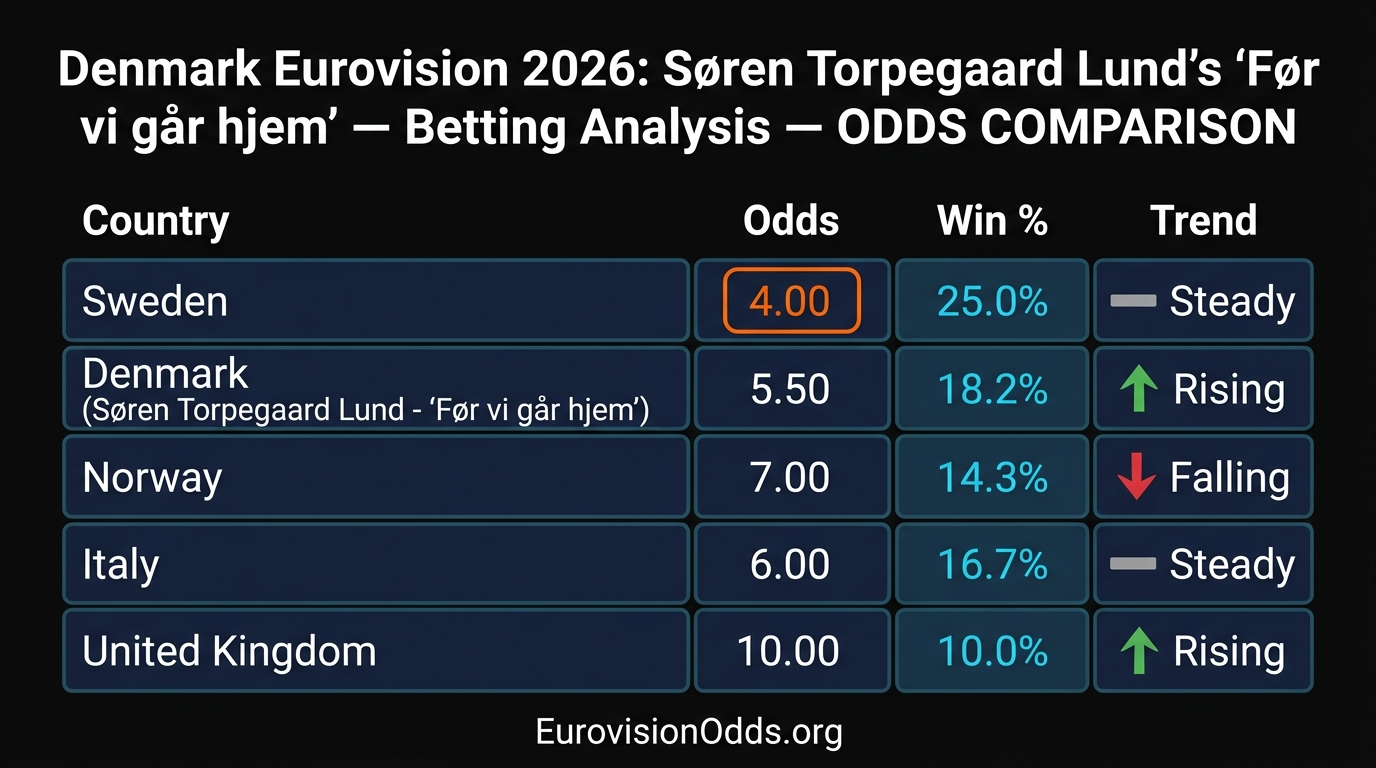
Odds Comparison: Where to Back Denmark
As of late March 2026, here is how Denmark's odds compare across the major bookmakers:
| Bookmaker | Odds | Implied Probability |
|---|---|---|
| Betfred | 6.50 | 15.4% |
| Bet365 | 6.00 | 16.7% |
| William Hill | 6.50 | 15.4% |
| Unibet | 6.00 | 16.7% |
| Paddy Power | 6.50 | 15.4% |
Betfred matches the best available price at 6.50 and is our recommended bookmaker for Eurovision markets. Their new customer offer — Bet £10 and Get £50 in Free Bets — provides excellent value for spreading across multiple Eurovision bets. You could back Denmark outright, add a semi-final qualifier bet, and still have free bet credit left for dark horse selections.
The odds have already shortened from their opening price, which was closer to 8.00-9.00 at some bookmakers immediately after Denmark's national selection. This tightening reflects growing consensus in the fan and betting communities that Denmark's entry is special. Further shortening is likely once rehearsal footage emerges from Vienna in May.
For the best value, consider placing your bet before rehearsals begin. If Denmark's staging delivers the intimate, emotionally devastating performance that the song demands, the odds could easily contract to 4.00 or below by Grand Final day. Locking in 6.50 now could look very shrewd in hindsight.
Risk Factors for Bettors
No bet is without risk, and backing Denmark at these odds requires acknowledging several legitimate concerns.
The language barrier remains real. No matter how emotionally powerful the performance, some percentage of the televote will always prefer to understand what is being sung. In a contest decided by margins, the Danish language choice could cost Denmark the 20-30 points that separate a winner from a runner-up.
Semi-final qualification is not guaranteed. While the market treats it as a near-certainty, upsets do happen. A poor vocal on the night, an unfavourable running order position, or unexpected competition from lower-ranked entries could theoretically see Denmark fall short. The probability is very low — perhaps 5% — but it is not zero, and an outright winner bet is void if the entry does not reach the Grand Final.
Finland is a formidable favourite. The market leader at approximately 2.50, Finland's Liekinheitin is the kind of genre-bending spectacle that Eurovision tends to reward. Denmark would need Finland to underperform, or would need to overperform itself, to overturn that gap. Beating the favourite is not impossible — Eurovision regularly produces upsets — but Denmark needs several things to go right simultaneously.
Staging risk. A stripped-back ballad lives or dies by its performance. There is no elaborate staging to hide behind if Torpegaard Lund has a vocally imperfect moment. One cracked note in the exposed opening section could deflate the entire performance. The upside of simplicity is enormous, but so is the downside.
Running order dependency. Denmark's chances are significantly affected by when the song is performed in the Grand Final. An early slot — particularly in the first five — would be damaging. Ballads need the audience to be warmed up, and early-performing emotional entries tend to be forgotten by the time voting opens. A late slot is almost essential for Denmark to maximise its potential.
Value Assessment: Is 6.50 the Right Price?
This is the crucial question. Our assessment: Denmark at 6.50 offers genuine value.
Here is the reasoning. The implied probability at 6.50 is approximately 15.4% (before bookmaker margin). We estimate Denmark's true win probability at closer to 11-14%, which means the odds are in the correct range but sit at the generous end. If you believe — as we do — that the performance will land well and that the jury vote will carry Denmark into contention, the true probability may even be slightly higher than the market suggests.
The comparison with France is instructive. France sits at approximately 6.00, just ahead of Denmark in the betting. France benefits from Big-4 automatic qualification (no semi-final risk) and a song in French that juries will adore. But France's televote ceiling is lower than Denmark's — French chanson tends to polarise the public vote. Denmark's emotional ballad arguably has broader televote appeal than France's more niche artistic statement.
At 6.50, Denmark offers the best risk-reward profile in the top tier of the market. Finland at 2.50 is the most likely winner but offers thin returns. France at 6.00 carries similar risk to Denmark with slightly lower reward. Greece at 9.00 and Australia at 10.00 are longer shots with lower win probabilities. Denmark sits in the sweet spot: short enough to indicate genuine contender status, long enough to deliver a meaningful return.
Our recommendation: Back Denmark at Betfred's 6.50 as a standalone outright bet. Consider pairing it with a smaller each-way bet that pays out on a top-3 finish for insurance. If rehearsal footage confirms the staging is as intimate and powerful as expected, consider adding to your position before the odds shorten further.
How to Place Your Bet
- Visit Betfred and open an account if you do not already have one.
- Navigate to Entertainment or Specials, then find Eurovision 2026.
- Select Denmark to win the Eurovision 2026 Grand Final.
- Enter your stake — remember to only bet what you can afford to lose.
- Confirm the bet and follow the contest through semi-finals and into the Grand Final.
Betfred also offers additional Eurovision markets including top-3 finish, top-5 finish, and semi-final qualification. Consider spreading your free bet credit across multiple Denmark-related markets for diversified exposure.
The Verdict
Denmark's entry in Eurovision 2026 is the kind of song that makes you remember why you fell in love with Eurovision in the first place. "Før vi går hjem" is beautiful, authentic, and emotionally devastating in a way that transcends language. Søren Torpegaard Lund has the voice to deliver it, and Denmark has the Eurovision pedigree — three wins across six decades — to suggest the country knows how to find the stage when it matters.
The risks are real. The Danish language is a barrier. The semi-final must be navigated. Finland stands between Denmark and victory. But at 6.50, the market is compensating you handsomely for those risks. This is a song that could finish anywhere from 1st to 8th depending on performance, staging, and running order — and in that range of outcomes, the current price offers genuine value.
If you back one entry outside the favourite at Eurovision 2026, make it Denmark. "Før vi går hjem" deserves to be heard by all of Europe. On 16 May in Vienna, it will be.
Get Your Free Eurovision Bet Here
New customers only. Register with BETFRED50. Deposit £10+ via Debit Card and place first bet £10+ at Evens (2.0)+ within 7 days to get 3 x £10 in Free Bets & 2 x £10 — 7-day expiry. Eligibility & payment exclusions apply. Full T&Cs apply.