
Australia has sent a string of talented performers to Eurovision since joining the contest in 2015, but none of them carry the name recognition, vocal pedigree, or sheer star quality of Delta Goodrem. The 41-year-old singer, songwriter, and pianist is one of the most successful artists in Australian music history, and she is bringing a song called Eclipse to Basel that has already earned widespread praise from fans, critics, and oddsmakers alike.

18+ | New customers only | T&Cs apply | Please gamble responsibly

With outright odds sitting at approximately 10.0 — placing her fifth in the overall market — Goodrem represents a fascinating betting proposition. But the real story might be hiding in the jury winner market, where Australia is priced at just 3.5, tied with France for the shortest odds. If you understand how Eurovision scoring works, that distinction matters enormously.
Let us unpack everything: the artist, the song, the odds, the history, and the betting angles that could make Australia the sharpest play of Eurovision 2026.
Who Is Delta Goodrem?
For readers outside Australia, Delta Goodrem's status in her home country is difficult to overstate. She burst onto the scene in 2003 with her debut album Innocent Eyes, which became the highest-selling album in Australia that year and one of the best-selling Australian albums of all time. It spent a staggering 29 weeks at number one on the ARIA charts and produced five consecutive number-one singles — a record that stood for years.
Her career has spanned more than two decades, producing multiple platinum albums, dozens of hit singles, and a reputation as one of the finest vocalists her country has ever produced. She has sold over nine million records worldwide, been nominated for and won countless ARIA Awards, and served as a coach on The Voice Australia for several seasons, cementing her status as a household name across the Asia-Pacific region.
But Goodrem is more than a pop star with impressive sales figures. She is a classically trained pianist and a songwriter who writes or co-writes virtually all of her material. Her vocal range and control are frequently compared to the elite tier of international pop vocalists, and her live performances are known for their emotional intensity and technical precision.
Perhaps most significantly for Eurovision purposes, Goodrem has a story. She was diagnosed with Hodgkin's lymphoma at just 18, in the middle of her meteoric rise, and fought through treatment while maintaining her career. That resilience and emotional depth permeate her music and her stage presence. Eurovision juries notice these things. They reward artists who communicate genuine feeling, and Goodrem does that better than almost anyone in the 2026 field.
The Song: Eclipse
Eclipse has generated serious buzz since its selection as Australia's Eurovision 2026 entry. The track is a powerful, mid-tempo pop ballad that builds from intimate, piano-driven verses into a soaring, anthemic chorus. It sits in a sonic space that feels designed for a Eurovision stage — dramatic without being overwrought, emotional without being saccharine, and structured around a vocal performance that only a singer of Goodrem's caliber could deliver.
The production is modern and polished, blending orchestral elements with contemporary pop textures. The arrangement gives Goodrem room to showcase her range, with quieter passages that demand subtlety and climactic moments that call for full-throated power. This kind of dynamic range is exactly what separates good Eurovision entries from great ones.
Lyrically, Eclipse deals with themes of transformation, emerging from darkness, and finding light after struggle. Given Goodrem's personal history, those themes carry an authenticity that a generic pop ballad could never achieve. The song feels lived-in, which is a quality that resonates with both juries and audiences.
Eurovision commentators and fan sites have been notably positive. Several prominent predictors have placed Eclipse in their top five predictions for the contest, and the song has been described as one of the most complete packages Australia has ever sent — combining a genuinely talented artist, a well-crafted song, and a narrative that writes itself.
Current Betting Odds: Where Australia Stands
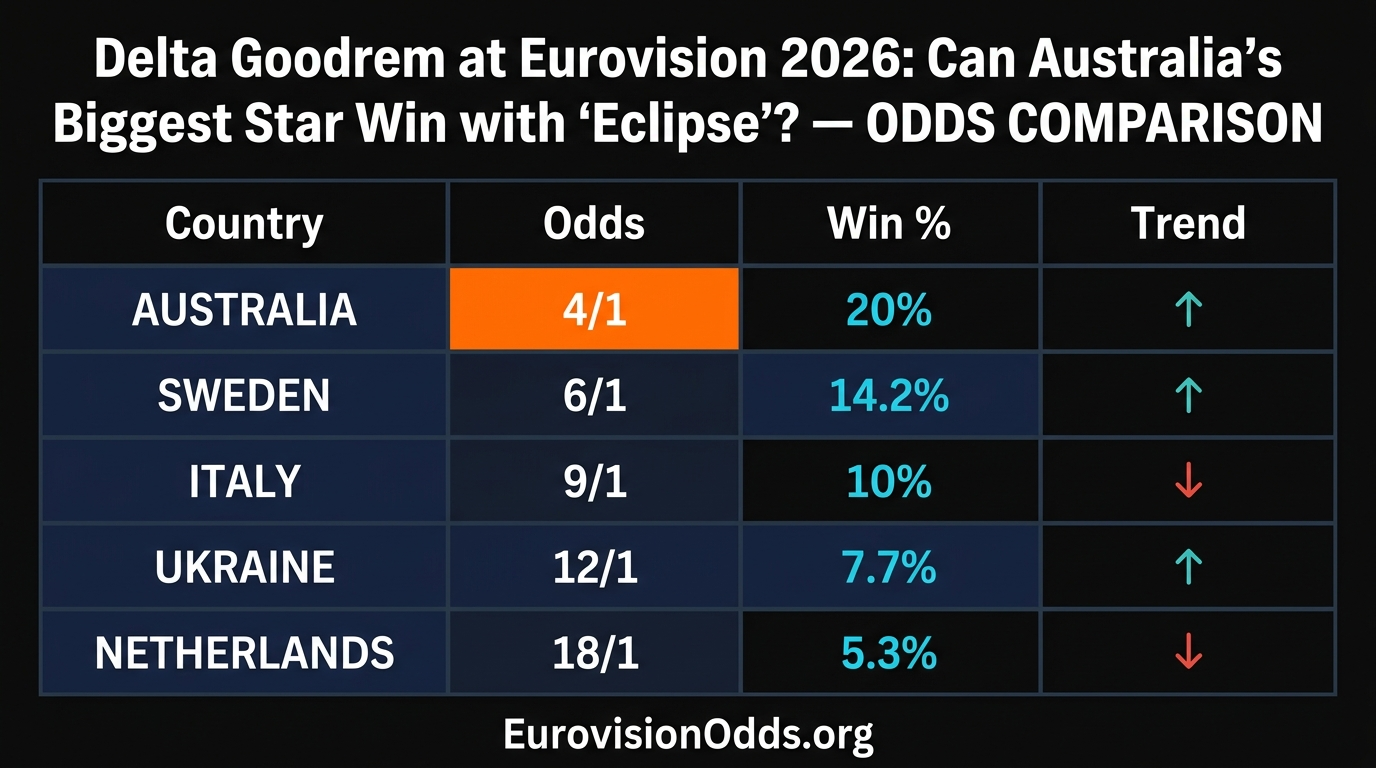
As of late March 2026, Australia's odds to win Eurovision 2026 outright sit at approximately 10.0 across the major bookmakers. This translates to an implied win probability of around 7% to 10%, and places Goodrem as roughly the fifth favorite in the overall market.
Here is the current picture across the top of the betting:
- Finland (Linda Lampenius & Pete Parkkonen — Liekinheitin): ~2.5
- France (Louane — Mon Amour): ~6.0
- Switzerland (host country advantage): ~7.0
- Sweden: ~8.0
- Australia (Delta Goodrem — Eclipse): ~10.0
At Betfred, Australia is available at competitive odds, and the bookmaker's Eurovision specials section offers additional markets beyond the outright winner that are worth exploring — particularly for the Australia angle, as we will discuss shortly.
Being fifth in the outright market is a respectable position, but it does not tell the full story. The gap between 10.0 and the favorite at 2.5 is significant, and an outright bet on Australia requires a genuine belief that Goodrem can overcome four entries that the market currently rates more highly. That is possible but far from certain.
However, there is another market where Australia looks far more compelling.
The Jury Winner Market: Australia's Hidden Value
This is where the betting gets genuinely interesting. In the Eurovision jury winner market — which pays out based on which country receives the most points from the professional jury vote alone — Australia is priced at just 3.5, tied with France for the shortest odds.
A price of 3.5 implies a win probability of roughly 22% to 28%, which is dramatically higher than Australia's 7% to 10% implied probability in the outright market. The discrepancy reflects a simple truth that smart Eurovision bettors have exploited for years: the jury vote and the televote often reward very different qualities, and some entries are much better suited to one than the other.
Delta Goodrem is, on paper, the prototypical jury favorite. Here is why:
Vocal excellence. Professional jury members, many of whom are trained musicians, producers, and industry professionals, place enormous weight on vocal ability. Goodrem's voice is her defining asset — a powerful, technically proficient instrument that she controls with precision. In a field where many acts rely on studio production and backing tracks to sound polished, Goodrem's ability to deliver a flawless live vocal stands out immediately.
Songwriting and artistry. Juries tend to reward entries that demonstrate genuine artistry beyond simple performance. The fact that Goodrem is a co-writer of Eclipse, a multi-instrumentalist, and a career artist with a 20-year catalogue gives her a credibility that manufactured pop acts cannot replicate.
Emotional depth. Jury members at Eurovision consistently score entries higher when they detect authentic emotion. Goodrem's personal story — her cancer battle, her resilience, her longevity in a brutal industry — infuses her performances with a depth that is impossible to fake. When she sings about emerging from darkness, she is not reading someone else's metaphor. She has lived it.
Professional staging. Australia takes Eurovision seriously and has historically invested in high-quality staging, choreography, and visual production. With an artist of Goodrem's stature, the staging budget and creative direction will be top-tier. Juries notice production quality, and Australia rarely disappoints on this front.
The jury winner market at 3.5 through bookmakers like Betfred may represent the single best-value bet on Australia at Eurovision 2026. Rather than needing Goodrem to overcome the televote challenges that have historically plagued Australia (more on that below), you only need her to top the jury rankings — and the market is telling you that is a very realistic outcome.
Australia's Eurovision History: From Newcomer to Contender
Australia's participation in Eurovision is one of the contest's most charming anomalies. The country was invited to participate in 2015 as a one-off celebration of the contest's 60th anniversary, driven by Australia's remarkably passionate Eurovision fanbase — the contest has been broadcast live in Australia since the 1980s, building a devoted following in the Southern Hemisphere.
That one-off invitation became a permanent arrangement, and Australia has been competing ever since. Their record is impressive for a relative newcomer:
- 2015: Guy Sebastian finished 5th with Tonight Again — a stunning debut.
- 2016: Dami Im finished 2nd with Sound of Silence — Australia's best-ever result, and one of the most dominant jury performances in modern Eurovision history. Im actually won the jury vote outright but was overtaken in the televote by Ukraine's Jamala.
- 2017: Isaiah Firebrace finished 9th with Don't Come Easy.
- 2018: Jessica Mauboy finished 20th with We Got Love.
- 2019: Kate Miller-Heidke finished 9th with Zero Gravity, a visually spectacular performance that remains a fan favorite.
- 2023: Voyager finished 9th with Promise — a power metal entry that was wildly popular with fans.
- 2024-2025: Mixed results, with Australia failing to qualify for the grand final in 2025.
The 2016 result with Dami Im is the critical data point for bettors. Im's second-place finish demonstrated that Australia can genuinely contend for the Eurovision title, and her path to near-victory was built on the same foundation that Goodrem brings: exceptional vocal ability, a powerful ballad, and overwhelming jury support. Im won the jury vote by a huge margin that year, and only the televote — where Australia's geographical distance becomes a disadvantage — prevented outright victory.
Delta Goodrem is, arguably, an even bigger name than Dami Im was in 2016, and Eclipse is being received at least as positively as Sound of Silence was at the same stage. If history is any guide, Australia is capable of producing a dominant jury performance in Basel.
The Televote Problem: Australia's Persistent Challenge
Here is the honest assessment that any responsible betting guide must include: Australia has a televote problem, and it is structural rather than artistic.
Eurovision's televote is driven by viewers across Europe and Australia picking up their phones and voting for their favorite acts. This system inherently advantages countries with large diaspora communities, neighboring nations that share cultural or linguistic ties, and entries that generate the kind of visceral, in-the-moment excitement that compels someone to vote immediately.
Australia has none of these structural advantages. There is no Australian diaspora scattered across European countries ready to bloc-vote. There are no neighboring nations whose viewers might feel cultural kinship. Australian viewers can vote, but they represent a single national allocation in a sea of 37 European voting blocs.
This geographical reality means that Australia must earn every single televote point purely on the strength of the performance. There are no freebies, no neighborly goodwill, no cultural familiarity to lean on. For a ballad like Eclipse — which is more cerebral and emotionally sophisticated than the high-energy dance tracks that tend to dominate the televote — this is a significant headwind.
Dami Im experienced this exact dynamic in 2016. She crushed the jury vote but finished much lower in the televote, and it was the televote gap that cost her the title. Delta Goodrem could face the same pattern: top of the jury rankings, middle of the pack in the televote, and a combined total that falls just short of the podium.
This is precisely why the jury winner market at 3.5 is so attractive compared to the outright at 10.0. The jury market removes the televote variable entirely and lets you bet purely on Goodrem's ability to impress the professionals. Given her talent and pedigree, that is a much more confident wager.
Semi-Final 2: The First Hurdle
Before the grand final, Australia must navigate Semi-Final 2, scheduled for May 14 in Basel. The semi-finals are the initial qualifying round, with roughly half of the competing acts being eliminated before the grand final.
Australia's placement in Semi-Final 2 is neither particularly advantageous nor disadvantageous. The key question is simply whether Eclipse will qualify comfortably, and all indications suggest it will. Entries backed by artists of Goodrem's caliber and songs of Eclipse's quality rarely fail to qualify, and the bookmakers reflect this — Australia is priced as a near-certainty for qualification.
That said, the semi-final performance matters for reasons beyond mere qualification. A strong showing in Semi-Final 2 generates momentum, media buzz, and social media discussion heading into the grand final two days later. If Goodrem delivers a commanding semi-final performance, her outright odds could shorten significantly, making current prices look like excellent value in retrospect.
Conversely, a shaky semi-final — even one that results in qualification — could see odds drift. Bettors who are confident in Goodrem should consider placing their wagers before the semi-final, when the odds are at their most generous.
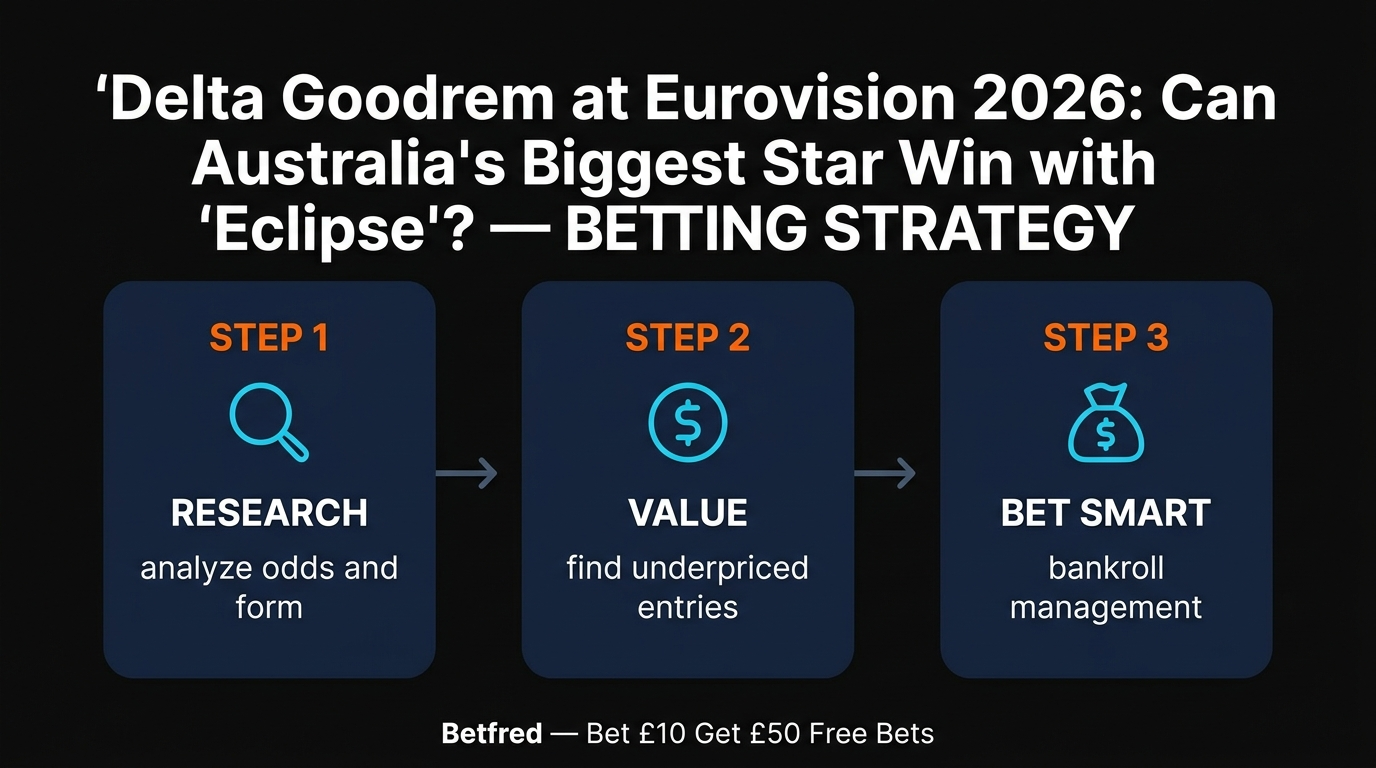
Smart Betting Strategy: How to Play Australia
Based on the analysis above, here is how a thoughtful bettor might approach the Australia angle at Eurovision 2026:
Primary bet: Jury winner at 3.5. This is the sharpest play. Goodrem's vocal ability, artistry, and emotional depth make her a genuine contender for the top jury score. At 3.5 — available through Betfred and other major bookmakers — you are getting a roughly 28% implied probability on an outcome that may be underpriced given Goodrem's profile. The comparison to Dami Im in 2016 (who won the jury vote outright) is directly relevant and encouraging.
Secondary bet: Outright winner at 10.0. This is higher risk, higher reward. At 10.0, you are getting a significant payout if Goodrem can overcome the televote deficit that has historically hindered Australia. It is not the most likely outcome, but 10.0 represents fair value for an artist of this caliber performing a song of this quality. A small-stake outright bet alongside a larger jury winner bet creates a balanced portfolio.
Each-way option. Some bookmakers offer each-way terms on Eurovision, typically paying out for a top-three or top-five finish. An each-way bet on Australia at 10.0 provides a safety net — you collect a return even if Goodrem finishes on the podium without winning outright. Given Australia's 2016 precedent (2nd place), this is a realistic outcome.
Avoid: Betting the qualification market. Australia will almost certainly qualify from Semi-Final 2. The odds on qualification will reflect this certainty, offering minimal value. Save your bankroll for the markets where genuine value exists.
Why Delta Goodrem Is a Game-Changer
Australia has sent good artists to Eurovision before. Guy Sebastian was established. Dami Im was supremely talented. Jessica Mauboy had pop credentials. But none of them are Delta Goodrem.
Goodrem operates on a different level of name recognition and cultural weight. She is not just a singer who happens to be from Australia — she is the defining female pop artist of a generation in that country. Her status is comparable to Kylie Minogue or Olivia Newton-John in terms of the emotional connection she holds with the Australian public and, increasingly, international audiences.
This matters for Eurovision in several ways. First, it guarantees maximum investment from the Australian broadcaster, SBS. When you send your biggest star, you do not cut corners on staging, creative direction, delegation support, or media strategy. Everything around the Goodrem campaign will be elite-level.
Second, it generates a wave of international media attention that most Eurovision entries never receive. Goodrem's participation has been covered by mainstream outlets across Europe, Asia, and the Americas — not just Eurovision fan sites. That awareness translates into casual viewers tuning in, and some of those casual viewers will pick up their phones and vote.
Third, and most importantly, Goodrem brings two decades of experience performing under pressure on the world's biggest stages. Eurovision is a one-shot, live-television pressure cooker. Many talented artists have crumbled under that intensity. Goodrem has been doing this since she was a teenager. She will not be overwhelmed by the occasion. If anything, the occasion will rise to meet her.
The Competition: Who Stands Between Australia and Victory?
At current odds, four entries are rated above Australia in the outright market:
Finland (Liekinheitin, ~2.5): The clear favorite, offering a unique genre-blending spectacle. Finland's classical-meets-pop approach will appeal to juries and televote alike. They are the entry to beat.
France (Mon Amour, ~6.0): France carries the advantage of singing in one of Europe's most beloved languages, and Louane is a well-known artist in her own right. France is tied with Australia at 3.5 in the jury market, making them the most direct competitor for that particular wager.
Switzerland (~7.0): The host country advantage is real at Eurovision. Swiss acts benefit from performing in front of a home crowd, receiving disproportionate media coverage, and being top of mind for casual viewers. Never discount the hosts.
Sweden (~8.0): Sweden is Eurovision royalty, with a track record of success that makes them perpetual contenders. Their fan-voting infrastructure is among the best in the contest.
Australia at 10.0 sits just behind this group, and the gap is not enormous. A strong rehearsal period in Basel could see Goodrem's odds shorten to 7.0 or 8.0, bringing her into the cluster of genuine favorites. Smart money gets in before that happens.
Final Verdict
Delta Goodrem and Eclipse represent the most compelling Australian Eurovision entry since Dami Im nearly won the whole thing in 2016. The combination of a world-class vocalist, a beautifully crafted song, and a genuine human story makes this entry a serious contender — particularly with the professional juries who will form half of the final scoring.
The outright odds of 10.0 offer a genuine each-way shot at glory, but the smartest bet on the board may be the jury winner market at 3.5. That price, available through bookmakers like Betfred, asks you to back one of the finest vocalists in the entire competition to top the jury rankings — a result that Australia has achieved before and that Goodrem's talent makes entirely plausible.
Australia may not be the favorite, but Eclipse could be the bet that lights up your slip.